
Zimmermann Telegram
The Zimmermann Telegram was a secret 1917 German message proposing a military alliance with Mexico that helped bring the United States into World War I.
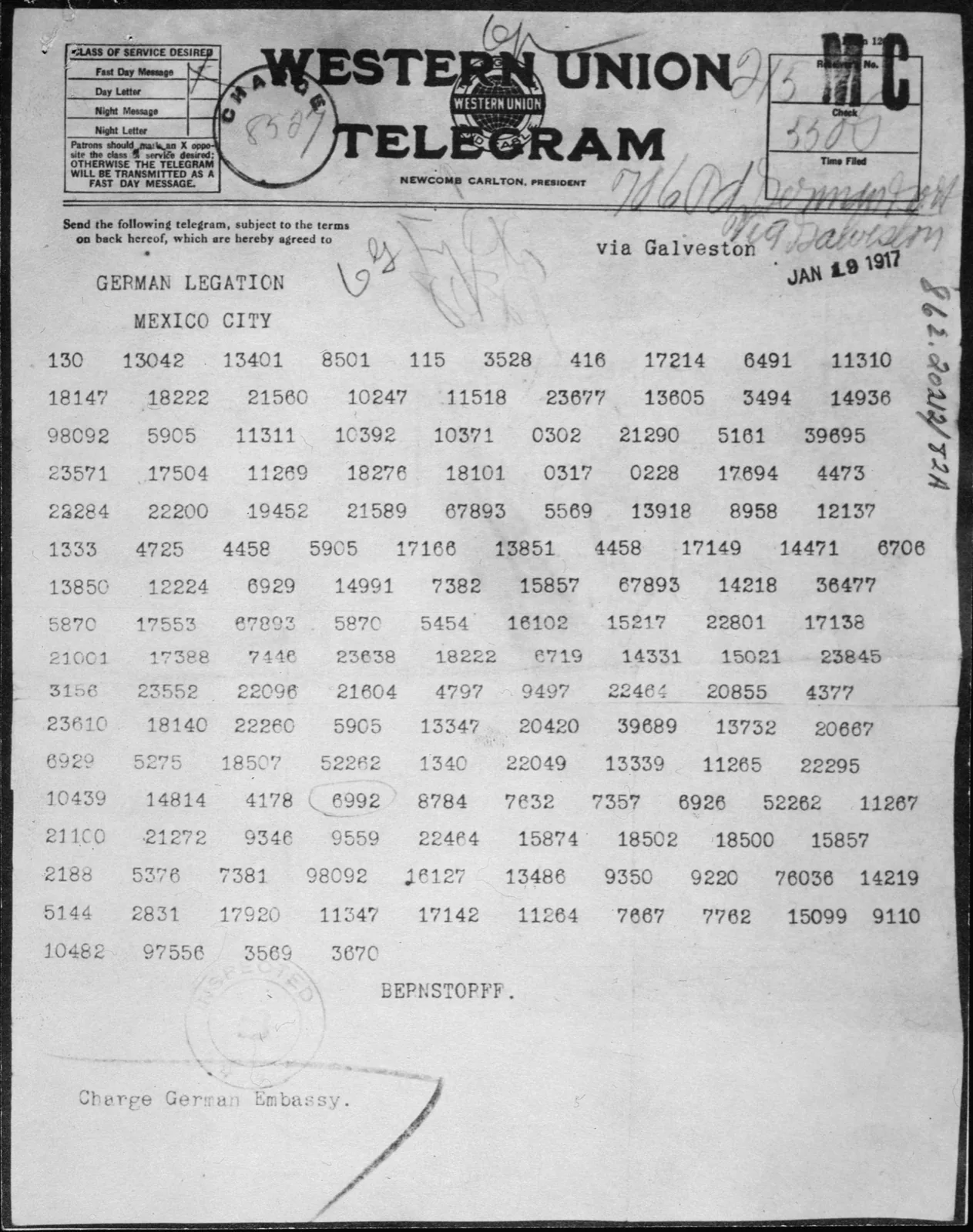
The Zimmermann Telegram was a coded message sent on January 16, 1917, by Arthur Zimmermann, Germany's foreign secretary, to the German ambassador in Mexico. It proposed that if the United States entered World War I, Mexico should join Germany's side. In return, Germany would help Mexico reconquer Texas, New Mexico, and Arizona, territories Mexico had lost to the United States in 1848. The telegram also suggested that Mexico invite Japan into the alliance. Zimmermann, a career diplomat from East Prussia who had served as a consul in China during the Boxer Rebellion, was the first non-aristocrat to hold Germany's top foreign policy post. He sent the message because Germany was about to resume sinking neutral ships near Britain and expected the United States to enter the war. British codebreakers intercepted and decoded the telegram. When American newspapers published it on March 1, 1917, public opinion turned sharply toward war, and five weeks later the United States declared war on Germany.
How Britain intercepted the Zimmermann Telegram
At the start of the war in 1914, the British navy cut Germany's undersea telegraph cables, forcing Germany to route diplomatic messages through cables that passed through British territory. British naval intelligence operated a codebreaking unit called Room 40, housed in the Admiralty building in London. Room 40's cryptographers had been working since 1915 to crack Germany's diplomatic codes.
The Zimmermann Telegram passed through a cable routed via London on its way to Washington. Room 40 intercepted it there. On January 17, two cryptographers, Nigel de Grey and William Montgomery, produced a partial decode. Their chief, Captain Reginald Hall, known as "Blinker" for a facial tic, recognized the telegram's importance but faced a problem. Revealing it would expose two British secrets: that Room 40 had broken Germany's diplomatic codes, and that Britain was reading cables that carried American diplomatic traffic. Germany had routed the message through a channel the United States had made available for peace communications.
Hall waited over a month. British agents in Mexico got hold of a separate copy of the message, the version the German embassy in Washington had forwarded to Mexico City. Hall gave that copy to the Americans so that the Germans would think the leak had come from their own embassy in Mexico rather than from British codebreaking. On February 19, Hall showed the decoded message to Edward Bell, secretary of the American embassy in London. Bell thought it was a forgery at first. Four days later, the British government formally handed the telegram to Walter Hines Page, the US ambassador.
How the telegram brought America into World War I
The Associated Press published the telegram on March 1, 1917. Many Americans, particularly in the isolationist Midwest, assumed the message was a British fake intended to pull the United States into the war.
Two days later, on March 3, a reporter at a press conference in Berlin asked Zimmermann whether the telegram was genuine. Zimmermann answered: "I cannot deny it. It is true." Historians still debate why he confirmed it rather than calling it a fake. He may have believed the British could prove its authenticity, making denial pointless. He may also have seen the alliance proposal as a reasonable defensive measure, since it was conditional on the United States declaring war first. Either way, his confirmation killed the forgery theory.
The telegram was not the only provocation. On January 31, Germany had announced it would begin unrestricted submarine warfare again, sinking any ship near Britain, including neutral vessels. The sinking of the Lusitania in 1915 had killed 1,198 people, 128 of them American. The submarine campaign told Americans that Germany would sink their ships. The Zimmermann Telegram told them that Germany was also plotting to give three American states to Mexico.
President Woodrow Wilson had won reelection in 1916 partly on the promise that he had kept the country out of the war. By April 1917, that position was no longer tenable. On April 2, Wilson went before Congress to ask for a declaration of war. Congress approved it on April 6. Zimmermann resigned as foreign secretary four months later.
Did Mexico accept the Zimmermann Telegram?
Mexico's president, Venustiano Carranza, received the German proposal and took it seriously enough to convene a military commission to evaluate it. The commission concluded that an alliance with Germany was not practical. Mexico did not have the military strength to fight the United States. Germany's promises of financial support were unreliable. Mexico was also in the middle of its own civil conflict and could not afford another war. Carranza officially rejected the proposal on April 14, 1917, a week after the United States joined the war.
American entry changed the outcome of World War I. The United States sent more than two million soldiers to France over the next nineteen months, and Germany signed an armistice in November 1918. Room 40's handling of the Zimmermann Telegram became one of the most studied intelligence operations in history, and Room 40 itself was a direct forerunner of the British codebreaking program that broke the Enigma machine in World War II.