
Tet Offensive
The Tet Offensive was a surprise North Vietnamese attack across South Vietnam in January 1968 that failed militarily but turned Americans against the war.
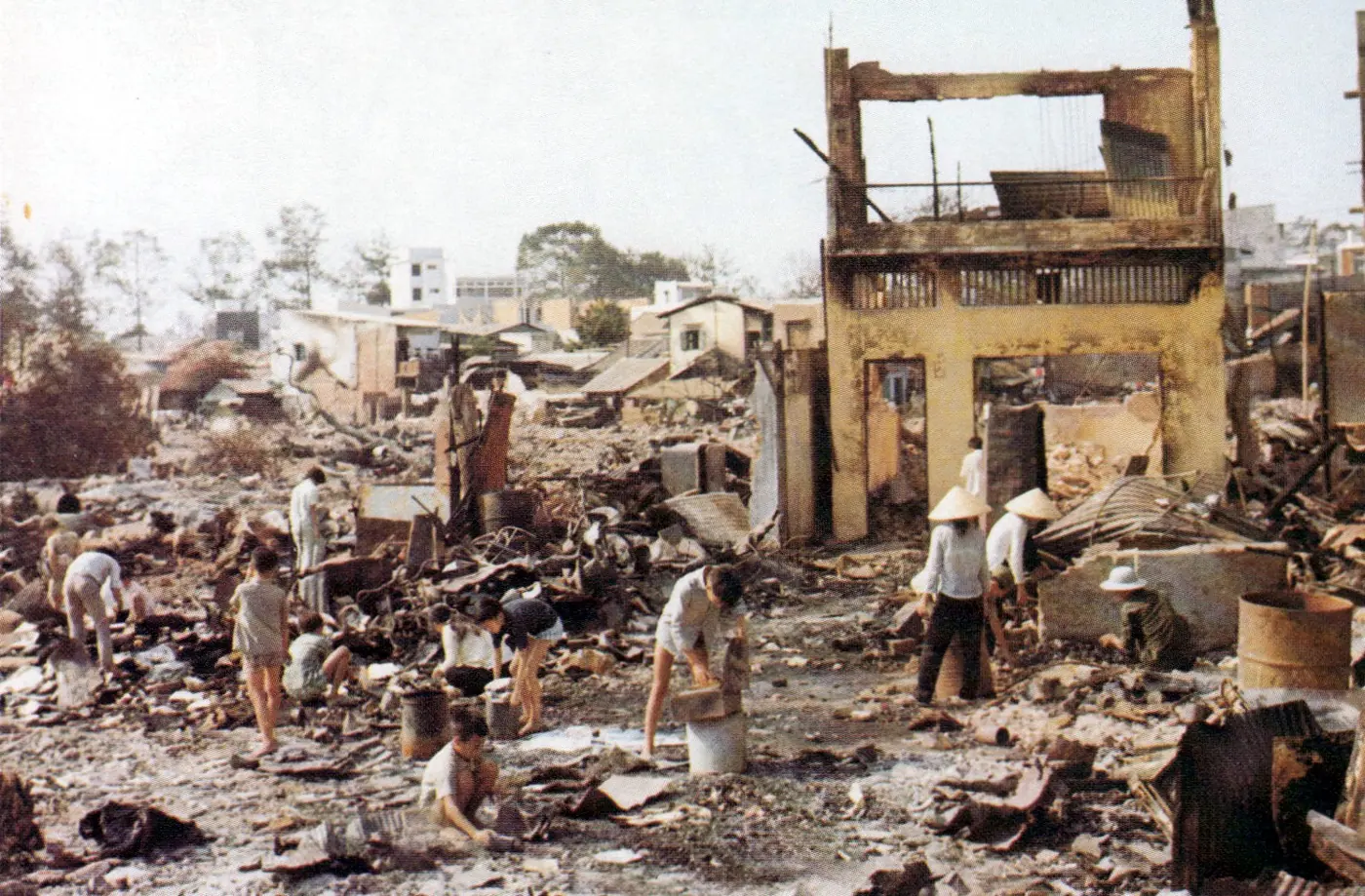
The Tet Offensive was a surprise attack by North Vietnamese and Viet Cong forces on more than a hundred cities and towns across South Vietnam. It began on January 31, 1968, during a truce for Tet, the Vietnamese lunar new year. About 80,000 troops took part, striking simultaneously across the country. The offensive failed as a military operation. Most attacks were beaten back within days, and the Viet Cong lost so many fighters that it never recovered as an independent force. But the scale of the attack destroyed public confidence in the war. American commanders had declared the war nearly won only weeks before. Within two months, President Lyndon Johnson partly halted the bombing of North Vietnam and withdrew from the 1968 presidential race.
How North Vietnam planned the Tet Offensive
Through most of 1967, the American public was told the war was going well. In November, General William Westmoreland, the US commander in Vietnam, spoke at the National Press Club in Washington and told the audience that victory was in sight. The optimism was deliberate. The Johnson administration had spent months encouraging officials to present evidence of progress to the American public.
Behind the optimism, North Vietnam's leadership was planning the largest operation of the war. The driving force was Le Duan, the first secretary of the Vietnamese Workers' Party, who held more real power than anyone in Hanoi, including Ho Chi Minh. Le Duan believed a massive coordinated attack on South Vietnam's cities would trigger a popular uprising against the Saigon government and break American willingness to continue the war. Ho Chi Minh and General Vo Nguyen Giap, the architect of the 1954 victory over the French at Dien Bien Phu, both opposed the plan as too ambitious. Le Duan pushed it through the Politburo anyway.
To draw American attention away from the cities, North Vietnamese forces besieged the US Marine base at Khe Sanh near the border in late January. Meanwhile, Viet Cong fighters moved into cities in small groups, hiding weapons among the goods brought in for the new year celebrations.
How the Tet Offensive unfolded
In the early hours of January 31, North Vietnamese and Viet Cong forces attacked simultaneously across South Vietnam. They hit Saigon, Hue, and dozens of provincial capitals. In Saigon, a squad of Viet Cong commandos breached the outer wall of the US embassy and held part of the compound for six hours before American military police and Marine guards killed or captured them all. Americans watched the fighting on the evening news. The enemy was inside the American embassy in the capital the United States was defending.
The next day, Associated Press photographer Eddie Adams captured South Vietnamese police chief Nguyen Ngoc Loan shooting a captured Viet Cong officer, Nguyen Van Lem, on a Saigon street. NBC television cameras filmed the same moment. The photograph and film were seen around the world.
Most of the attacks across South Vietnam were beaten back within days. But in Hue, the old imperial capital, communist forces held the city for nearly a month. American and South Vietnamese troops fought for weeks to retake Hue in the most intense house-to-house combat of the entire conflict. Large parts of the city were reduced to rubble. Before withdrawing, communist forces killed an estimated 2,800 to 6,000 civilians, mostly government workers, teachers, and anyone connected to the Saigon regime, and buried them in mass graves.
Did the United States win the Tet Offensive?
Militarily, yes. The general uprising Le Duan expected never happened. The Viet Cong committed its fighters in the open and was destroyed as an effective force. From 1968 on, the war was carried on primarily by North Vietnam's own army rather than southern guerrillas. By any conventional military measure, the United States and South Vietnam won.
But the offensive contradicted everything the Johnson administration had been saying. Ten weeks before the attacks, General Westmoreland had told Americans the war was nearly over. On February 27, CBS Evening News anchor Walter Cronkite, one of the most trusted figures in American public life, delivered a rare editorial. Cronkite had gone to Vietnam to see the fighting for himself, and he told his audience the war was "mired in stalemate" and could only end through negotiation. Westmoreland requested 206,000 additional troops. The request leaked to the New York Times and was refused.
On March 31, Johnson announced a partial halt to the bombing of North Vietnam and offered peace talks. At the end of the same broadcast, he announced he would not run for re-election.
Why the Tet Offensive changed the Vietnam War
The distance between the government's claims and what Americans saw on television already had a name: the "credibility gap." After Tet, large parts of the American press and public stopped trusting official accounts of the war. That distrust outlasted Vietnam. It shaped coverage of every American conflict afterward, from tighter control of journalists in later wars to the suspicion that greeted American claims about Iraqi weapons of mass destruction in 2003.
Hanoi's leaders had not planned for this result. They had expected the southern population to rise up, and its failure to do so was a serious blow. But they read the outcome correctly. For the remaining years of the war, North Vietnam's strategy targeted American political patience rather than American military power. By every military measure, America's position in Vietnam was stronger after the Tet Offensive. But the country's willingness to keep fighting had collapsed.
The Tet Offensive is the standard example of a principle in guerrilla warfare: the side that loses every battle can still win a war if it outlasts the other side's willingness to fight. North Vietnam won the war in April 1975, seven years after the offensive.