
Trans-Siberian Railway
The Trans-Siberian Railway runs 9,289 kilometers from Moscow to Vladivostok, the longest railway in the world, built from 1891 to 1916.
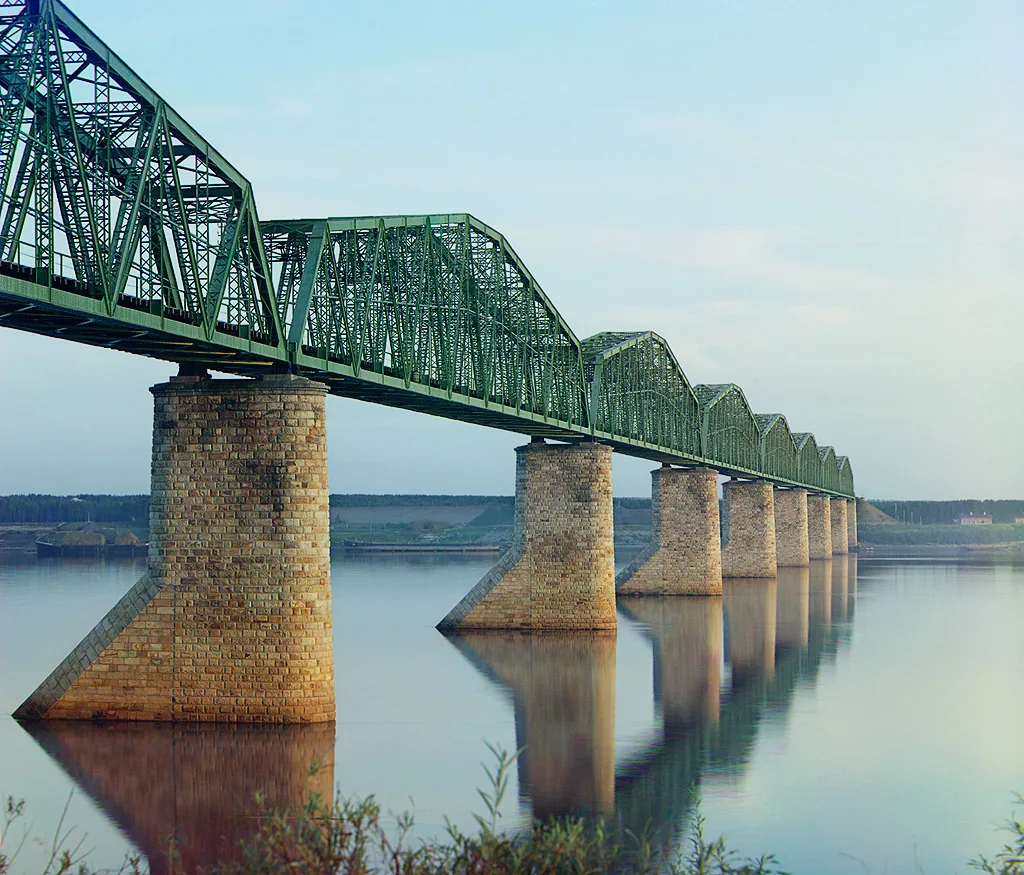
The Trans-Siberian Railway covers 9,289 kilometers between Moscow and Vladivostok, crossing eight time zones. It is the longest railway line in the world. Russia began building it in 1891 and finished the all-Russian route in 1916, a project that took 25 years and accounted for a fifth of Russia's national debt. Before the railway, sending troops or goods from Moscow to the Pacific took months by road or required a sea route through the Indian Ocean. The railway turned Siberia from a territory Russia claimed on maps into one it could govern, settle, and defend.
How Russia built the Trans-Siberian Railway
Tsar Alexander III ordered the railway in 1891. His finance minister, Sergei Witte, drove the project. Witte's case went beyond trade. A railway across Siberia would let Russia settle the east, collect taxes from it, station troops along it, and establish a Pacific presence before Britain or Japan could shut Russia out. Building it would also force Russia to produce steel, coal, and locomotives at a scale the country had never managed, pushing it toward industrialization.
Witte paid for the railway by raising foreign loans, increasing taxes, and printing rubles. He made the future Tsar Nicholas II chairman of the Siberian Railway Committee, set hard deadlines for each section, and pushed his engineers to keep pace.
The route crossed permafrost, dense taiga, and rivers more than a kilometer wide. The workforce included convicts and soldiers. The most difficult stretch ran along the southern shore of Lake Baikal, where workers cut the line into cliff faces and blasted dozens of tunnels through rock. Until that section opened in 1905, trains crossed Lake Baikal on ferries. In the winter of 1904, when the ferries could not break through the ice, engineers laid temporary track across the frozen lake.
The shortcut through Manchuria
Between Chita and Vladivostok, the railway had two possible routes. It could follow the Amur River through difficult terrain, staying on Russian soil. Or it could cut straight across Manchuria, which belonged to China. Russia chose the shortcut.
In 1896, Witte secured permission to build the Chinese Eastern Railway from the Qing government, weakened after its defeat by Japan in 1895. The line opened in 1903. A southern branch ran to Port Arthur, a warm-water port Russia had leased on the Pacific coast. What looked like a railway concession worked as an occupation. Russian troops, railway police, and administrators spread across northern Manchuria, and Russia gained a naval base on the Pacific that did not freeze in winter.
Japan concluded that its window to challenge Russia was closing. Once the Trans-Siberian was finished and double-tracked, Russia could move armies to the Pacific faster than Tokyo could ship its own forces across the sea. In February 1904, Japan attacked. At the time, the Trans-Siberian was still single-track for most of its length, and it had to supply a war roughly 8,000 kilometers from Russia's factories. That limited capacity contributed to Russia's defeat in the Russo-Japanese War.
After the defeat, Russia finished the Amur line, running entirely on Russian soil, in 1916. The Chinese Eastern Railway remained a source of tension between Russia and China for decades. The Soviet Union transferred it to China at the end of 1952.
How the Trans-Siberian Railway changed Russia
The railway's effects went beyond moving cargo. After 1906, Prime Minister Pyotr Stolypin used it to resettle European Russia's overcrowded peasantry. Between 1908 and 1913, roughly three million people moved east along the line into Siberia.
In 1918, during the Russian Civil War, the Czechoslovak Legion, about 60,000 soldiers stranded in Russia after Russia left World War I, seized the Trans-Siberian Railway across its entire length. By late summer they controlled a corridor from the Volga to the Pacific, and their revolt drew Japanese, American, British, and French forces into what had started as a Russian civil war.
In 1941, the railway carried out one of the most important logistics operations of the twentieth century. As German armies advanced into western Russia, the Soviet government dismantled over 1,500 factories, loaded them onto trains, and moved them east to the Urals and Siberia. Relocated tank factories were producing T-34s by December of that year. That evacuation is one of the main reasons the Soviet Union survived the war.
The Trans-Siberian Railway today
The railway still runs daily service between Moscow and Vladivostok. The journey takes six to seven days. Russian oil, coal, and shipping containers travel eastward along two routes: the Trans-Siberian itself and the Baikal-Amur Mainline, a second line built north of Lake Baikal in the Soviet era.
Since 2022, European sanctions have pushed Russia to redirect trade toward China and the Pacific. Eastbound coal exports by rail reached about 118 million tonnes in 2025. The bottleneck is track capacity, not Chinese demand. Much of the Baikal-Amur line is still single-track, and the same problem that slowed Russia's war effort in 1904, too few rails heading east, now limits its ability to sell to Asia. Russia has committed 3.7 trillion rubles to expand the eastern lines, but the work will take until at least the early 2030s.