
Nicholas II
Nicholas II was the last emperor of Russia, ruling from 1894 until the 1917 revolution ended 304 years of Romanov rule.
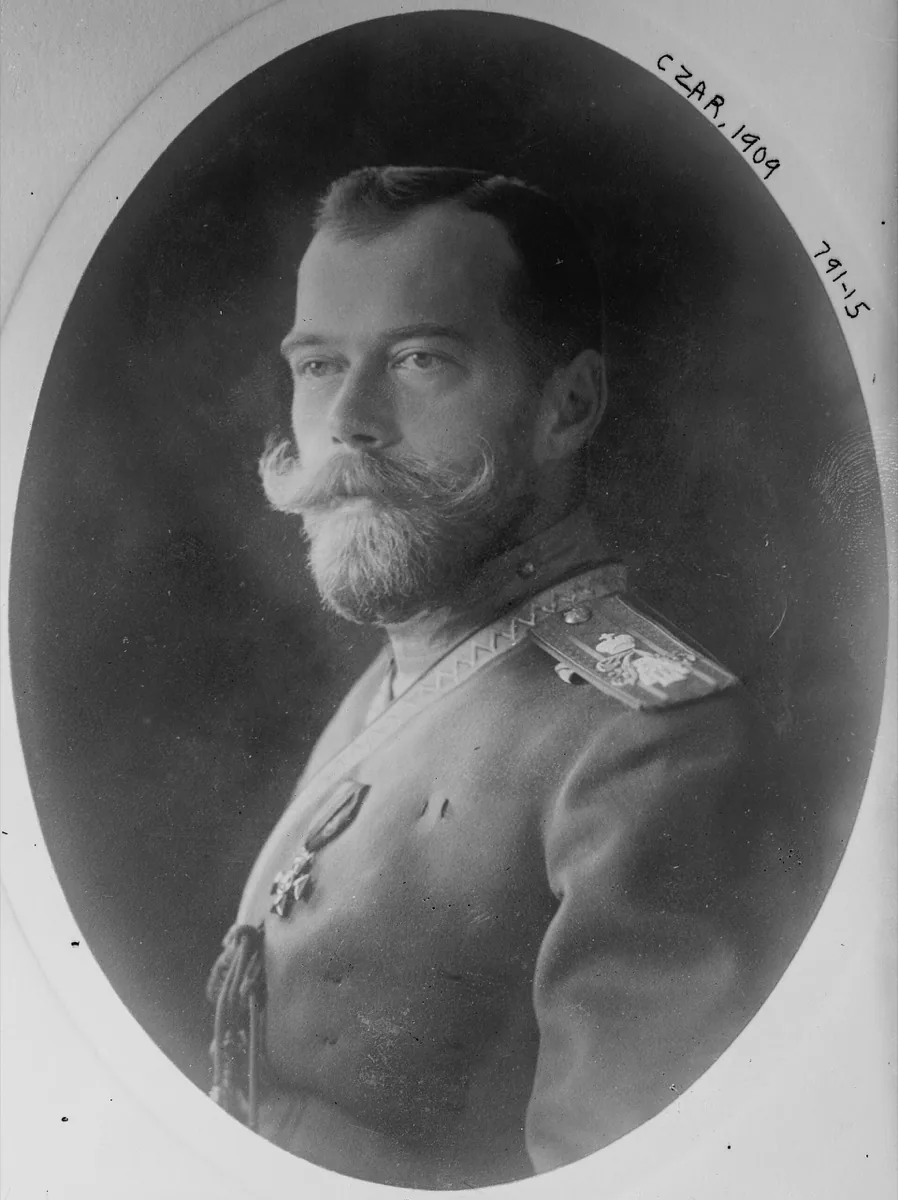
Nicholas II was the last emperor of Russia. Born in 1868, he came to the throne in 1894, when he was twenty-six, after his father Alexander III died of kidney disease. He ruled for twenty-two years until a revolution forced him from power in March 1917. The Bolsheviks executed him the following year along with his wife, his five children, and four of their servants.
Nicholas was gentle and devoted to his family. He kept a diary from age fourteen, loved photography, and owned one of the largest car collections in Europe. Shortly after becoming tsar he told a cousin he felt unready for the job and had no idea how to deal with his ministers. But he believed his autocratic power was a sacred trust from God, and he refused every serious chance to share it. That refusal cost the Romanov dynasty its 304-year hold on Russia.
How Nicholas II lost his people's trust
The troubles started at Nicholas's own coronation. On May 30, 1896, a crowd of hundreds of thousands gathered on Khodynka Field outside Moscow, where the government was handing out free food and souvenir cups. A rumor spread that the gifts were running out, and the crowd surged forward. The field was a military training ground full of trenches and ditches, and at least 1,389 people were crushed to death. That evening, on his advisers' urging, Nicholas attended a ball at the French embassy. The public noticed.
In 1904, Nicholas's government drifted into war with Japan, in part because officials believed a quick victory would calm domestic unrest. Russia lost badly. The Baltic Fleet sailed halfway around the world to fight and was destroyed at the Battle of Tsushima in the Russo-Japanese War.
Defeats in the war helped set off a revolution at home. On January 22, 1905, a priest named Father Georgy Gapon led a peaceful procession of workers toward the Winter Palace in St. Petersburg. They carried a petition addressed to Nicholas, whom many still trusted. Troops opened fire on the crowd. The massacre, known as Bloody Sunday, killed around 200 people and destroyed the faith ordinary Russians had placed in Nicholas.
Strikes, mutinies, and peasant uprisings spread across the country. Under pressure, Nicholas issued the October Manifesto, which promised individual rights and a new elected parliament, the Duma. Nicholas had given way only under threat and resented the concession at once. Over the next decade he dissolved assemblies he disliked and rewrote the voting rules to produce compliant ones.
How World War I brought down Nicholas II
Nicholas also faced a private crisis that weakened the monarchy from within. His son and heir, Alexei, who was born in 1904, suffered from hemophilia. The family kept this secret from the country. Alexei's mother, Alexandra, came to depend on Grigori Rasputin, a Siberian holy man who appeared to ease the boy's condition. Rasputin's growing presence at court, and the scandals it produced, damaged what remained of the monarchy's reputation.
In 1914 Russia entered World War I in support of Serbia. The war laid bare the weaknesses in the Russian state: soldiers went without rifles, the railways could not keep up, and cities ran short of bread. In late summer 1915, Nicholas traveled to army headquarters and assumed direct command. From that point, every military defeat was blamed on him personally. He left Alexandra, who was German-born and widely accused of disloyalty (the charge was false), to manage affairs at home on Rasputin's counsel. She cycled through ministers so quickly that the government lost all direction.
By late 1916, even members of the aristocracy had turned against Nicholas and Alexandra. A circle of noblemen killed Rasputin that December, but removing him did not save the monarchy. In March 1917, bread shortages in Petrograd sparked a general uprising, and the garrison refused orders to shoot. Senior generals and Duma politicians informed Nicholas that the army would no longer obey him. On March 15, 1917, Nicholas abdicated aboard a train at Pskov, first on his own behalf and then, after a doctor told him that Alexei's hemophilia was incurable, on his son's behalf as well. His brother, Grand Duke Michael, declined the crown. Romanov rule, 304 years old, was over.
How did Nicholas II and his family die?
After the abdication, the family was held under guard and eventually moved east to the city of Yekaterinburg. As the Russian Civil War spread, Bolshevik leaders grew worried that advancing anti-Bolshevik forces might free the Romanovs and use them as a rallying point.
During the early hours of July 17, 1918, guards woke the family, brought them down to a cellar in the Ipatiev House, and shot them. The dead were Nicholas, Alexandra, their five children (Olga, Tatiana, Maria, Anastasia, and Alexei), and four members of their household: the family doctor, a maid, a footman, and a cook. The bodies were buried secretly in the forest outside the city.
The remains stayed hidden for more than seventy years. In 1991 a grave near Yekaterinburg was opened, and DNA testing confirmed the bones of Nicholas, Alexandra, and three of their daughters. In 2000 the Russian Orthodox Church canonized the family as "passion-bearers," recognizing the humility with which they accepted their deaths. A second grave discovered in 2007 held the remains of Alexei and one more daughter.
The Soviet government that followed Nicholas ruled Russia for the next seventy-four years and proved far more repressive than the autocracy before it.