
Wars of the Roses
The Wars of the Roses were a series of English civil wars between 1455 and 1487 that destroyed the old nobility and put the Tudors on the throne.
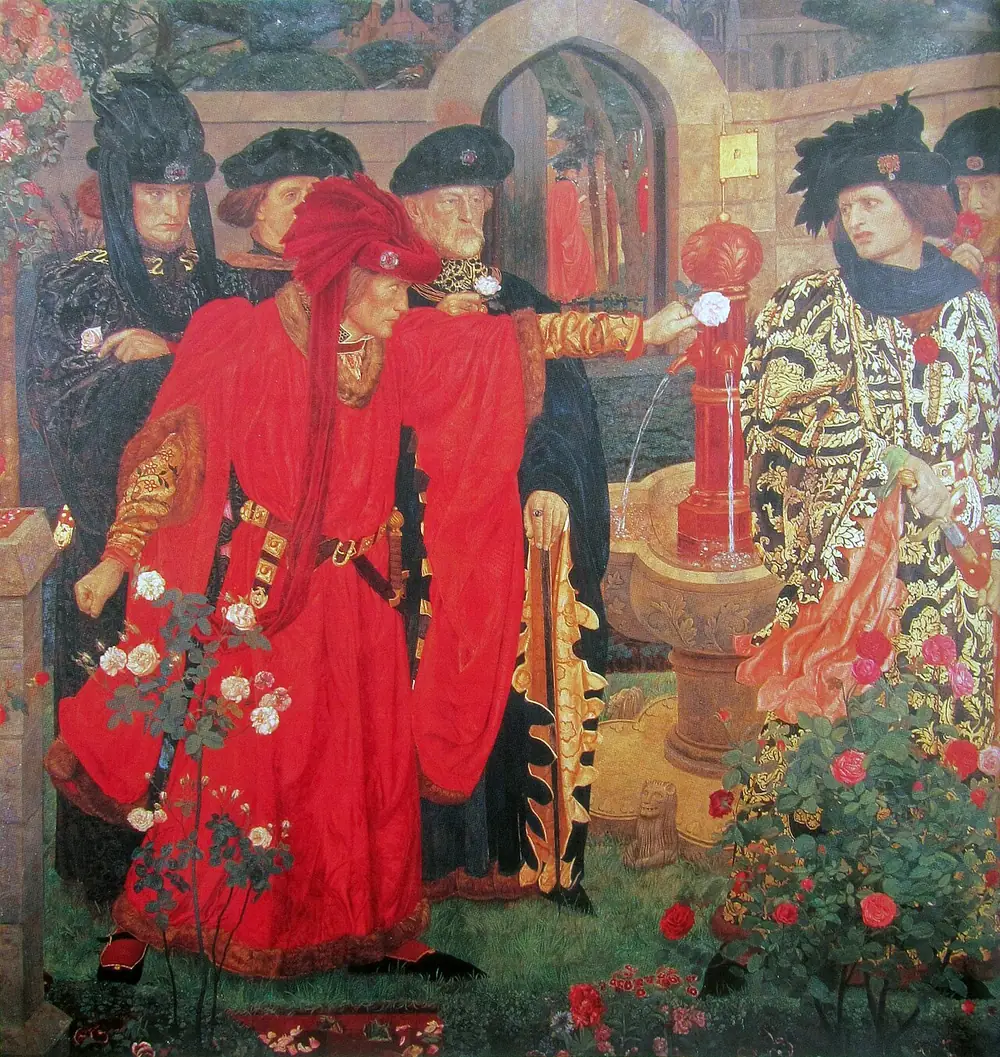
The Wars of the Roses were a series of civil wars in England, fought from 1455 to 1487. Two rival branches of the royal family, Lancaster and York, both descended from King Edward III, fought each other for the English crown. The conflict came in violent campaigns separated by years of peace. One king died in battle, three others were deposed, and much of the old English nobility was destroyed. By the end, a minor nobleman named Henry Tudor held the throne and founded a dynasty too powerful for any single nobleman to threaten.
How a weak king started the Wars of the Roses
Henry VI became king of England in 1422, at the age of nine months. As an adult he was devout and gentle, with little ability for politics or war. By 1453 he had lost every French territory his father, Henry V, had won in the Hundred Years' War. That same year, Henry VI suffered a complete mental collapse. He became unresponsive, unable to speak, walk, or hold up his own head. His maternal grandfather, Charles VI of France, had suffered similar episodes, and the condition may have been inherited. When Henry VI's only son was born a few months later, the queen and the Duke of Buckingham brought the baby to him. Henry VI glanced at the child and looked away. He stayed in this state for about eighteen months.
Richard, Duke of York, took over as protector during the king's illness. Richard had a strong claim to the throne through his own descent from Edward III, and he had long been shut out of Henry VI's inner circle. Queen Margaret of Anjou saw Richard as a direct threat to her infant son's inheritance, and when Henry VI recovered enough to resume his role, she pushed Richard aside. England at the time was full of armed men with no war to fight. Powerful nobles maintained their own private armies, and thousands of soldiers had come home from the failed campaigns in France. The country had both the grievances and the manpower for a civil war.
The first battle came at St Albans in May 1455. It was closer to a street fight in a small town than a pitched battle, but it killed several of the king's leading advisers and opened thirty years of conflict.
The bloodiest battles of the Wars of the Roses
The wars were not one continuous campaign. They erupted in fierce bursts and then fell silent for years. The worst single day came on March 29, 1461, at Towton in Yorkshire. Two armies clashed in a snowstorm, and the Yorkists destroyed the Lancastrian force. A letter written days afterward put the death toll at 28,000. The real number was almost certainly lower, but Towton likely stands as the single deadliest day of combat on English soil. England's total population at the time was only about two million, still reduced by the Black Death a century earlier.
Richard, Duke of York, never saw the victory. He had been killed at the Battle of Wakefield the previous December. Queen Margaret's forces cut off his head and stuck it on the gates of York wearing a paper crown. But his eldest son took the throne as Edward IV.
Edward IV's most powerful supporter was Richard Neville, Earl of Warwick, known as "the Kingmaker." The alliance fell apart when Edward IV secretly married Elizabeth Woodville, a woman Warwick had not chosen. The new queen's family pushed Warwick out of influence. In 1470, Warwick switched sides. He allied with his old enemy, Queen Margaret, and for a few months restored Henry VI as king.
Edward IV returned with fresh troops in 1471. He defeated and killed Warwick at the Battle of Barnet in April, then destroyed the remaining Lancastrian army at Tewkesbury in May. Henry VI died in the Tower of London on May 21, 1471. The official cause was natural death. Almost no one believed it.
How Henry Tudor won the crown at Bosworth
Edward IV ruled in peace until he died in April 1483, at the age of 40. He left two young sons: Edward, who was twelve, and Richard, who was nine. His brother, Richard of Gloucester, was named protector. Within months, Richard of Gloucester had declared himself king as Richard III, and the two boys had vanished inside the Tower of London. They were never seen again. Their disappearance, and the widespread suspicion that Richard III had ordered their deaths, broke the Yorkist coalition apart.
Henry Tudor was a part-Welsh exile living in Brittany with a thin claim to the throne. His mother, Margaret Beaufort, was a great-granddaughter of John of Gaunt, one of Edward III's sons. By 1485, Henry Tudor was the last Lancastrian claimant left alive. He landed in Wales in August with a small army of French mercenaries and English exiles.
The two sides met at Bosworth Field on August 22, 1485. Richard III had the larger force, but the outcome depended on Thomas Stanley and his brother William Stanley, who held 4,000 to 6,000 men on the flank and stayed out of the fighting. Henry Tudor's mother was married to Thomas Stanley, so the Stanleys had reason to favor Henry Tudor. Richard III held Thomas Stanley's son as a hostage to prevent betrayal. It did not work. When Richard III led a cavalry charge straight at Henry Tudor, William Stanley's men struck Richard III's force from the side. Richard III was killed, the last English king to die in battle. In 2012, archaeologists found his skeleton under a parking lot in Leicester, his skull cracked open and his spine curved by scoliosis.
Henry Tudor became Henry VII. He married Elizabeth of York, Edward IV's daughter, and combined the Lancastrian and Yorkist emblems into the Tudor rose. He crushed the last Yorkist rising at the Battle of Stoke Field in 1487. Then he secured his position through administration. He confiscated his enemies' lands. He bound surviving nobles to him with financial agreements that would bankrupt them if they defied him. He enforced laws against keeping private armies. The English nobility, after thirty years of internal war, was too weakened to resist.
The crown under the Tudors could do things earlier English kings could not. In the 1530s, Henry VII's son, Henry VIII, broke with Rome, seized the monasteries, and remade England's religion. No coalition of nobles formed to stop him.
Why are they called the Wars of the Roses?
Nobody at the time used that name. The Yorkists used a white rose as one of their badges, but the Lancastrians did not regularly display a red one. The name comes from a scene in Shakespeare's play Henry VI, Part 1, where noblemen pick red and white roses to show which side they support. Sir Walter Scott borrowed the image in his 1829 novel Anne of Geierstein, and from there the phrase entered common use.
Henry VII combined the red and white roses into the Tudor rose after he took the throne. It was a piece of political branding meant to show that the two warring houses were now united under his family. The Tudors spent about a century telling England how terrible the wars had been. Shakespeare's history plays are the most lasting part of that effort. They end with Richard III portrayed as a villain and Henry Tudor as the savior of the country. The real Richard III was likely ruthless, but the character in Shakespeare's play was shaped by a dynasty that needed England to remember the wars as a disaster the Tudors had ended.