
Hundred Years' War
The Hundred Years' War was a series of conflicts between England and France from 1337 to 1453, fought over the French throne.
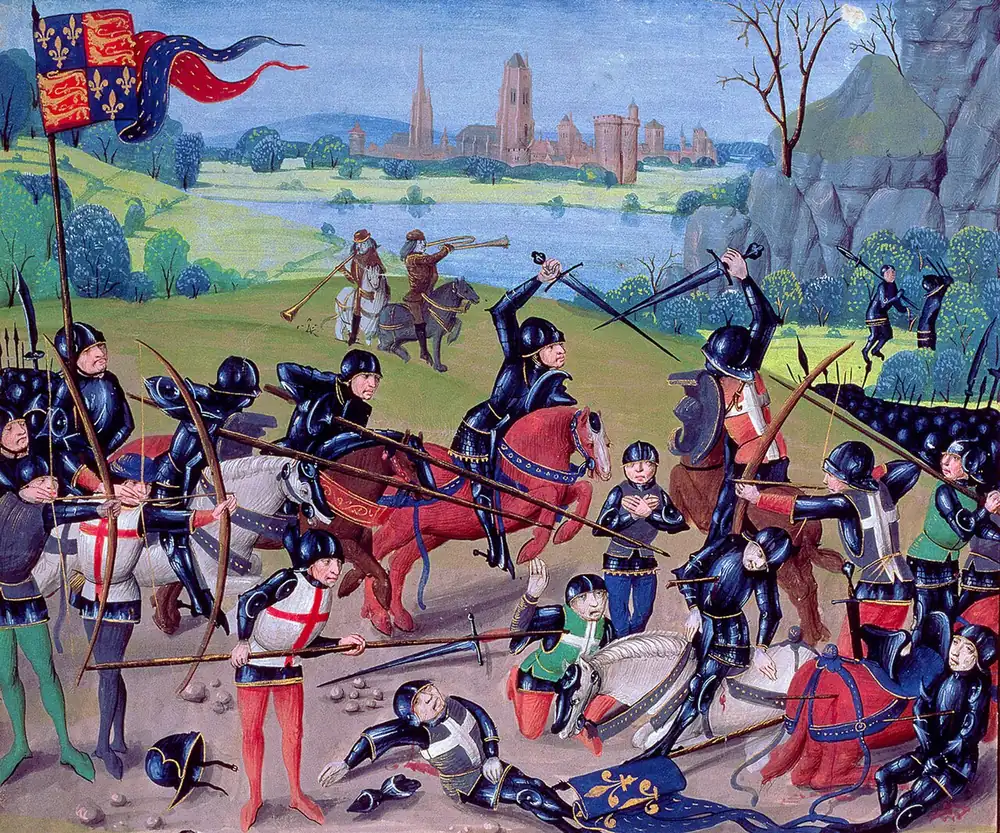
The Hundred Years' War was a series of wars between England and France, fought from 1337 to 1453 over who should wear the French crown. The English king Edward III claimed the throne through his mother, a French princess, and for decades English armies won nearly every major battle. English longbowmen shattered larger French forces at Crécy in 1346 and Poitiers in 1356, and at one point England controlled roughly a third of France. But France recovered. A 17-year-old farmer's daughter named Joan of Arc revived the French cause in 1429, and French artillery ended the war at the Battle of Castillon in 1453. The war was never one long fight. It played out in bursts of campaigning, broken by long truces, over 116 years. It changed both countries more than any shift in territory did. France came out with a professional army and a centralized monarchy. England, driven from France, looked west across the ocean.
How the war started
In 1328, the last French king in the direct male line died without a son. A cousin, Philip VI, took the throne. Edward III of England had a rival claim through his mother, Isabella, daughter of an earlier French king, Philip IV. French jurists declared that no claim to the crown could run through a woman's line.
For nine years the dispute stayed political. The break came in 1337. Philip seized Gascony, a rich wine-growing region in the French southwest that Edward governed as a feudal subject of the French crown. Edward responded by declaring himself the rightful king of France.
The English army was smaller than France's, but it fought differently. At Crécy in 1346, English soldiers fought on foot behind rows of longbowmen, and they shattered a French army at least twice their size. At Poitiers in 1356, the English took King John II of France prisoner. His ransom was set at 3 million gold crowns, roughly 15 years of England's peacetime revenue. France never finished paying it. Under the Treaty of Bretigny in 1360, Edward gained roughly a third of France.
How France turned the war around
France then changed strategy. Bertrand du Guesclin, the new French commander, refused open battle. He recaptured English-held towns one by one, and by 1380 most of the territory England had gained was back in French hands.
A generation later, Henry V of England reopened the war. At Agincourt in 1415, his outnumbered army destroyed a much larger French force. Under the Treaty of Troyes in 1420, the French heir was cut out of the succession and Henry was recognized as the future king of France. But Henry V died of dysentery in August 1422, at the age of 35. The French king, Charles VI, died about seven weeks later. Henry's infant son, Henry VI, was declared king of both countries, but real power on both sides was weak and divided.
By 1429, England and its ally, the Duchy of Burgundy, controlled most of northern France. The city of Orléans was under siege, and the French cause looked finished. Then Joan of Arc arrived.
Joan was about 17, the daughter of a tenant farmer in Domrémy, a village on the border of Lorraine. She had no military training. She claimed that saints had spoken to her and told her to drive the English out of France. She traveled to the French court at Chinon and persuaded the dauphin Charles to send her with a relief force to Orléans. The siege was broken in nine days. Joan then escorted Charles to Reims, the traditional coronation city, where he was crowned King Charles VII. The coronation gave him something he had lacked: he was no longer a rebel claimant but a consecrated king.
Joan was captured by Burgundian soldiers at Compiègne in 1430, sold to the English, tried for heresy, and burned at the stake in Rouen in May 1431. She was 19. But her effect on the war outlasted her. She had given the French side a legitimate king and a cause that reached beyond feudal obligation.
In 1435, Burgundy switched sides. England lost its strongest ally on the continent. France then assembled what England could not match. Charles VII used a permanent tax, the taille, to pay for the compagnies d'ordonnance in 1445, a professional standing army. He also funded an artillery corps run by Jean and Gaspard Bureau, which became the most effective in Europe. At the Battle of Castillon in 1453, the Bureau brothers' cannon tore through English formations on the open field. After Castillon, England held nothing in France except the port of Calais, which it lost in 1558.
Who won the Hundred Years' War?
France won. England's bid for the French crown failed completely, and by 1453 England had lost almost every acre it had held in France. But the war reshaped both countries in ways that went far beyond any battle.
France came out with a permanent tax system, professional soldiers on year-round pay, and a crown that had brought large provinces under direct royal control. This was the centralized state that Louis XIV later inherited. England, driven from France, stopped looking east and turned toward the sea, a direction that would eventually produce its global empire. The English ruling class, which had spoken French for centuries after the Norman conquest, switched entirely to English.
Both countries came out of the war with a new kind of identity. Before the war, the English and French crowns were branches of the same extended royal family. After it, each side saw the other as a foreign nation. The war did more than any peace treaty to separate France and England into distinct peoples.
For England, the aftermath was violent. Defeated nobles returned home with armed retinues, unpaid soldiers, and old grievances. Two years after Castillon, in 1455, they started the civil war known as the Wars of the Roses.