
Black Death
The Black Death was a plague pandemic from 1347 to 1351 that killed a third to half of Europe's population.
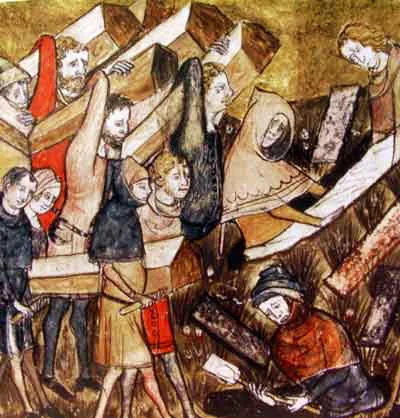
The Black Death was the deadliest pandemic in recorded history. Between 1347 and 1351, a wave of plague swept from Central Asia across the Mediterranean and into Europe, killing an estimated 25 to 50 million Europeans, a third to half of the continent's population. The disease traveled the same trade routes that carried silk and spice from China to the Mediterranean, and the societies it passed through never fully recovered.
The cause was Yersinia pestis, a bacterium carried by fleas that lived on rodents. The plague took two main forms: bubonic plague, named for the painful black swellings called buboes that it caused, and pneumonic plague, which spread through the air from person to person and could kill within days.
How the plague reached Europe
The plague spread along the Silk Road, the network of trade routes connecting China and Central Asia to the Mediterranean. Infected fleas traveled on rats, and rats traveled with cargo. The disease moved along caravan routes, through ports, and into cities.
In 1346, an army of the Golden Horde was besieging Caffa, a Genoese trading colony on the Crimean Peninsula, when plague broke out among its soldiers. According to the Italian notary Gabriele de' Mussi, the besiegers launched plague-infected bodies over the city walls, an episode sometimes called one of the first uses of biological warfare. Historians debate whether the catapulting actually happened, but Genoese traders from the Black Sea did carry the disease by ship into the Mediterranean, reaching Sicily by late 1347.
From Sicily the plague moved fast. Within months it spread to mainland Italy, France, and Spain. By 1349 it was in England, Germany, and Scandinavia. Villages emptied. Some cities lost half their populations within months. Florence, one of the richest cities in Europe, may have lost more than half its people. People who were healthy in the morning could be dead by evening, and in some villages there were not enough survivors to bury the dead.
How the Black Death changed Europe
With so many dead, survivors found themselves in a different world. Labor was suddenly scarce, and peasants and workers who had spent their lives at the bottom of the feudal order discovered they had bargaining power for the first time. A lord who refused to raise pay could lose his workers to the next estate. Wages rose and rents fell across the continent. The shortage of workers also rewarded labor-saving inventions, as employers looked for ways to produce more with fewer hands.
Governments tried to push back. In England, the Statute of Labourers of 1351 attempted to freeze wages at pre-plague levels and punish workers who left their villages for better pay. The law failed. Workers ignored it, and resentment over its enforcement helped cause the Peasants' Revolt of 1381. Across Western Europe, serfdom broke down as landlords lost the power to keep peasants on their estates. The feudal system was permanently weakened.
The Church lost lasting authority, because it could neither explain the plague nor stop it. Some historians argue that the upheaval helped push Europe toward the Renaissance, as higher wages, new inventions, and a loosening of old certainties opened space for new thinking.
The plague also brought violence against scapegoats. Jewish communities across Europe were accused of poisoning wells to spread the disease. In Strasbourg in February 1349, the city's authorities burned about 2,000 Jews alive. In Basel, dozens of Jews were killed the month before. Hundreds of Jewish communities across the German-speaking lands were attacked or destroyed in one of the worst waves of antisemitic persecution in medieval history.
How many people died in the Black Death?
Modern estimates say the Black Death killed between 25 and 50 million people in Europe between 1347 and 1353, roughly a third to half the continent's population. Recent research into medieval records, including studies of tenant turnover on English manors, suggests the higher end of that range is more accurate for many regions.
The global death toll is harder to estimate. The plague struck not just Europe but the Middle East, North Africa, and Central Asia. Egypt and the Levant may have lost a third to half their populations in the first wave alone. Worldwide estimates range from 75 to 200 million dead. Historians estimate the world's population fell from about 475 million to between 350 and 375 million.
The plague burned itself out in Europe by the early 1350s but never truly disappeared. Yersinia pestis returned in waves for more than 350 years, resurfacing every decade or so across Europe and beyond. The Black Death remains the deadliest event, relative to population, in recorded human history.