
Washington Consensus
The Washington Consensus is a 1989 list of ten economic reforms for Latin America that became the default prescription for developing countries worldwide.
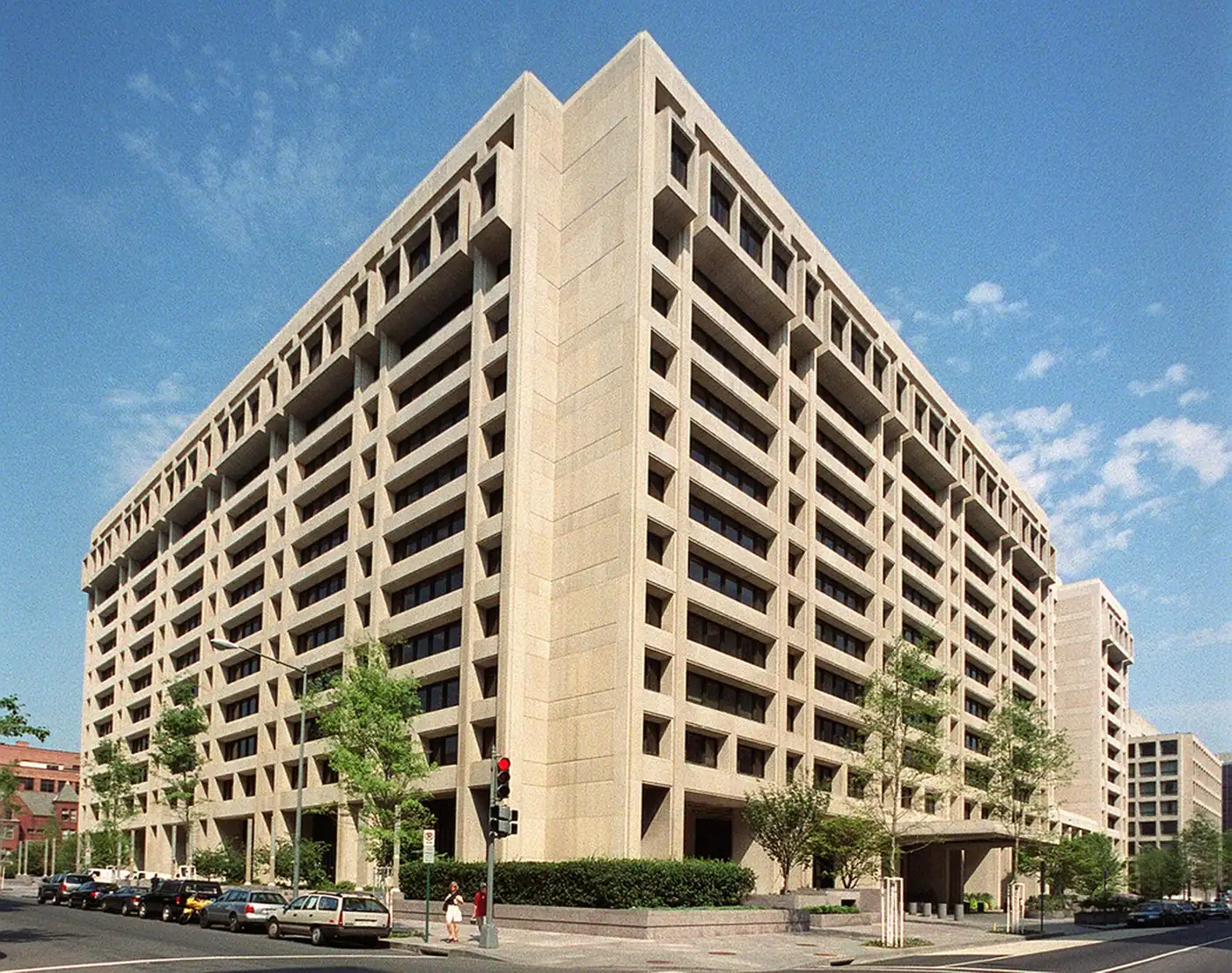
The Washington Consensus is a list of ten economic reforms that the English economist John Williamson wrote in 1989 to summarize what Washington's major institutions recommended for Latin American countries struggling with debt. The main institutions were the International Monetary Fund, the World Bank, and the US Treasury, all based within a few blocks of each other in Washington, D.C. On its own, the list was mostly ordinary advice: keep deficits small, cut trade barriers, let exchange rates adjust. But within a few years the phrase took on a much larger meaning, that only one set of economic policies was acceptable and that international lenders would withhold money from countries that did not follow them. Williamson argued for decades afterward that he had summarized a moment, not issued a universal prescription.
How the Washington Consensus became a global prescription
Williamson prepared the list for a 1989 conference hosted by the Institute for International Economics, a think tank near Dupont Circle in Washington, D.C. Born in Hereford, England, he had studied at the London School of Economics and earned his doctorate at Princeton. By 1989 he was a senior fellow at the Institute, and he wanted to pin down a single point: which economic policies did the IMF, the World Bank, and the US Treasury currently support for Latin America? He identified ten reforms and coined a term for them that he later wished he could take back.
The timing turned a description into a program. Williamson presented his paper in the same month the Berlin Wall fell. Two years later the Soviet Union was gone, and no rival economic model had a government behind it. The ten items stopped being a summary of what Washington thought about Latin America and started being treated as what every developing country was supposed to do.
The mechanism was lending. Governments that could not pay their foreign debts needed loans from the IMF and the World Bank, the institutions created under the Bretton Woods system. Those loans came with conditions: the borrower had to adopt specific reforms. Through this conditionality, what one group of institutions believed turned into a set of requirements for dozens of countries.
What happened when countries followed the Washington Consensus
The fiscal and monetary reforms produced clear results. Countries across Latin America brought down inflation rates that had been running at hundreds or thousands of percent a year, and those rates mostly stayed low. Budget discipline and central banks free from political control became standard practice.
Beyond that, the record was poor. Russia attempted the most extreme version in 1992, a program of shock therapy that liberalized prices, privatized state enterprises rapidly, and expected legal institutions to catch up later. They did not. Without functioning courts or property registries, rapid privatization put state assets into the hands of well-connected insiders who became oligarchs. By 1994 about 70 percent of Russia's large and medium-sized enterprises had been privatized, while the country's GDP had fallen roughly 30 percent from its 1991 level.
Capital account liberalization, the free movement of financial investment across borders, was pushed on developing countries even though Williamson had deliberately left it off his list. Opening small economies to unrestricted flows of foreign capital left them exposed to sudden reversals. In 1997, foreign investors pulled their money out of Thailand, South Korea, and Indonesia within months, setting off the Asian financial crisis. The IMF responded by demanding spending cuts from governments that were facing capital flight, not overspending. The response made the crisis worse and cost the IMF a generation of credibility across East Asia.
The two fastest-growing large economies, China and India, ignored much of the prescription. Both liberalized selectively, kept controls on capital flows, maintained large state sectors, and chose their own sequence of reforms. Latin America itself grew more slowly after adopting the reforms than it had before its debt crisis. Per capita GDP had grown about 3 percent a year from 1960 to 1979. From 1980 to 1999, it grew about 0.5 percent a year.
The ten policies of the Washington Consensus
Williamson's original 1989 list contained ten reforms, all aimed at Latin American countries in debt crisis:
- Fiscal discipline: keep budget deficits small enough to finance without causing inflation.
- Shifting government spending toward health care, schools, and infrastructure.
- Tax reform: broaden the tax base and cut high marginal rates.
- Market-determined interest rates.
- A competitive exchange rate, kept low enough to help exports grow.
- Trade liberalization: lower tariffs and remove import quotas.
- Openness to foreign direct investment.
- Privatization of state-owned enterprises.
- Deregulation: remove barriers to entry for new businesses.
- Legal protections for property rights.
The list did not include capital account liberalization. Williamson left that out deliberately because he considered it dangerous for countries with weak financial systems. The policy was later promoted under his label anyway, and it was a central cause of the 1997 Asian financial crisis.
The Washington Consensus today
The 2008 financial crisis, which began in the United States, ended the argument over which country had the right model for development. By then the phrase "Washington Consensus" had been purely pejorative for years. Williamson, the economist who coined it, died in 2021 at 83, having spent more than two decades objecting that half the things criticized under his label were never on his list.
Some of the original reforms survived. Almost no government today proposes financing large permanent deficits by printing money, and most countries now keep their central banks independent of elected officials. What did not survive was the confidence that development follows a checklist, that legal and political institutions will grow on their own once markets are opened, and that one city's advice applies everywhere. No shared framework for economic development has taken its place.