
Disputed territory · South Asia
Kashmir
Tense since the May 2025 strikesUpdated October 12, 2026
Kashmir is a mountain region where the Himalaya and Karakoram ranges meet. India, Pakistan and China each control part of it. India holds a little under half of the land, Pakistan about a third and China about a fifth. India claims all of it. Pakistan says the part India holds is disputed and should be decided by its people. India and Pakistan have fought over it since 1947, most recently for four days in May 2025. The ceasefire of May 10, 2025 holds, but India and Pakistan hold no formal talks.
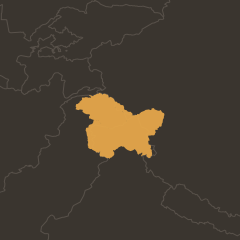
- Disputed since
- 1947
- when British India was split in two
- Area
- 222,000 km²
- the whole former princely state, a little smaller than the UK
- Line of Control
- About 740 km
- where the armies stopped in 1971
- Last fighting
- May 2025
- four days of strikes, then a ceasefire
- Nuclear warheads
- 190 and 170
- India and Pakistan, FAS 2026
Kashmir in 30 seconds
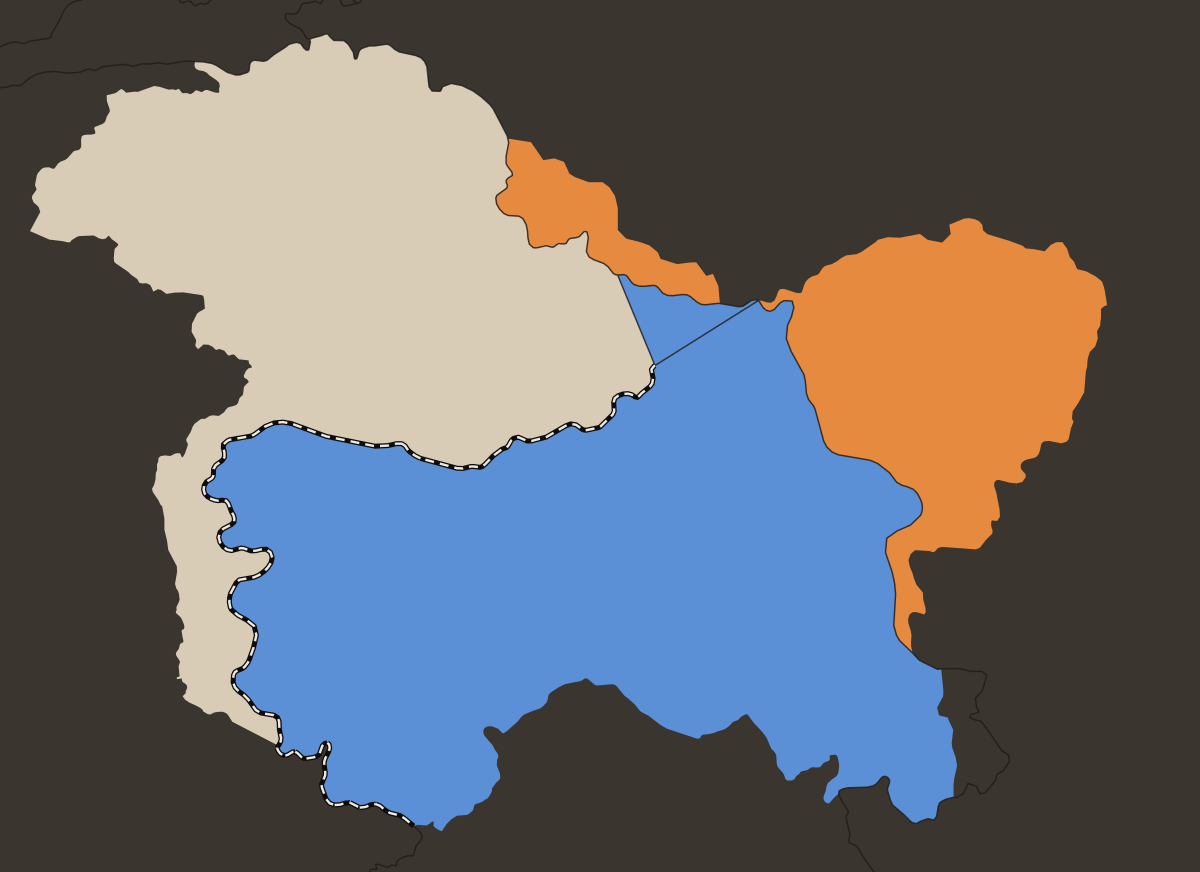
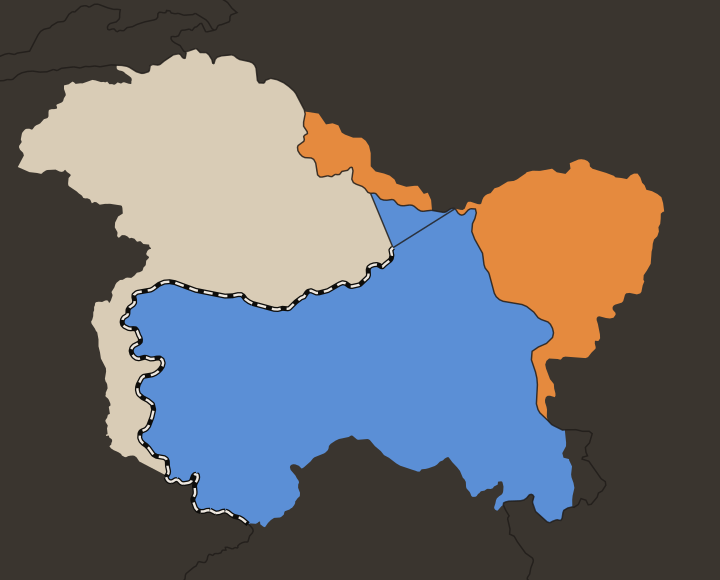
- India holds the Kashmir Valley, Jammu and Ladakh. Pakistan holds Azad Kashmir and Gilgit-Baltistan. China holds Aksai Chin and the Shaksgam Valley.
- The Line of Control is where the armies stood at the end of the 1971 war, close to the 1949 ceasefire line. Neither India nor Pakistan accepts it as a border.
- Both India and Pakistan have nuclear weapons. Every crisis since 1998 has stopped short of full war. The May 2025 fighting lasted four days.
- The rivers Pakistan's farms need flow through Indian-held Kashmir first. India has held the 1960 treaty that shares those rivers "in abeyance" since April 2025.
Who controls Kashmir?
No single country controls Kashmir. India controls the most land and most of the people. India holds the Kashmir Valley, Jammu and Ladakh, about 46% of the former princely state. Pakistan holds Azad Kashmir and Gilgit-Baltistan, about 35%. China holds Aksai Chin and the Shaksgam Valley, about 19%. About 70% of Kashmir's people live on the Indian side. India's 2011 census counted 12.5 million in its part. Pakistan's 2017 census counted about 4 million in Azad Kashmir and 1.5 million in Gilgit-Baltistan.
India claims the whole region, including the parts China holds. Pakistan says the Indian-held part is disputed and should be settled under UN resolutions. Pakistan's official map of 2020 labels Indian-held Kashmir "disputed territory" with its final status to be decided under UN resolutions.
 India
35%
India
35% Pakistan
19%
Pakistan
19% China
China
 GILGIT-BALTISTAN
AZAD
GILGIT-BALTISTAN
AZADKASHMIR JAMMU AND KASHMIR LADAKH AKSAI CHIN Siachen
Glacier Shaksgam Valley PAKISTAN INDIA CHINA Srinagar Jammu Leh Kargil Gilgit Skardu Muzaffarabad Islamabad K2 Line of Control Line of Actual Control
 GILGIT-BALTISTAN
JAMMU AND KASHMIR
LADAKH
AKSAI CHIN
PAKISTAN
INDIA
CHINA
Srinagar
Jammu
Leh
Gilgit
Line of Control
GILGIT-BALTISTAN
JAMMU AND KASHMIR
LADAKH
AKSAI CHIN
PAKISTAN
INDIA
CHINA
Srinagar
Jammu
Leh
Gilgit
Line of Control
Why do India and Pakistan both claim Kashmir?
When Britain left India in 1947, more than 560 princely states had to join India or Pakistan. Kashmir was the largest by area. Its ruler, Maharaja Hari Singh, was Hindu. The 1941 census put the Muslim share at 77%. He wanted independence and put off the choice.
On October 22, 1947, Pashtun tribesmen armed by Pakistan invaded. Hari Singh fled to Jammu and asked India for troops. India required accession first. V.P. Menon, the Indian official who came for his signature, later told a story about those days. In Menon's telling, Hari Singh told his staff that if Menon came back from Delhi, all was well. If not, they should shoot the maharaja in his sleep. Hari Singh signed (India dates it October 26). Indian troops flew into Srinagar on October 27. Pakistan says a Muslim-majority region should have joined Pakistan and that Hari Singh signed under pressure. India says the accession was legal and final.
UN Resolution 47 (April 21, 1948) called for a plebiscite once Pakistan had withdrawn the tribesmen and India had cut its forces to a minimum. The two sides never agreed on how to withdraw their forces, so the vote never took place.
How Kashmir was divided
- 1947Tribesmen from Pakistan invade, Hari Singh joins India and the first war begins
- 1949A UN-brokered ceasefire line splits Kashmir
- 1962War between China and India confirms China's hold on Aksai Chin
- 1963Pakistan cedes the Shaksgam Valley to China
- 1965A second India-Pakistan war. The line does not move.
- 1972The Simla Agreement turns the 1971 ceasefire line into the Line of Control
- 1984India takes the Siachen Glacier
- 1999The Kargil War, a year after India and Pakistan tested nuclear bombs
- 2019India ends Indian-held Kashmir's special status under Article 370
- 202526 killed at Pahalgam. Four days of strikes follow.
What is the Line of Control?
The Line of Control runs about 740 km from the Chenab river near Akhnoor to a point called NJ9842. The first ceasefire line was fixed in the Karachi Agreement of July 27, 1949. After the 1971 war, the Simla Agreement of July 2, 1972 replaced it with the line where the armies stood at the ceasefire of December 17, 1971, which mostly follows the old one. India and Pakistan agreed not to alter it unilaterally and to refrain from the threat or use of force against it. The Line of Control is not an international border. India fenced about 550 km of it by 2004. The fence, called the Anti-Infiltration Obstacle System, stands back from the line itself.
North of NJ9842 the line was never drawn. On April 13, 1984, India took the Siachen Glacier in Operation Meghdoot. Indian posts sit at up to about 6,000 m. Weather, altitude and avalanches have killed far more Indian and Pakistani soldiers than enemy fire.
Siachen Glacier
6,000 m
The world's highest battlefield
India lost 869 soldiers on the Siachen Glacier from 1984 to 2015. Most died from cold, altitude and avalanches rather than enemy fire. In April 2012 an avalanche at Gayari buried about 140 Pakistanis, most of them soldiers.
In February 2016 an avalanche at Sonam Post buried 10 Indian soldiers. Lance Naik Hanamanthappa Koppad was dug out alive on February 8, five days later. He died in a Delhi hospital on February 11.
Could the Kashmir conflict turn into a nuclear war?
India first tested a nuclear weapon in 1974. India and Pakistan both tested in May 1998. Since then India and Pakistan have faced the Kargil War in 1999, a military standoff from 2001 to 2002, Indian strikes in 2016 (which Pakistan denies took place) and 2019, and four days of fighting in May 2025. Each crisis stopped short of full war.
On April 22, 2025, gunmen killed 26 people at Pahalgam (25 Indians and one Nepali, most of them tourists). India blamed militants based in Pakistan. Pakistan denied a role. On May 7, India struck what it said were nine militant sites in Pakistan and Pakistan-held Kashmir. Pakistan said civilians were hit. Four days of fighting with jets, missiles and drones followed. A ceasefire was announced on May 10.
India's nuclear doctrine is no first use, with an exception for a major biological or chemical attack. Pakistan has made no such promise. India has about 190 nuclear warheads and Pakistan about 170.
Nuclear warheads, 2026
Full ranking →- China620
- India190
- Pakistan170
What does China have to do with Kashmir?
China holds about a fifth of the former princely state in two pieces. China built its Xinjiang-Tibet road (now G219) across Aksai Chin in the mid-1950s and held most of the area before the 1962 war. The war confirmed China's control. Pakistan ceded the Shaksgam Valley to China in a March 2, 1963 agreement. The agreement calls the transfer provisional until Kashmir is settled. India rejects the 1963 agreement (most recently on January 9, 2026).
China is Pakistan's closest ally. China supplied 80% of Pakistan's arms imports in 2021-25 (SIPRI). The China-Pakistan Economic Corridor runs through Gilgit-Baltistan over the Khunjerab Pass. On June 15, 2020, 20 Indian soldiers and at least 4 Chinese soldiers died in a clash in the Galwan Valley, on the Line of Actual Control, the unmarked line between Indian-held Ladakh and Chinese-held Aksai Chin. Xi Jinping visited India in September 2026 for the first time since 2019. No border deal was announced.
China and Kashmir
- Aksai ChinHeld by China since the 1950s, about 38,000 km² by India's count
- Shaksgam ValleyCeded by Pakistan in 1963, about 5,180 km²
- Galwan Valley20 Indian soldiers and at least 4 Chinese died in a clash, June 2020
What is at stake in Kashmir?
Water
The Indus, Jhelum and Chenab flow through Indian-held Kashmir before reaching Pakistan's farms. India has held the 1960 Indus Waters Treaty "in abeyance" since April 23, 2025. On August 31, 2026, a Court of Arbitration in The Hague ruled the treaty is fully in force and India cannot suspend it. India, which boycotted the case, rejected the ruling.
Roads to China
China's Xinjiang-Tibet highway (G219) crosses Aksai Chin. The Karakoram Highway over the Khunjerab Pass is Pakistan's only road to China and runs through Gilgit-Baltistan as part of the China-Pakistan Economic Corridor.
People
About 70% of Kashmir's people live on the Indian side. An armed revolt against Indian rule began in 1989. India says Pakistan arms and trains the militants. Pakistan says it gives only political support. India counted 47,000 dead by 2008. Kashmiri rights groups say more than 70,000 have died.
Questions about Kashmir
Is Kashmir part of India or Pakistan?
Both, in part. China holds a third piece. India governs its part as two union territories, Jammu and Kashmir and Ladakh, which are run more directly from Delhi than India's states, created on October 31, 2019. Pakistan governs Azad Kashmir and Gilgit-Baltistan. Each government shows the whole region as its own or as disputed on official maps.
What was Article 370?
Article 370 gave Jammu and Kashmir its own constitution and flag. Indian laws covered only defense, foreign affairs and communications unless the state agreed. Article 35A reserved land and state government jobs for permanent residents. On August 5, 2019, India revoked Article 370, and Parliament voted to split the state from October 31. India's Supreme Court unanimously upheld the revocation on December 11, 2023. The court said statehood should be restored "as soon as possible". Elections were held in 2024 and Omar Abdullah became chief minister. Statehood has not been restored as of October 2026. The assembly passed a statehood resolution in September 2026.
What happened at Pahalgam in 2025?
On April 22, 2025, gunmen killed 26 people near Pahalgam, 25 Indians and one Nepali, most of them tourists. India blamed Pakistan-based militants. Pakistan denied a role. India held the Indus Waters Treaty in abeyance the next day. On May 7, India struck nine sites in Pakistan and Pakistan-held Kashmir. The fighting ended with a ceasefire on May 10.
Have India and Pakistan ever come close to a peace deal?
In February 1999, India's prime minister, Atal Bihari Vajpayee, rode the first bus from Amritsar to Lahore. The actor Dev Anand and cricketer Kapil Dev were aboard. Vajpayee signed the Lahore Declaration. In May, Pakistani troops were found at Kargil. From 2004 to 2007, envoys Satinder Lambah of India and Tariq Aziz of Pakistan held about 30 secret meetings, by Pakistan's account. Pakistani President Pervez Musharraf's four points (no new borders, a soft Line of Control, self-government with troops withdrawn, a joint mechanism) became public in December 2006. Pakistan's foreign minister Kasuri later said "We were very near." The talks stalled in March 2007 when Musharraf's domestic crisis began.