
Why every financial bubble gets compared to Dutch tulip mania
In 1637, a single tulip bulb sold for twice the price of an Amsterdam canal house. The crash lasted days. The legend has lasted nearly four centuries.
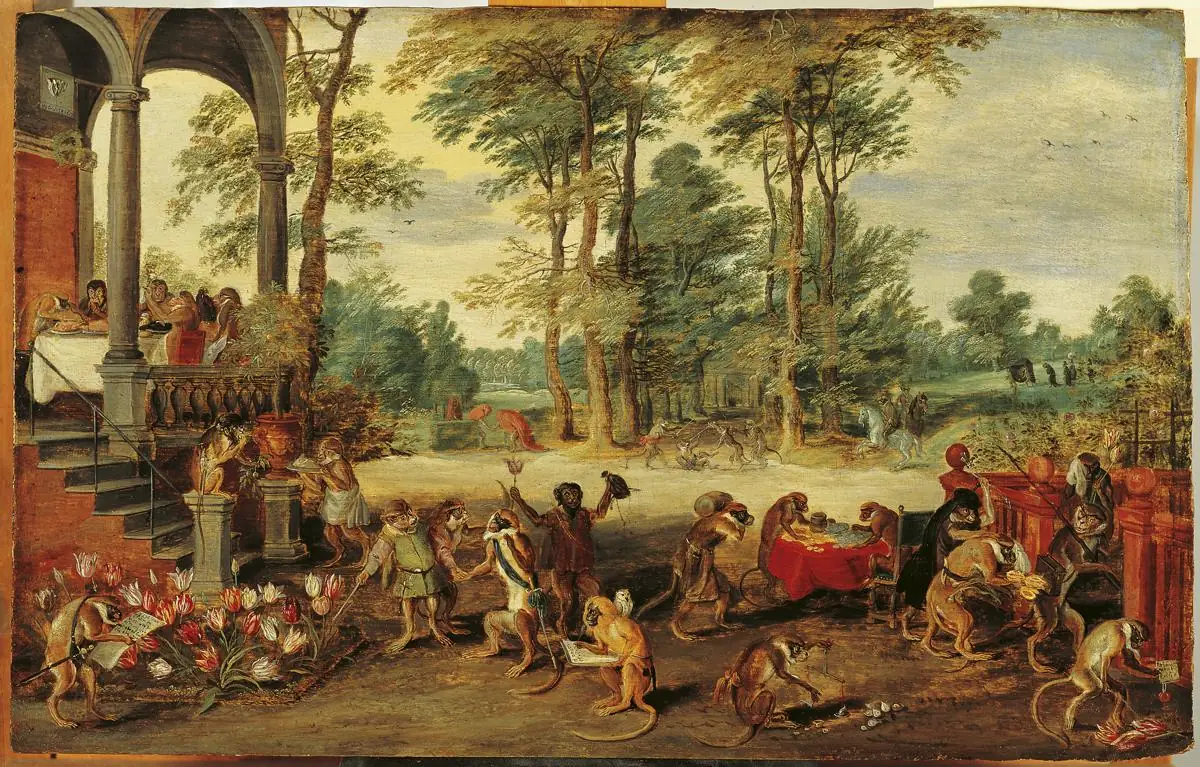
In the winter of 1637, a single tulip bulb sold in the Dutch Republic for roughly 10,000 guilders. That was about twice the price of a house on one of Amsterdam's main canals. A skilled craftsman earned around 300 guilders in a year.
Five weeks later, the market collapsed. Buyers stopped showing up to auctions. Prices fell by more than 90 percent in a matter of days. The episode is almost certainly the most famous financial crash in history. Whenever a stock, a cryptocurrency, or any other asset rises to absurd prices and then collapses, someone will compare it to tulip mania. The real story is smaller, and more interesting, than the version most people know.
How a flower became a luxury commodity
Tulips reached western Europe from the Ottoman Empire in the mid-1500s. The man who brought them to the Dutch Republic was a Flemish botanist named Carolus Clusius, born Charles de l'Écluse. Clusius had spent decades traveling across Europe cataloging plants, from the mountains of Spain to the imperial gardens of Vienna, where the Habsburg emperor Maximilian II had hired him to manage a botanical collection. He was a Protestant in an era of religious wars, and he moved from court to court until the University of Leiden offered him a position in 1593. He was sixty-seven years old. He brought tulip bulbs with him and planted them in the university's new botanical garden. They were stolen almost immediately. Within a decade, tulips had spread across the Dutch Republic through a mix of theft, gifting, and commercial sale.
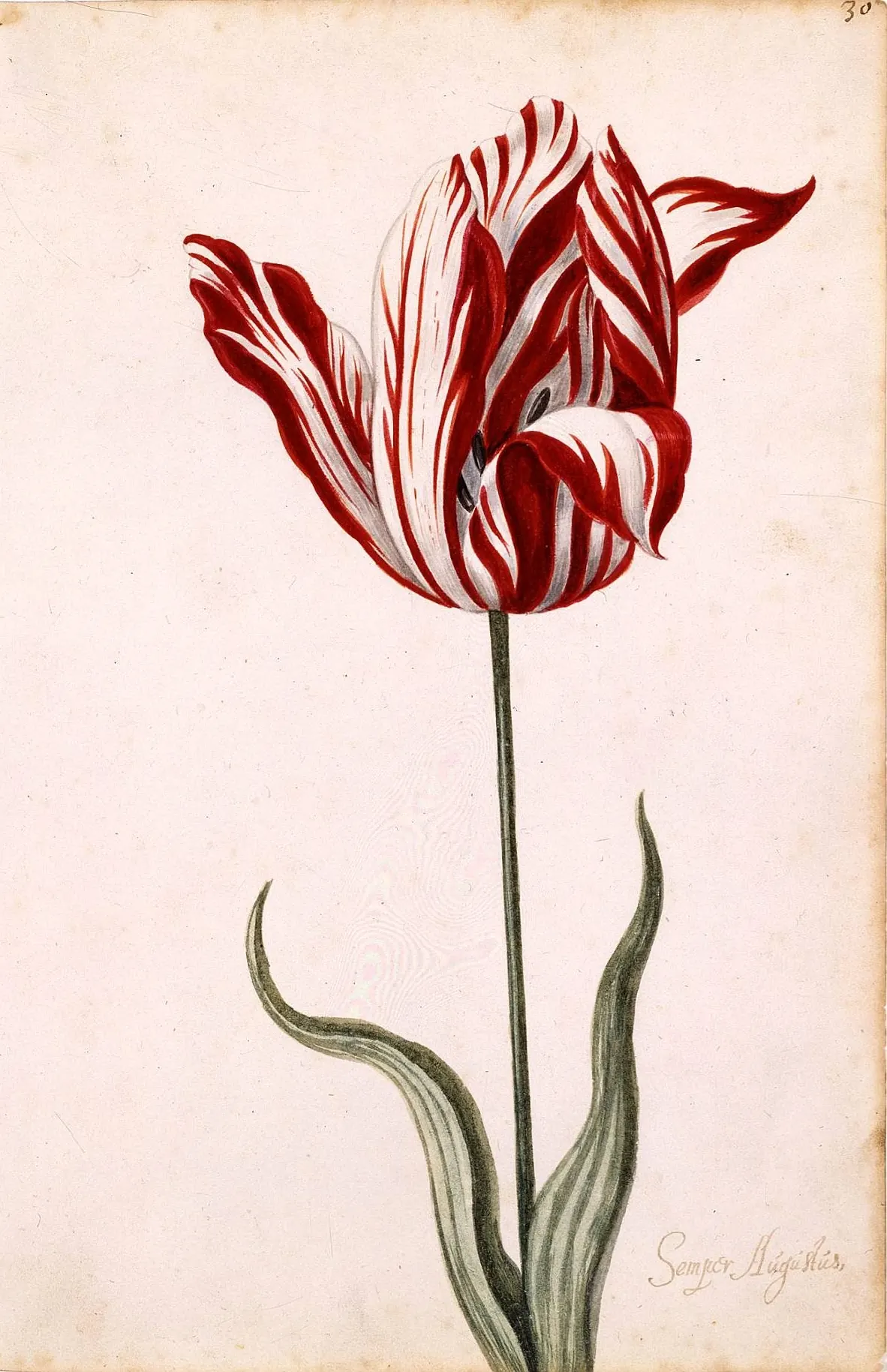
What made certain tulips valuable was a biological accident nobody at the time understood. A virus called the tulip breaking virus, carried by aphids, infected some bulbs and produced vivid streaks of color across the petals: flames of red on white, or purple on yellow. These "broken" tulips could not be bred reliably. A grower might plant a hundred ordinary bulbs and get two or three with the striking patterns that collectors wanted. The most famous variety, the Semper Augustus, had white petals streaked with crimson. At one point only twelve bulbs were known to exist. The supply was tiny and unpredictable, and the prices reflected it.
The timing mattered too. The Dutch Republic in the 1630s was the richest country in the world. Amsterdam was the center of global trade. The Dutch East India Company, founded in 1602, had created the world's first stock exchange. Credit was easy. Merchants, craftsmen, and even textile workers had money to spare and a culture that rewarded risk. Tulips, already expensive and fashionable among the wealthy, became the asset everyone wanted in on.
How the market actually worked
By 1636, tulip trading had moved from gardens to tavern back rooms. Buyers and sellers exchanged what were essentially futures contracts: written agreements to buy or sell specific bulbs at a set price when they came out of the ground in spring. The Dutch called this the windhandel, the "wind trade," because no physical tulips changed hands. The bulbs stayed in the soil. What moved was paper.
The contracts were informal. No court or exchange enforced them. Deals were sealed with a handshake and a round of wine paid for by the buyer, a custom known as "wine money." A single bulb could be resold three or four times in a single day, each buyer expecting to flip the contract at a higher price before anyone had to deliver an actual flower. By late January 1637, the prices written on these agreements had lost all connection to what anyone would pay for a tulip to put in the ground.
The crash
On February 3, 1637, a routine tulip auction in Haarlem found no buyers. The auctioneer lowered his asking prices again and again. Nobody bid. Historians believe the bubonic plague, which was spreading through Haarlem that winter, may have kept buyers home. Whatever the cause, the news traveled fast. Within days, auctions across the Dutch Republic reported the same thing: no bids at any price.
Prices collapsed almost overnight. Holders of futures contracts found themselves owing hundreds or thousands of guilders for bulbs now worth a fraction of that amount. Most simply refused to pay. Town governments and local courts stepped in and eventually settled most contracts at roughly 3 to 5 percent of the original price. A few traders who had concentrated their bets were ruined.
But there was no banking crisis, no wave of bankruptcies, and no recession. The Dutch economy kept growing. The historian Anne Goldgar, who spent years examining the surviving court records, notarial archives, and merchant correspondence from Amsterdam and Haarlem for her 2007 book Tulipmania, found that only about 350 people were involved in the high end of the trade at all. Just 37 of them paid more than 300 guilders for a single bulb. She found fewer than half a dozen people who suffered clear financial harm afterward, and even in those cases, it was not certain that tulips were the cause.
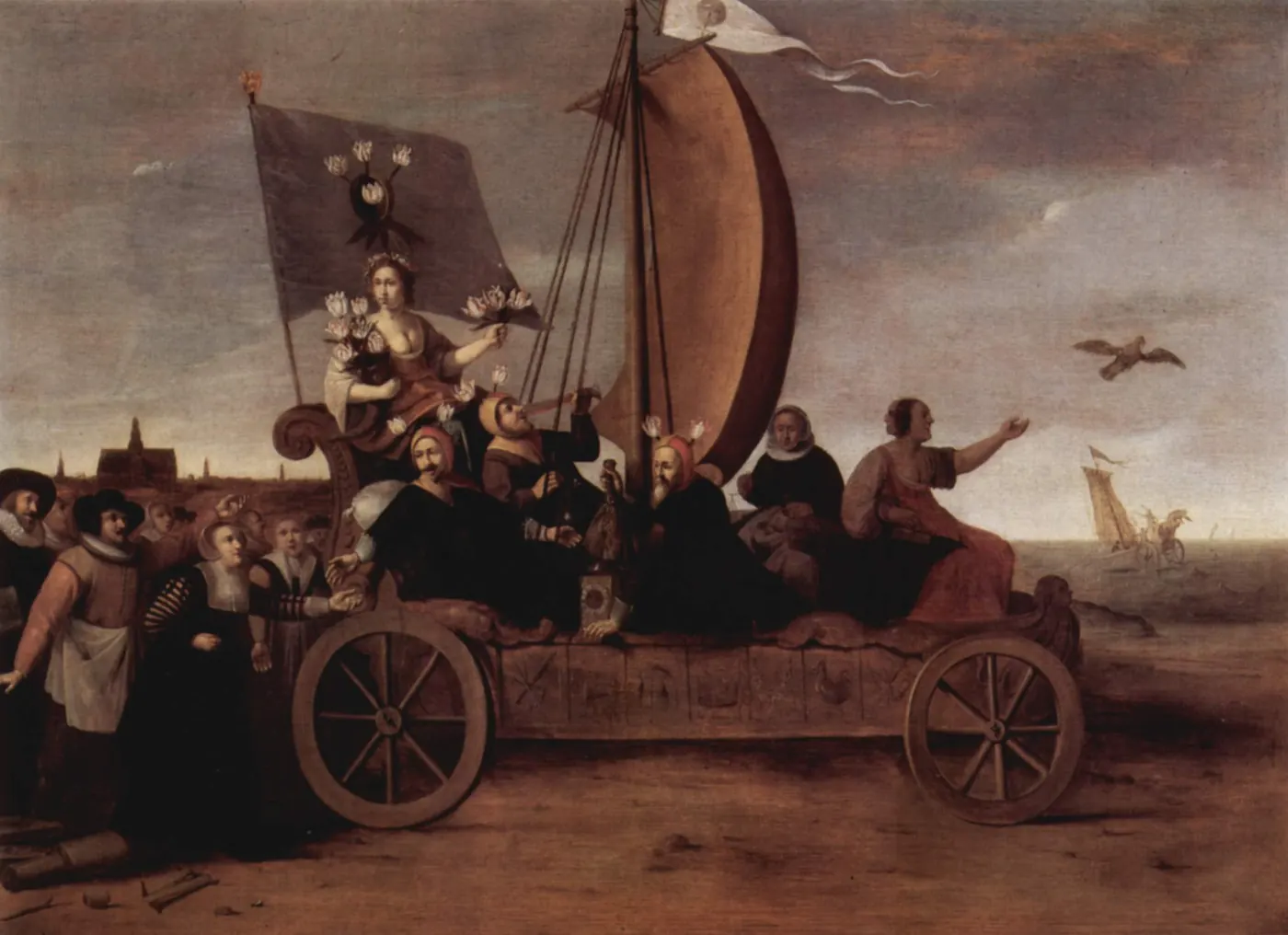
The book that built the legend
The crash itself was limited. Its reputation became enormous. The explanation is mostly one book.
In 1841, a Scottish journalist and poet named Charles Mackay published Extraordinary Popular Delusions and the Madness of Crowds. Mackay had started his career at the Morning Chronicle in London, where a young Charles Dickens was a colleague on the same paper. Mackay was best known in his own time for writing popular songs and verse. He was an entertainer by instinct, and he wrote about tulips the way he wrote everything: for maximum effect.
His sources were Dutch pamphlets from the 1630s and 1640s, satirical moral tales written after the crash to mock greedy speculators. Mackay treated these pamphlets as factual history. He repeated the story of a sailor who supposedly ate a Semper Augustus bulb thinking it was an onion and was thrown in prison, a tale that almost certainly never happened. He described families selling their houses for flowers, citywide ruin, and economic collapse across the republic. None of this matched the court records and merchant letters that Goldgar examined nearly two centuries later.
But the book was vivid and readable, and it sold. It was reprinted throughout the nineteenth and twentieth centuries. It became required reading on Wall Street and in MBA classrooms. When economists or commentators needed a shorthand for irrational speculation, they reached for Mackay's version of the tulip crash, not for the archival record.
Why the comparison keeps coming back
The tulip crash was real. Prices did spike far beyond any rational value and then collapsed. People did lose money. Journalists and analysts have invoked tulip mania during the dot-com crash of 2000, the US housing collapse of 2008, the crypto crash of 2022, and China's ongoing property crisis. In every case, it meant the same thing: the market was irrational, the crash was inevitable, and someone should have seen it coming.
The version of tulip mania they have in mind is Mackay's: a whole society seized by collective madness, ordinary families bankrupted by flowers, an inevitable reckoning that wrecked the economy. That version is simpler and more dramatic than what actually happened. It also flatters the person making the comparison by implying they would never have been so foolish.
The irony is that the real tulip crash, the one Goldgar found in the archives, is a better analogy for most of these episodes than Mackay's version. Crypto crashes and meme stock collapses work the same way the tulip crash actually worked: a speculative asset with no intrinsic value spikes in price, speculators pile in, the price collapses, and the people who bet heavily lose money. The broader economy barely notices. Nobody's pension disappears. No banks fail. That is what happened in the Dutch Republic in 1637, and it is roughly what happened when Bitcoin lost 75 percent of its value in 2022.
The comparison people reach for is the apocalyptic one, the economy-destroying mania from Mackay's book. The comparison that actually fits is the smaller, stranger, real one: a speculative fever that burned the speculators and left everyone else alone. Four centuries of repetition, and the most famous cautionary tale in the history of finance is more accurate than the people citing it have ever realized.
Test what you learned
5 questions on this article. About two minutes, no signup.