
Dutch East India Company
The Dutch East India Company was chartered in 1602 and became the first company to sell public shares, using military force to control the spice trade.
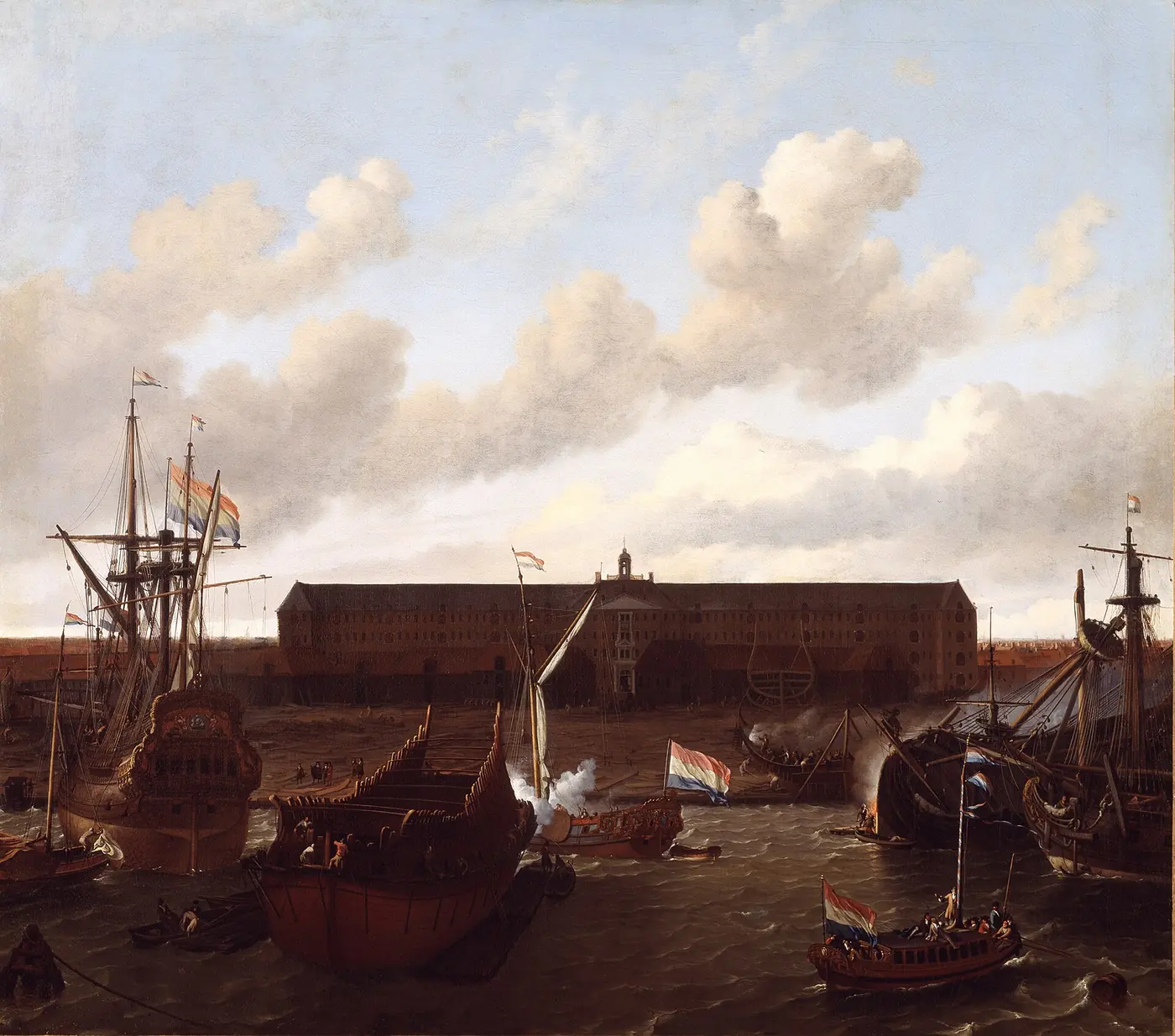
The Dutch East India Company, known by its Dutch initials VOC, was a trading company chartered by the Dutch government on March 20, 1602. No company before it had sold shares that ordinary people could buy and trade, and its charter gave it powers no modern corporation has: the authority to recruit soldiers, construct forts, start wars, negotiate treaties, and put prisoners to death. The VOC used those powers across a region stretching from southern Africa to Japan for nearly two centuries. At its peak it employed about 50,000 people and operated around 150 ships. No trading company in the world was larger. The VOC also carried out massacres to protect its trade monopolies, most notably on the Banda Islands, where most of the population was killed or enslaved to secure the world's only source of nutmeg.
How the Dutch East India Company created the stock market
Before 1602, Dutch merchants financed voyages to Asia one at a time. A group of investors would pool money for a single expedition, wait two or three years for the ships to return, split the profits, and dissolve the partnership. Many ships never came back at all.
The VOC's 1602 charter changed this. It merged six regional trading companies into one, raised 6.4 million guilders from more than 1,100 investors, and locked the capital in for ten years. The investors were not just wealthy merchants. Artisans and servants bought shares too. Anyone who wanted their money back before the ten years were up could sell their share to someone else. This trading happened at the Amsterdam exchange, which became the world's first stock market. Within a generation, traders there were using techniques that still exist today: short selling, options, and futures contracts.
A board called the Heeren XVII, the Lords Seventeen, ran the company. They were delegates from the six original chambers and met a few times a year to set policy for operations a voyage of about eight months from the Netherlands. When business was good, the VOC returned its shareholders 18 percent a year or more. Over its 197-year life, the company sent nearly 5,000 ships to Asia and transported about a million Europeans east.
How the VOC conquered the spice trade
The VOC did not try to compete with local traders in Asian markets. It aimed to own the sources of the most valuable goods and shut everyone else out.
The man who carried out this strategy was Jan Pieterszoon Coen. Coen was born in the Dutch town of Hoorn in 1587. As a teenager he worked for a Flemish merchant in Rome, where he learned bookkeeping. He joined the VOC at 19, and by 31 he was governor-general of all the company's operations in Asia. In 1619 he founded the city of Batavia, the VOC's Asian headquarters, on the ruins of the Javanese port of Jayakarta. Coen believed that trade in Asia required war, and he acted on that belief.
In 1621, Coen ordered the conquest of the Banda Islands, a small chain in eastern Indonesia that was the only place on earth where nutmeg and mace grew. The result was a massacre. Of the roughly 15,000 Bandanese, only about 1,000 were left on the islands. The rest were killed, starved, enslaved, or driven away. The VOC divided the emptied islands into plantations and worked them with enslaved laborers. Coen reported the operation to the company's directors in Amsterdam as a routine business matter. On the nearby island of Ambon, the VOC enforced its clove monopoly by periodically sending expeditions to cut down any spice trees that local farmers had planted without permission.
Around these monopolies the VOC built a network across Asia. It took Malacca from the Portuguese in 1641, controlling the strait that connected the Indian Ocean to the South China Sea. It ran the only European trading post in Japan, a small artificial island called Dejima in Nagasaki harbor, where a handful of Dutch traders lived under strict Japanese supervision for over two centuries. In 1652 the company set up a supply station at the Cape of Good Hope, which grew into a permanent settler colony. In the 1600s, the VOC's most reliable profits came not from shipping spices back to Europe but from moving goods between ports within Asia.
What happened to the Dutch East India Company?
The VOC's decline took over a century. The spice trade that had made the company rich became less important as European demand shifted to textiles, tea, and coffee. Nutmeg and cloves grew on a few small islands the VOC could control. These new products came from regions too large to monopolize.
Wars with England drained the company's treasury. But the deeper problem was corruption. VOC employees in Asia were poorly paid and worked thousands of miles from anyone who could watch them. Many ran private trading businesses on the side, using company ships, warehouses, and contacts. The practice was so widespread that people joked the initials VOC really stood for "Vergaan Onder Corruptie," Dutch for "perished under corruption."
By the late 1700s the company was borrowing money to fund dividend payments its revenues could no longer cover. When French revolutionary armies invaded the Netherlands in 1795, the new Dutch government took over the company. The VOC's charter was allowed to lapse, and on December 31, 1799, the VOC officially ceased to exist. The Dutch state assumed its debts and took control of its territories. The Dutch government ruled the Indonesian possessions as the Dutch East Indies, which became Indonesia in 1945.
The English East India Company, which followed a similar path in India, lasted only several decades longer. Both demonstrated what follows when a government hands sovereign authority to a private business. A company can conquer territory, but it cannot govern it forever. The costs grow, corruption spreads, and the government takes over.