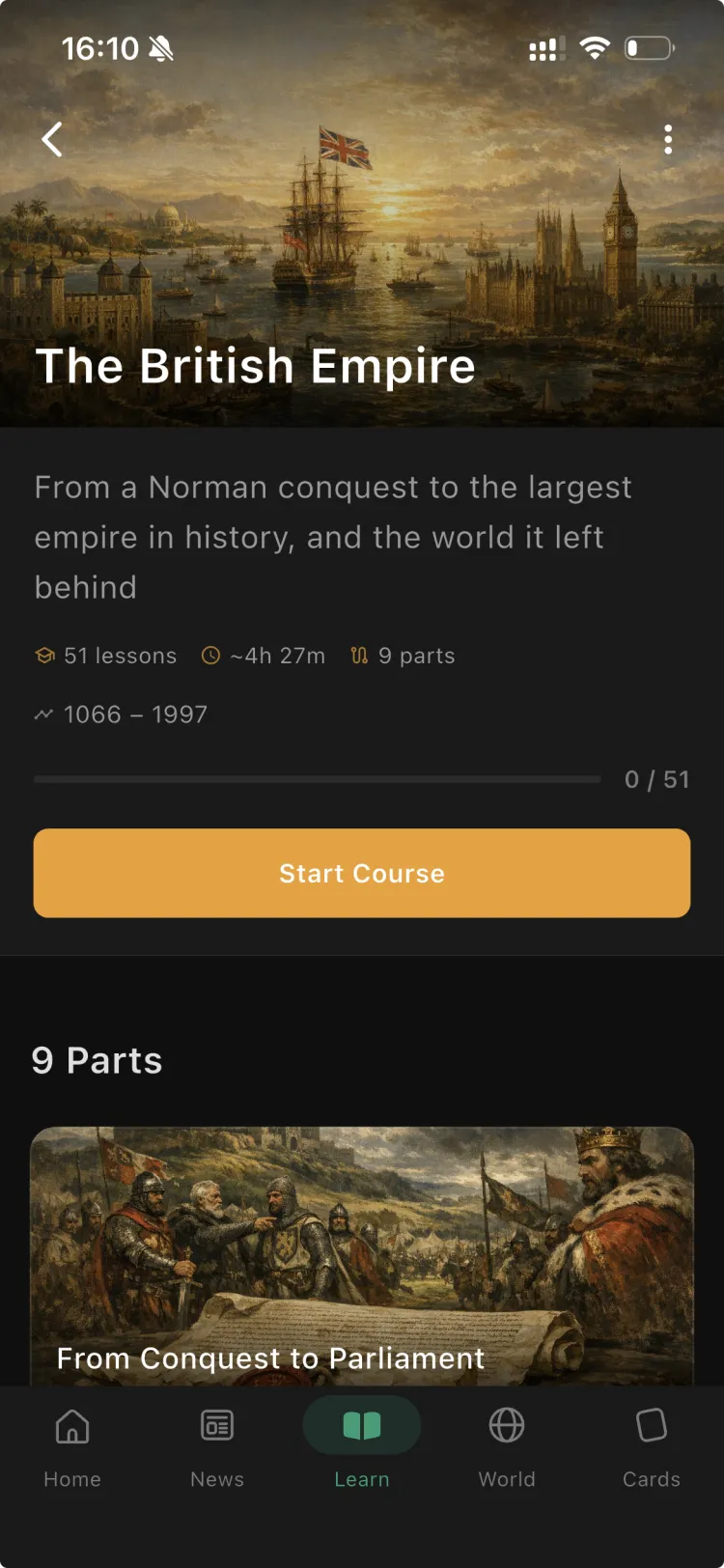
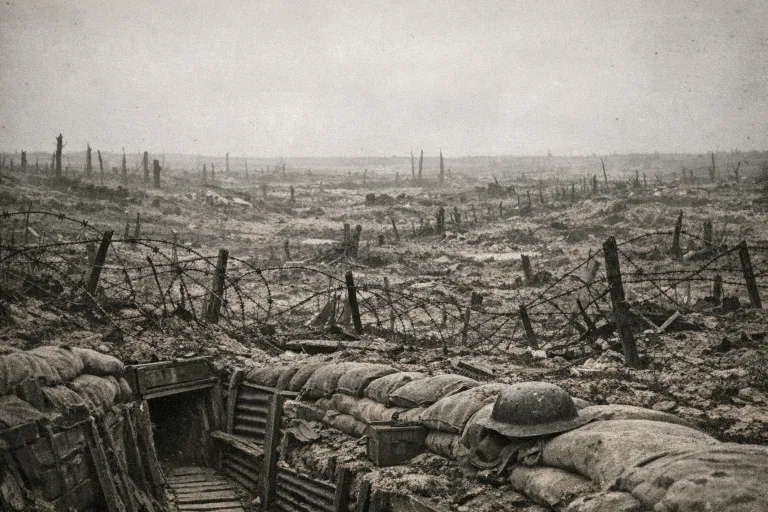
The British Empire
How a Norman invasion in 1066 built the most centralized state in medieval Europe, how that state assembled an empire covering a quarter of the world's land, and how two world wars and colonial resistance brought the British Empire down within 50 years.
1066 to 1997 · 9 parts · 51 lessons · about 4.5 hours
Free for 7 days, cancel anytime. iPhone and Android.
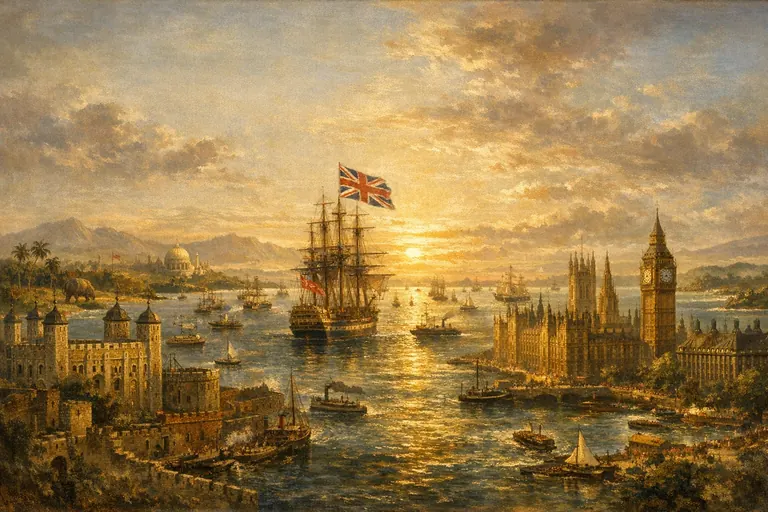
Questions this course answers
- Why did the barons force King John to seal Magna Carta in 1215?
- How did the triangular trade build British wealth on enslaved Africans?
- Why did Britain industrialize before every other country?
- Why did the Great Famine kill a million Irish while Ireland exported food?
- How did Britain force China to accept the opium trade?
- How did the largest empire in history come apart in fifty years?
Nine parts, 51 lessons
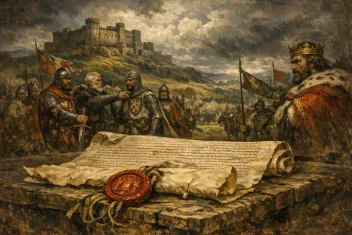 Part 1 · 1066 to 1689
From Conquest to Parliament
How a Norman invasion built the most centralized state in medieval Europe, and how that state's own barons forced it to accept the rule of law.
-
1
6 min
The Norman Conquest and Feudal England
In October 1066, Duke William of Normandy defeated King Harold at Hastings, replaced England's entire ruling class, and built a system of centralized control.
-
2
5 min
Magna Carta: The Great Charter
In June 1215, barons forced King John to seal Magna Carta to protect their feudal privileges. It set the precedent that even a king must follow the law.
-
3
5 min
The Hundred Years' War and English Identity
A series of wars with France from 1337 to 1453 replaced French with English as the language of law and turned England away from the continent, toward the sea.
-
4
5 min
Tudor England and the Break with Rome
Henry VIII broke with Rome because the Pope would not annul his marriage. The break made England a fully sovereign state for the first time.
-
5
4 min
The English Civil War
After losing a civil war to Parliament, King Charles I was tried and publicly beheaded on January 30, 1649. No people in Europe had done this before.
-
6
5 min
The Glorious Revolution and Constitutional Monarchy
In 1688, James II fled when William of Orange invaded at the invitation of English leaders. The 1689 Bill of Rights then made Parliament sovereign.
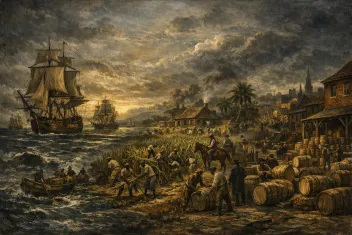 Part 2 · 1627 to 1833
The Atlantic Economy: Slavery, Sugar, and Empire
How sugar made tiny Caribbean islands Britain's most valuable colonies, and how the slave trade built British wealth on millions of enslaved Africans.
-
7
5 min
The Caribbean and the Sugar Revolution
Sugar made Caribbean islands like Barbados and Jamaica Britain's most valuable colonies, and the deadly work demanded a constant supply of enslaved Africans.
-
8
5 min
The Triangular Trade
For 167 years, British ships carried goods to West Africa, captive Africans to the Americas, and sugar and tobacco home. One in seven captives died at sea.
-
9
5 min
The Cities That Slavery Built
Liverpool, Bristol, and London grew rich on the slave trade. In 1833 Britain paid slaveholders 20 million pounds, borrowed money not fully repaid until 2015.
-
10
5 min
Abolition: Morality, Economics, and Power
Britain abolished the slave trade in 1807 and slavery in 1833. Moral conviction was real, but slave revolts and free-trade economics also drove it.
-
11
5 min
Abolition as Imperial Tool
After 1807, Britain used the Royal Navy to police the slave trade. Anti-slavery treaties gave Britain the right to board foreign ships at will.
 Part 3 · 1709 to 1851
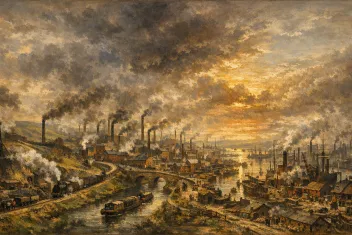
The Industrial Revolution
How coal, steam, and iron turned a small island into the workshop of the world and gave Britain the industrial base to build the largest empire in history.
-
12
5 min
Why Britain? The Conditions for Revolution
Around 1760, Britain began to industrialize, helped by cheap coal, colonial capital, and property rights. Within a century it made half the world's iron.
-
13
5 min
Coal, Steam, and Iron
Newcomen built a machine to pump water from coal mines in 1712. By 1850, Britain burned more coal than the rest of the world combined.
-
14
5 min
The Social Revolution: Cities, Classes, and Misery
Manchester grew fifteen-fold in under a century. Children as young as six worked 14-hour days. In Liverpool's working families, the average age at death was 15.
-
15
5 min
How Industry Remade Global Power
In 1750, India and China made half the world's manufactured goods. By 1900 their share was under 8%, as British goods and gunboats forced open Asian markets.
-
16
5 min
The Second Industrial Revolution and Relative Decline
Britain invented the Industrial Revolution, then watched Germany and America master the next one in steel, chemicals, and electricity.
 Part 4 · 1600 to 1815
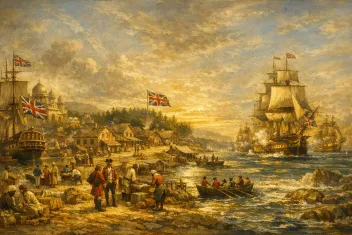
Building the Empire
How a joint-stock company conquered India, how American colonists fought for self-rule, and how naval supremacy after Trafalgar made Britain the global hegemon.
-
17
5 min
The East India Company: The Corporation That Conquered
Queen Elizabeth I chartered the East India Company in 1600. It went on to build a private army twice the size of Britain's and rule 200 million people.
-
18
5 min
The American Colonies: From Settlement to Tension
Three thousand miles of ocean and 150 years of self-governance turned American colonists into people who believed they had rights no king could take away.
-
19
5 min
The American Revolution: How Britain Lost America
The Continental Army lost most major battles, but distance, a French alliance, and a hostile population cost Britain its American colonies.
-
20
5 min
The Napoleonic Wars and Pax Britannica
Nelson destroyed the French and Spanish fleets at Trafalgar without losing a ship. Wellington beat Napoleon at Waterloo. Britain had a century of supremacy.
-
21
5 min
Rule Britannia: Naval Supremacy and the Balance of Power
The Royal Navy controlled five chokepoints: Gibraltar, Suez, the Cape, Singapore, the Channel. Any ship going anywhere passed through a British bottleneck.
-
22
5 min
The Victorian Zenith: Empire at Its Height
At Victoria's Diamond Jubilee in 1897, Britain governed a quarter of the world's land and people, the largest political entity since Rome.
 Part 5 · 1169 to 1998
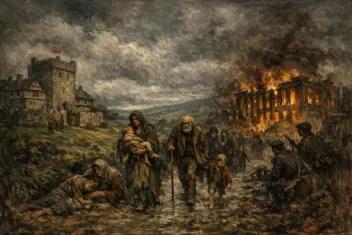
Ireland: Britain's First Colony
How England conquered and colonized Ireland, how British policy let a million Irish die in the Great Famine, and how partition led to the Troubles.
-
23
6 min
Conquest, Plantation, and the Protestant Ascendancy
Over five centuries, England confiscated Irish land and replaced Catholic owners with Protestant settlers. Catholic ownership collapsed from 59% to 5%.
-
24
5 min
The Great Famine
Between 1845 and 1852, about a million Irish people died of hunger and disease, while nearly 4,000 ships carried food from Ireland to Britain in 1847 alone.
-
25
5 min
Home Rule and the Easter Rising
About 1,600 rebels seized Dublin's General Post Office on Easter Monday 1916. The Rising failed, but 16 executions turned military defeat into a founding myth.
-
26
6 min
Partition and the Irish Free State
In 1921, Michael Collins signed a treaty creating the Irish Free State and letting Northern Ireland opt out. He was killed in the civil war that followed.
-
27
6 min
The Troubles and the Legacy
Roughly 3,500 people died in 30 years of conflict in Northern Ireland. The Good Friday Agreement stopped the killing but left the constitutional question open.
 Part 6 · 1600 to 1947
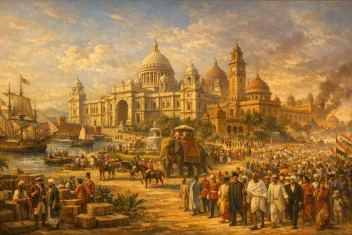
The Jewel in the Crown: India
How the East India Company absorbed India, how the Raj governed 300 million people, and how the drain of wealth reshaped India's economy for a century.
-
28
5 min
From Trading Posts to Conquest
Over 150 years the East India Company used war, subsidiary alliances, bribery, and the Doctrine of Lapse until it controlled 60% of India by 1857.
-
29
6 min
The Indian Rebellion of 1857 and the Birth of the Raj
In 1857, Indian soldiers rebelled against their British officers. Britain crushed the revolt brutally, dissolved the East India Company, and began the Raj.
-
30
6 min
The Raj Machine: How Britain Ruled 300 Million People
Roughly 1,000 British officials governed 300 million Indians. The Raj ran on Indian intermediaries, extraction railways, and a policy of divide and rule.
-
31
5 min
The Drain of Wealth: How Empire Reshaped India's Economy
India's share of world GDP fell from 24% in 1700 to 4% by 1950. The wealth flowed to Britain through taxation, trade manipulation, and the Home Charges.
-
32
6 min
Gandhi, Partition, and the Scars That Remain
Gandhi's mass civil disobedience helped end British rule in 1947, but partition killed between 1 and 2 million people and displaced 15 million.
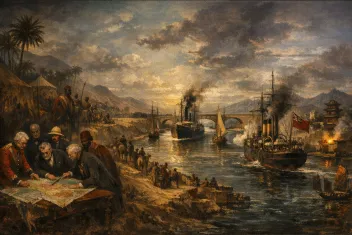 Part 7 · 1839 to 1914
The Scramble, China, and the Sun Never Sets
How Europe carved up Africa in a single generation, how Britain forced open China with opium, and how colonial resistance revealed the limits of imperial power.
-
33
5 min
The Scramble for Africa: Carving Up a Continent
Europeans controlled 10% of Africa in 1870 and 90% by 1914. The borders were drawn by men who had never set foot on the land they divided.
-
34
5 min
Southern Africa: Diamonds, Gold, and the Boer Wars
A diamond found in 1867 and gold in 1886 drew Cecil Rhodes and led to the Boer War, where Britain needed 450,000 troops and built its first concentration camps.
-
35
5 min
Egypt and the Suez Canal: The Lifeline of Empire
France built the Suez Canal and Disraeli bought Egypt's shares in 1875. In 1956, Nasser nationalized it, Britain invaded, and America forced a retreat.
-
36
5 min
The Opium Wars: Forcing Open China
China wanted nothing Britain made, so British merchants smuggled in opium from India. When China tried to stop the drug trade, Britain went to war twice.
-
37
5 min
Hong Kong and the Century of Humiliation
China ceded Hong Kong to Britain in 1842 after an opium war and regained it in 1997. The Century of Humiliation still drives Chinese foreign policy today.
-
38
6 min
The Colonial Machine: How Imperial Rule Actually Worked
A small number of British officials governed a quarter of the world through local intermediaries, colonial law, and armies the colonies paid for themselves.
-
39
5 min
Resistance and Rebellion Across the Empire
Zulu warriors destroyed a British army at Isandlwana. Afghan tribesmen destroyed another in mountain passes. No colony accepted British rule quietly.
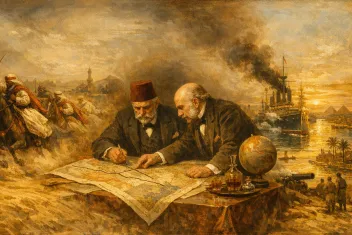 Part 8 · 1830 to 1948
A Line in the Sand: Reshaping the Middle East
How Britain competed with Russia for Central Asia, made three contradictory promises during the Ottoman collapse, and drew Middle East borders people still fight over.
-
40
6 min
The Great Game: Britain vs. Russia
Britain and Russia competed for Central Asia without ever fighting each other. Britain invaded Afghanistan to guard India but could not hold it.
-
41
4 min
The Ottoman Collapse and British Opportunity
In World War I, Britain promised Arab independence, a carve-up with France, and a Jewish homeland in Palestine. The three promises could not all be kept.
-
42
5 min
Sykes-Picot: The Map That Changed Everything
In 1916, Britain's Mark Sykes and France's Francois Georges-Picot drew lines that shaped Iraq, Syria, and Jordan. In 2014, ISIS bulldozed the Iraq-Syria border.
-
43
6 min
The Mandate System: Iraq, Palestine, and Transjordan
Britain took Iraq and Palestine as mandates. The King-Crane Commission found locals opposed British and French rule, and its report was suppressed.
-
44
6 min
Broken Promises: Arabs, Zionists, and the Palestine Question
Britain pledged a Jewish homeland in a territory that was over 90% Arab. Thirty years later, Britain left without resolving the contradiction.
-
45
6 min
The Legacy: Why the Middle East Looks the Way It Does
The borders Britain and France drew after 1918 were arbitrary, yet they outlasted both empires and Arab attempts in the 1950s and 1960s to erase them.
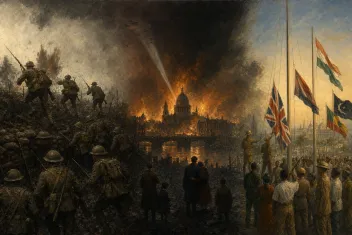 Part 9 · 1914 to 1997
World Wars and Imperial Sunset
How two world wars bankrupted Britain, and how the British Empire dissolved between Indian independence in 1947 and the Hong Kong handover in 1997.
-
46
5 min
Britain and WWI: The War That Broke the Old Order
World War I cost nearly 900,000 British Empire lives, drew in 1.3 million Indian soldiers, and turned Britain from the world's largest creditor into a debtor.
-
47
6 min
Gallipoli, the Somme, and the Price of Empire
On July 1, 1916, the first day of the Somme, 19,240 British soldiers were killed. For three years, industrial weapons made defense cheaper than attack.
-
48
6 min
Between the Wars: A Crumbling Edifice
In 1921 the British Empire reached its greatest size, a quarter of the world's land and some 458 million people, just as Britain could no longer afford it.
-
49
6 min
Britain’s Finest Hour: WWII and the Last Stand
Britain won World War II by borrowing from the United States and its own colonies and by raising millions of colonial troops. The debts helped end the empire.
-
50
4 min
The Wind of Change: Decolonization
It took 350 years to build the British Empire and 50 to dismantle it. Between 1947 and 1997, the largest empire in history dissolved.
-
51
5 min
The Legacy of the British Empire
The British Empire left behind English, now spoken by 1.5 billion people, and common law, but also arbitrary borders and a North-South wealth gap.
Lessons you can finish in one sitting.
Each lesson tells one part of the story and explains why it happened, with maps, images and quotes from the sources. A few questions at the end check that it stuck, and the key facts go into the course's flashcards.
- 4 to 6 minutes a lesson
- Two to four questions after each lesson
- 375 flashcards for this course