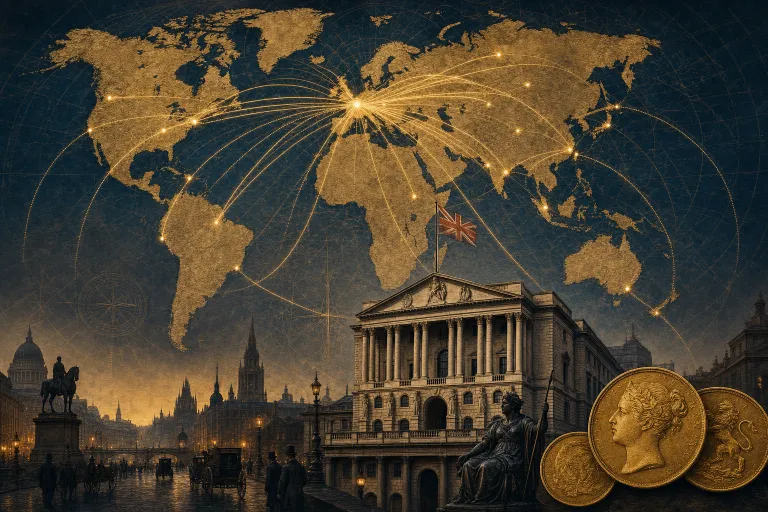
The United States: Colonies to Superpower
Thirteen quarrelsome colonies on the Atlantic seaboard became a republic that fought a civil war over slavery, industrialized faster than any nation in history, helped win two world wars, and was left the world's only superpower when the Soviet Union collapsed in 1991.
1607 to 1991 · 7 parts · 35 lessons · about 5 hours
Free for 7 days, cancel anytime. iPhone and Android.
Questions this course answers
- How did the American colonies learn to govern themselves?
- How did the colonies win a war against the British Empire?
- Why did Thomas Jefferson buy Louisiana when he doubted the Constitution allowed it?
- Why were enslaved people worth more than every factory in America by 1860?
- How did the United States become an empire in 1898?
- Why did the Soviet Union collapse and leave America as the sole superpower?
Seven parts, 35 lessons
 Part 1 · 1607 to 1763
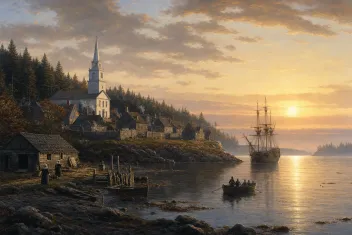
The Improbable Colonies
Three different colonial societies formed along the Atlantic seaboard, governing themselves for a century while Britain barely paid attention.
-
1
7 min
A Mosaic, Not a Nation
By 1700, three different Americas lined the coast: Puritan New England, the slave-and-tobacco Chesapeake, and a polyglot trading zone in between.
-
2
9 min
The Atlantic Engine
Northern merchants insured slave voyages and distilled the rum that bought captives. The entire Atlantic economy ran on sugar and enslaved labor.
-
3
10 min
Salutary Neglect
For over a century, Britain ruled its colonies loosely. Americans became among the most self-governing people on earth and saw self-rule as a birthright.
-
4
11 min
The War That Made the Revolution
Britain drove France out of North America but nearly went bankrupt doing it. The debt, new taxes, and a ban on settling western land led to the Revolution.
 Part 2 · 1763 to 1791
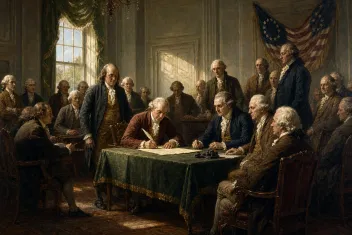
Inventing a Republic
A tax dispute became a revolution. The colonies won by surviving until France tipped the war, then built a constitution from bitter compromise.
-
5
10 min
No Taxation Without Representation
The American Revolution began as an argument: could Britain's Parliament, three thousand miles away, tax colonists who had no vote in it?
-
6
9 min
The Most Dangerous Idea
In 1776 Thomas Jefferson wrote that all men are created equal. The Declaration was a bid for French help and a claim later turned against its own authors.
-
7
11 min
How the Colonies Won
At Yorktown, about half the allied troops were French and a French fleet sealed the trap. The Revolution was won as much in Paris as at Valley Forge.
-
8
10 min
The Failed First Try
Americans built a government too weak to function. Within years the country was bankrupt, its money worthless, and armed farmers marched on a federal arsenal.
-
9
7 min
Designing a Power Machine
In 1787, delegates told to fix the Articles of Confederation wrote a new Constitution designed to check power. Some of its bargains protected slavery.
-
10
7 min
Federalists vs Anti-Federalists
The Constitution barely passed: Massachusetts voted 187 to 168 and New York 30 to 27. Anti-Federalist demands led to the Bill of Rights.
 Part 3 · 1789 to 1850
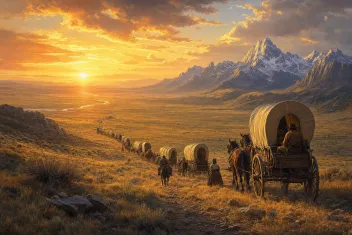
Manifest Destiny
In sixty years the republic expanded from the Atlantic to the Pacific: Louisiana, Texas, California. The conquered land forced the question: slave or free?
-
11
8 min
Hamilton's Republic
Alexander Hamilton built the financial machinery that made the republic solvent. The feud between Hamilton and Jefferson produced the first political parties.
-
12
7 min
Doubling the Country
In 1803 Thomas Jefferson bought Louisiana and doubled the country for about four cents an acre, though he was almost sure the Constitution did not allow it.
-
13
8 min
The Monroe Doctrine
In 1823 the United States, with almost no navy, told the empires of Europe to stay out of the Americas. The British fleet quietly backed the bluff.
-
14
9 min
The Trail of Tears
The United States took land from Native nations by treaty, by fraud, and finally by force, and President Andrew Jackson defied the Supreme Court to do it.
-
15
8 min
The Mexican War
In three years the United States tore away half of Mexico. The conquered land forced the one question the country could not answer: slave or free.
 Part 4 · 1850 to 1877
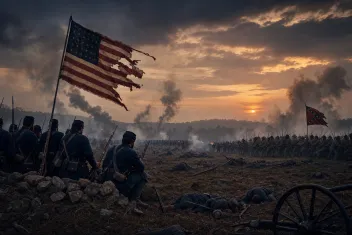
A Nation Forged in War
The Civil War killed 750,000 Americans and remade the Constitution. Reconstruction built a multiracial democracy that was abandoned for a century.
-
16
9 min
King Cotton
By 1860 the roughly four million enslaved people were worth more than every railroad, factory, and bank combined, and the South would fight to keep them.
-
17
7 min
Secession
Abraham Lincoln won the presidency without appearing on the ballot in ten Southern states. Within months, seven states walked out to save slavery.
-
18
9 min
Why the North Won
The Union had four times the free population, almost all the manufacturing, and most of the railroads. Winning still took four years and about 750,000 deaths.
-
19
9 min
The Second Founding
From 1865 to 1870, three amendments ended slavery and promised citizenship, equal protection, and the vote. Serious enforcement came nearly a century later.
-
20
8 min
Reconstruction Betrayed
For one decade, Black men voted, held office, and built schools under federal protection. Then the troops went home and white supremacy locked back into place.
 Part 5 · 1865 to 1914
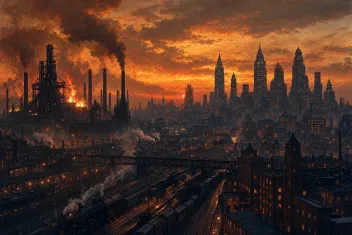
The Industrial Colossus
The United States industrialized faster than any nation in history, passed Britain as the world's largest economy around 1890, and in 1898 took an overseas empire.
-
21
7 min
The Gilded Age
Around 1890 the United States passed Britain as the world's largest economy. Andrew Carnegie and John D. Rockefeller built vast fortunes amid deep inequality.
-
22
8 min
A Nation of Immigrants
Between 1880 and 1924, roughly 25 million immigrants arrived, the largest migration the world had seen. Immigrant labor was the engine of American industry.
-
23
9 min
The Progressive Revolt
Populists and Progressives invented the regulatory state: the FDA, the income tax, antitrust. They chose reform over revolution to tame industrial inequality.
-
24
9 min
1898: America Becomes an Empire
In 1898 the United States beat Spain in ten weeks and took Cuba, Puerto Rico, Guam, and the Philippines, then fought a far bloodier war in the Philippines.
 Part 6 · 1914 to 1945
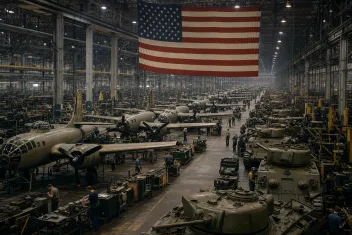
Onto the World Stage
Two world wars made America the indispensable power. Between them, depression and the New Deal built the modern American state.
-
25
8 min
The Reluctant Arbiter
American loans and munitions kept the Allies fighting before US troops arrived. Woodrow Wilson designed the League of Nations, but the Senate rejected it.
-
26
9 min
The Retreat from the World
The United States rejected the League of Nations, raised tariffs, and boomed on credit. In 1929 its economy collapsed and dragged the world down.
-
27
10 min
The New Deal
Franklin Roosevelt's New Deal did not end the Depression, but it built the modern American state, including bank deposit insurance and Social Security.
-
28
8 min
The Arsenal of Democracy
The United States out-produced the entire Axis in tanks, planes, and ships, and emerged in 1945 with roughly half the world's manufacturing output.
-
29
8 min
Designing the Postwar World
At Bretton Woods the dollar became the world's money, and at San Francisco the United Nations was born. Unlike 1919, America would not retreat.
 Part 7 · 1945 to 1991
The American Century
Containment, NATO, the dollar, and a web of bases made the United States the leader of a global order. In 1991 the Soviet Union collapsed.
-
30
8 min
Containment
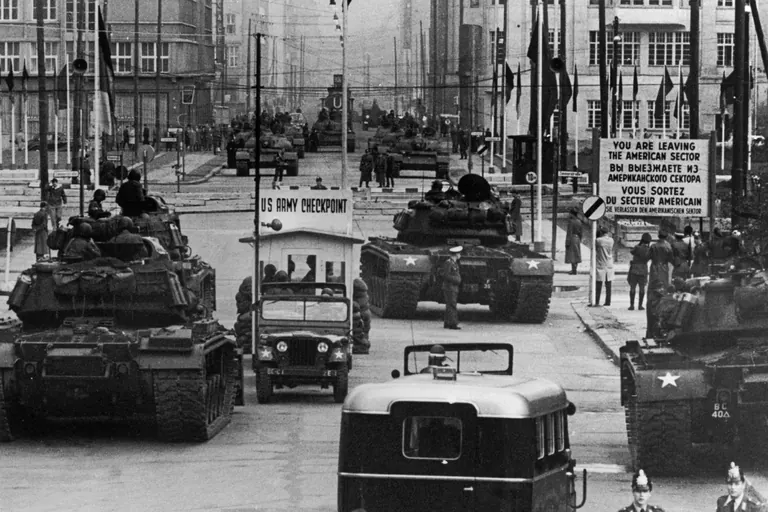
In 1947 the United States chose to contain the Soviet Union. Within two years it launched the Truman Doctrine, the Marshall Plan, and NATO.
-
31
7 min
How American Hegemony Works
The United States leads a system built on the dollar, alliances, bases worldwide, and cultural pull. Other countries largely chose to join because it paid.
-
32
8 min
The Contradiction at Home
While claiming to lead the free world, America denied freedom to millions at home. The civil rights movement turned that Cold War contradiction into pressure.
-
33
10 min
Vietnam and the Limits of Power
In Vietnam a peasant army fought the US military to a standstill. The United States had mistaken a war for national independence for a war about communism.
-
34
10 min
The Unipolar Moment
In 1991 the Soviet Union dissolved, leaving the United States the sole superpower. Francis Fukuyama wrote of the end of history.
-
35
10 min
The Water We Swim In
The dollar, the internet, NATO, and the rules-based order are all American-built. Whether the American Century is ending is being decided now.
Lessons you can finish in one sitting.
Each lesson tells one part of the story and explains why it happened, with maps, images and quotes from the sources. A few questions at the end check that it stuck, and the key facts go into the course's flashcards.
- 7 to 11 minutes a lesson
- Three to four questions after each lesson
- 247 flashcards for this course