China: The Fall of the Middle Kingdom
For centuries China was the richest civilization on Earth. Then it was forced open by opium and foreign guns, torn apart by rebellion and civil war, and remade under Mao Zedong at a cost of tens of millions of lives.
1368 to 1976 · 4 parts · 29 lessons · about 3 hours
Free for 7 days, cancel anytime. iPhone and Android.
Questions this course answers
- Why did China always reunify after collapse while Europe never did?
- How did Britain use opium to force open the world's largest economy?
- Why did losing to Japan in 1895 hurt Chinese morale more than the Opium Wars?
- What really happened on the Long March, and what role did Mao Zedong play?
- Why did Mao's Communists defeat the Nationalists against every expectation?
- How did the Great Leap Forward cause the deadliest famine in history?
Four parts, 29 lessons
 Part 1 · 1368 to 1799
The Height and the System
For most of history China was the richest and most advanced civilization on Earth, with gunpowder, printing, and the compass centuries before Europe.
-
1
7 min
Why China Always Came Back
Rome fell once and Europe never reunified. China collapsed at least three times and reassembled every time. That reflex still drives Beijing's claim to Taiwan.
-
2
6 min
The Most Advanced Civilization on Earth
Around 1100 the largest city on Earth was Chinese, with paper money, printed books, and well over a million people, while London had perhaps 15,000 people.
-
3
6 min
The Road Not Taken
In 1405, almost a century before Columbus, China sent over 300 ships into the Indian Ocean. Later voyages reached Africa, then China let the navy rot.
-
4
6 min
Outsiders on the Throne
The Qing dynasty ruled China for 268 years, and the Qing were not Chinese. A few million Manchus from beyond the Great Wall governed over a hundred million Han.
-
5
6 min
Ruling All Under Heaven
For thirteen centuries officials chosen by grueling exams ran the world's most sophisticated bureaucracy, certain that China had nothing to learn from anyone.
 Part 2 · 1793 to 1911
The Century of Humiliation
Opium, the bloodiest civil war in history, defeat by Japan, and foreign concessions stripped away much of China's sovereignty. In 1911 its 2,000-year-old throne fell.
-
6
6 min
The Kowtow
In 1793 Britain sent its grandest embassy to China. The Qianlong Emperor declined every request and told King George III that China needed nothing.
-
7
7 min
The Opium Wars
To fix its trade deficit, Britain got China addicted to opium. When China destroyed the drug, Britain went to war, twice, and won with humiliating ease.
-
8
7 min
The Taiping Catastrophe
Hong Xiuquan, a failed exam candidate who believed he was the younger brother of Jesus, started the Taiping Rebellion. It killed more people than World War I.
-
9
7 min
Buying Guns, Keeping the System
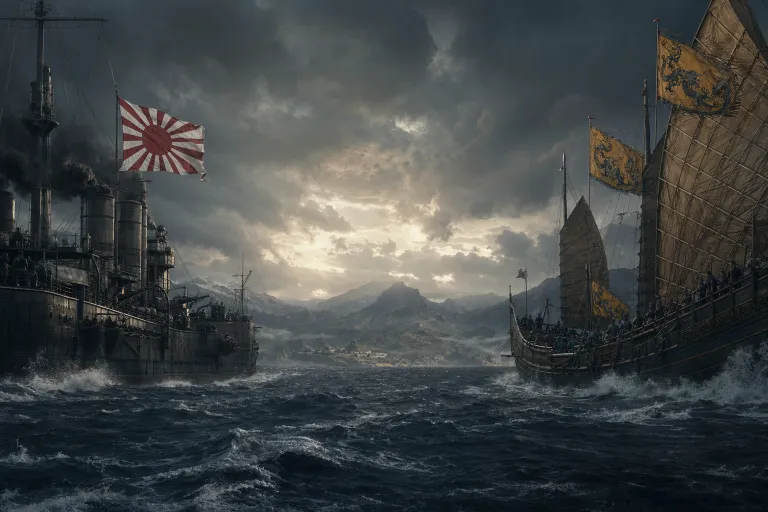
For thirty years China bought Western guns while keeping the old system intact. Then Japan, long dismissed as a lesser neighbor, sank China's navy in 1895.
-
10
6 min
Carving the Melon
After Japan's victory in 1895, Germany, Russia, France, Britain, and Japan carved China into spheres of influence. The Chinese called it slicing the melon.
-
11
6 min
The Boxer Uprising
In 1900 peasants convinced that ritual magic made them bulletproof tried to drive every foreigner out of China. An eight-nation army marched into Beijing.
-
12
6 min
The 1911 Revolution
An accidental bomb blast in a revolutionaries' hideout set off a mutiny that ended the Chinese monarchy, an institution unbroken since 221 BC.
-
13
6 min
The Wound That Made Modern China
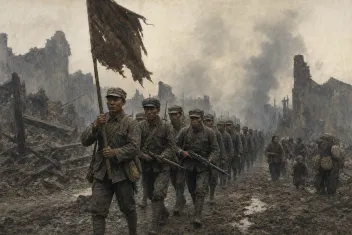
Chinese schools teach the Century of Humiliation, a framing invented by nationalists in the 1910s and 1920s and revived by the Communist Party after 1989.
 Part 3 · 1912 to 1949
Revolution and War
The emperor was gone, but warlords tore China apart. The Nationalists and the Communists fought Japan and each other until Mao won in 1949.
-
14
6 min
Sun Yat-sen
Sun Yat-sen failed at almost everything and was in Denver when the 1911 uprising broke out. Both Beijing and Taipei still claim him as a founding father.
-
15
6 min
The Three Principles of the People
Sun Yat-sen distilled the revolution into three words: nationalism, democracy, livelihood. Taiwan made them its anthem. The Communist Party claims them too.
-
16
6 min
The Republic That Wasn't
China's first republic worked for about a year. Its president, Yuan Shikai, had rivals killed, dissolved parliament, and declared himself emperor.
-
17
7 min
The Warlord Era
From 1916 to 1928 China had no functioning central government, only generals. Rival warlords carved the country into armed fiefs and fought constantly.
-
18
6 min
May Fourth
In 1919 the victors of World War I gave German-held Shandong to Japan. The student protests that followed helped give rise to the Chinese Communist Party.
-
19
6 min
Nationalists and Communists
The Nationalists and Communists started as allies. In 1927 Chiang Kai-shek turned on the Communists in Shanghai, opening a civil war that lasted 22 years.
-
20
6 min
The Long March
In 1934 some 86,000 Communists fled their southern base. A year and 6,000 miles later, about 8,000 reached safety, and Mao Zedong had won military command.
-
21
6 min
The War of Resistance
Japan invaded in 1937, and perhaps fifteen million Chinese died. The war drained the Nationalists while the Communists grew thirtyfold behind Japanese lines.
-
22
6 min
Why Mao Won
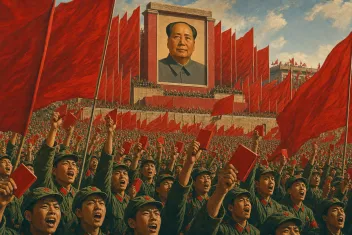
In 1945 the Nationalists had three times the troops, all the cities, and American backing. By 1949 their armies had dissolved and Mao stood atop Tiananmen.
 Part 4 · 1949 to 1976
Mao's China
From 1949 to 1976 Mao Zedong led China through land reform, the Korean War, the Great Leap famine, the Cultural Revolution, and an opening to the United States.
-
23
6 min
Mao
Mao unified China and restored its pride, then drove the country into history's worst famine and a decade of chaos. Mao's portrait still hangs over Tiananmen.
-
24
6 min
China Stands Up
The early People's Republic tamed hyperinflation and gave land to 300 million peasants. For the first time in a century, China had a government that governed.
-
25
6 min
The Korean War
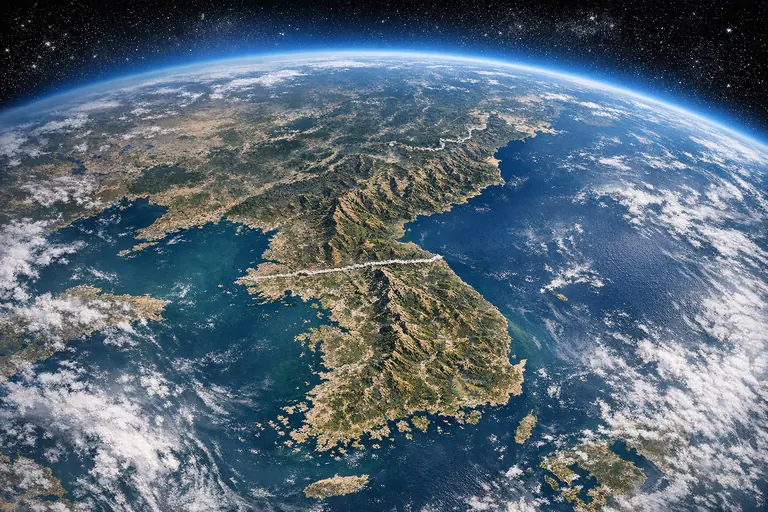
A year after the civil war, China fought the United States to a standstill in Korea. Perhaps hundreds of thousands of Chinese died, including Mao's son.
-
26
6 min
The Great Leap Forward
Mao herded 500 million peasants into communes and ordered harvests that existed only on paper. Between fifteen and forty-five million people starved to death.
-
27
6 min
The Cultural Revolution
In 1966 Mao Zedong set the Red Guards against the Communist Party to purge his rivals. For a decade students beat teachers and children denounced parents.
-
28
6 min
The Split and the Opening
China and the Soviet Union went from allies to border war by 1969. Cornered, Mao reached out to the United States, and in 1972 Nixon flew to Beijing.
-
29
6 min
The Death of Mao
Mao died in 1976. Within a month Mao's radical allies were arrested, and within two years Deng Xiaoping had begun dismantling almost everything Mao stood for.
Lessons you can finish in one sitting.
Each lesson tells one part of the story and explains why it happened, with maps, images and quotes from the sources. A few questions at the end check that it stuck, and the key facts go into the course's flashcards.
- 6 to 7 minutes a lesson
- Four questions after each lesson
- 203 flashcards for this course