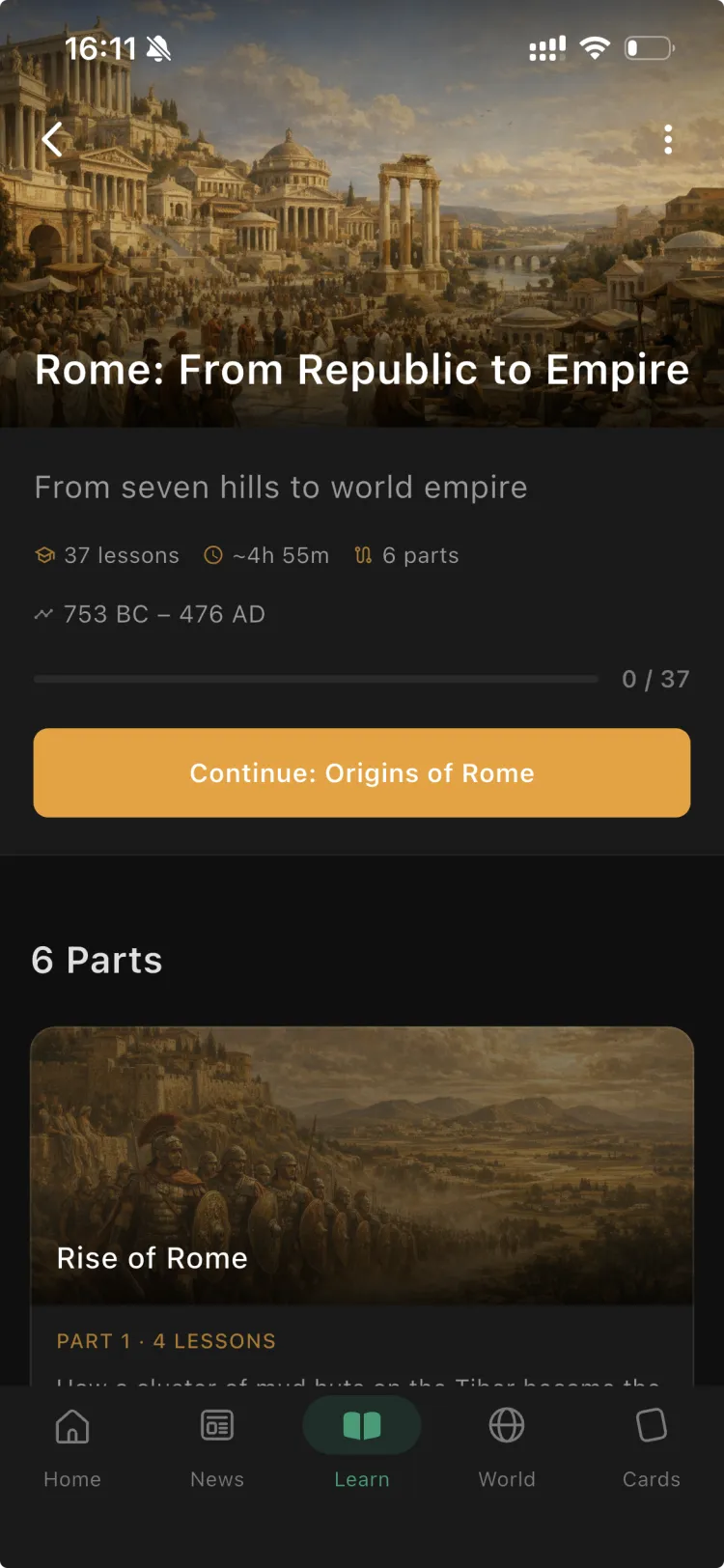
Rome: From Republic to Empire
How a village of mud huts on the Tiber came to rule the Mediterranean, why its Republic destroyed itself at the height of its power, and how the empire that replaced it held on in the West for five more centuries.
753 BC to 476 AD · 6 parts · 37 lessons · about 5 hours
Free for 7 days, cancel anytime. iPhone and Android.
Questions this course answers
- Why did a village on the Tiber, and not one of its richer neighbors, end up ruling Italy?
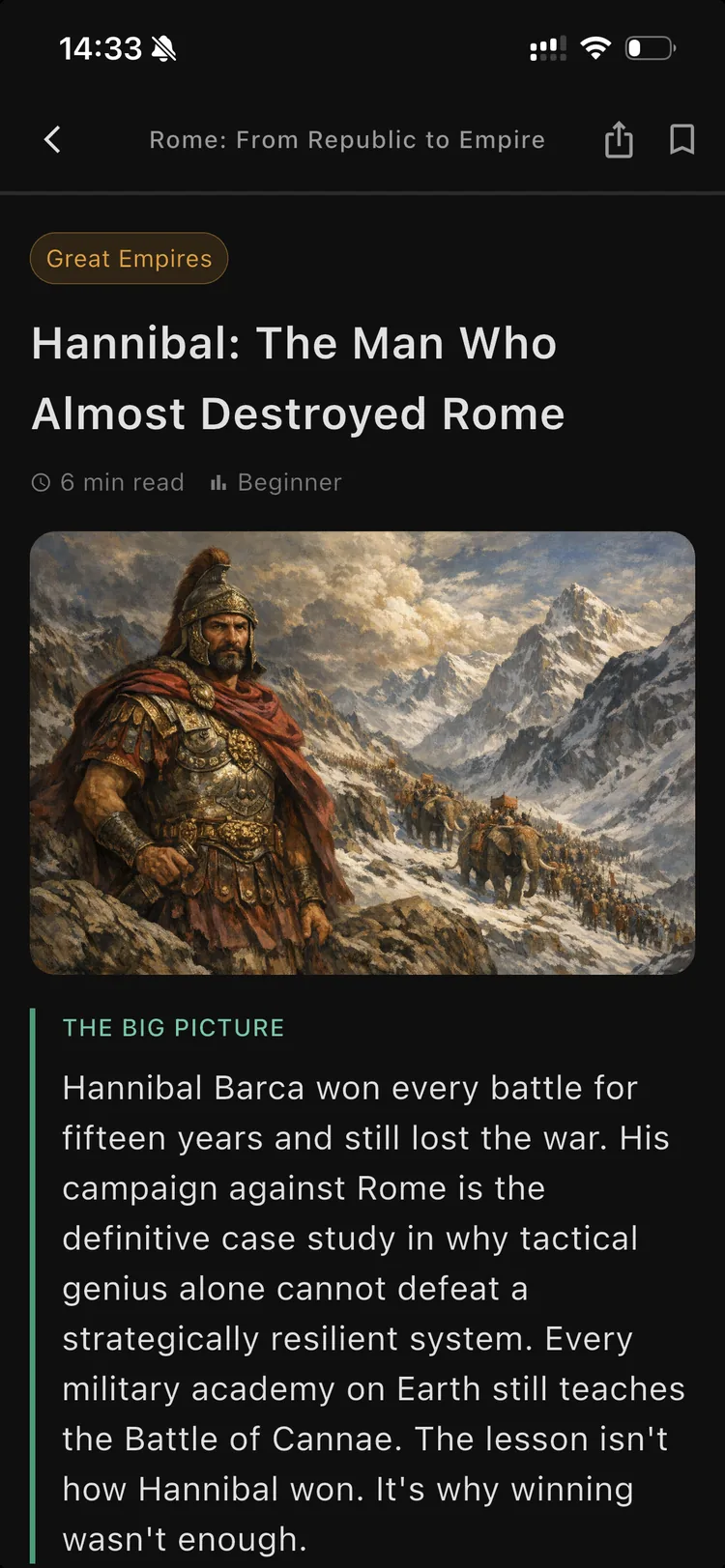
- How did Hannibal win every battle for fifteen years and still lose the war?
- Why did Rome's greatest victories destroy the Republic?
- How did Augustus make himself emperor while claiming to restore the Republic?
- How did a few thousand officials govern 60 million people?
- Why did the West fall in 476 AD while the East lasted another thousand years?
Six parts, 37 lessons
 Part 1 · 753 to 264 BC
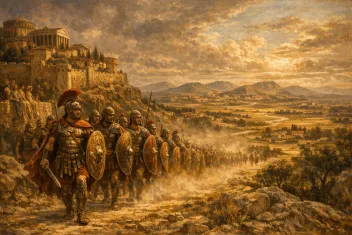
Rise of Rome
How a cluster of mud huts on the Tiber became the master of Italy: the geography, the system, and the secret weapon of absorption.
-
1
4 min
Origins of Rome
Why this village on a hill above the Tiber, and not one of its richer neighbors, went on to rule the Mediterranean.
-
2
5 min
Rome's Conquest of Italy
Most empires conquer and enslave. Rome conquered and recruited, with a deal so good that fighting it stopped making sense.
-
3
5 min
The Roman System
The real achievement was a machine: a constitution built to stop tyranny, an army of citizen farmers, and the roads that held it together.
-
4
7 min
The Struggle of the Orders
Two centuries of cold war between Rome's poor and its elite, and the compromises that made the Republic so hard to break.
 Part 2 · 264 to 146 BC
The Punic Wars
Rome against Carthage: three wars, a century of blood, and the making of a Mediterranean superpower.
-
5
6 min
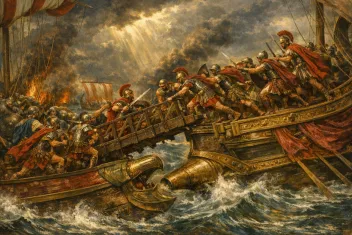
The First Punic War
In 264 BC Rome had no navy. By 241 BC it had beaten the greatest naval power in the Mediterranean, after losing 700 ships.
-
6
6 min
Hannibal: The Man Who Almost Destroyed Rome
Hannibal won every battle for fifteen years and still lost the war. Why tactical genius could not break a resilient system.
-
7
6 min
Scipio and Rome's Revenge
After Cannae, Rome learned. A 25-year-old studied Hannibal's playbook, took the war to Africa and beat him at Zama.
-
8
5 min
The Destruction of Carthage
In 146 BC Rome did not conquer Carthage. It erased it, although the city no longer posed a threat.
-
9
6 min
Rome as Mediterranean Master
Between 200 and 133 BC Rome beat every major power around the Mediterranean, and the wealth it won began to destroy the Republic.
 Part 3 · 133 to 27 BC
Fall of the Republic
A century of revolution and civil war. From the Gracchi to Augustus, the Republic destroys itself with the wealth and armies its conquests created.
-
10
6 min
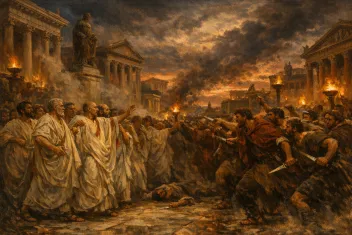
The Gracchi Brothers
In 133 BC two brothers tried to fix the Republic, and the Senate beat them to death.
-
11
7 min
Marius and the Military Revolution
A general from nowhere opened the legions to the landless poor and made Roman armies loyal to their commanders.
-
12
7 min
Sulla: The First March on Rome
The first general in five centuries to turn the legions on Rome itself, and then, to everyone's surprise, to retire.
-
13
8 min
Pompey, Crassus, and the Broken System
Two overmighty generals and a paralyzed Senate made every reform impossible and every private deal necessary.
-
14
7 min
Cicero: The Voice of a Dying Republic
The greatest orator of the Republic tried to save it with words and laws, and was murdered for it.
-
15
9 min
Caesar: The Conquest of Gaul
Ten years in Gaul gave Caesar eleven loyal legions, a masterpiece of propaganda and a death toll approaching a million.
-
16
7 min
Caesar: The Rubicon and the Dictatorship
Caesar crossed a small river with one legion, won every war that followed, and kept the Republic's institutions while draining them of meaning.
-
17
9 min
The Ides of March and the War That Followed
About sixty senators stabbed Caesar, believing his death would restore the Republic. It did not.
-
18
7 min
Why the Republic Fell
Nobody murdered the Republic. It killed itself over a hundred years, one justified violation at a time.
 Part 4 · 44 BC to 14 AD
Augustus and the Birth of Empire
The man who ended the Republic by pretending to restore it, and the template of autocracy dressed up as constitutional government.
-
19
7 min
The Last Civil War
Actium, an Egyptian queen fleeing mid-battle, and how Octavian destroyed the last armed opposition in the Roman world.
-
20
8 min
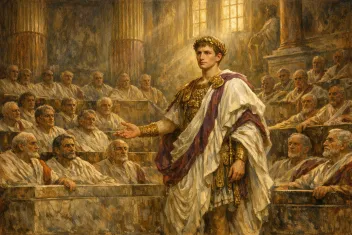
The Augustan Settlement
In 27 BC Octavian gave up absolute power so that the Senate would beg him to keep it.
-
21
8 min
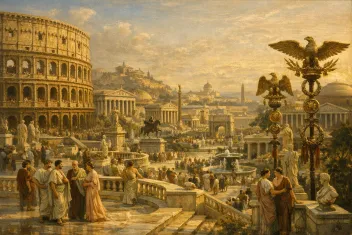
The Golden Age
Two centuries of peace, Virgil's Aeneid and a city rebuilt in marble, and the political freedom Romans traded for them.
-
22
8 min
The Legacy of Augustus
He invented the most durable political template in history and could not solve the one problem that mattered: who comes next.
 Part 5 · 14 to 180 AD
The Empire at Its Height
From Tiberius to Marcus Aurelius: emperors good and catastrophic, civil wars survived, and the empire at its greatest extent.
-
23
9 min
The Julio-Claudians
A paranoid recluse, a possible madman, an underestimated administrator and an artist who burned Rome. The system survived all four.
-
24
9 min
The Year of Four Emperors
In 69 AD four men wore the purple, and the army learned that an emperor could be made anywhere.
-
25
9 min
The Five Good Emperors
Eighty-four years of emperors chosen for merit rather than birth, and the luck that made it possible.
-
26
9 min
How the Empire Actually Worked
A few thousand officials governed 60 to 70 million people. The secret was delegation.
-
27
9 min
The Roman Military Machine
Thirty legions and their auxiliaries held ten thousand kilometers of frontier. How the ancient world's most effective army was built.
-
28
9 min
Roman Society and Culture
Aqueducts, roads, Roman law, slavery and the games: daily life in a state of seventy million people.
 Part 6 · 180 to 476 AD
Crisis, Christianity, and the Fall
The long decline: the Crisis of the Third Century, the rise of Christianity and the slow end of Roman power in the West.
-
29
9 min
Commodus and the End of the Golden Age
The wisest Stoic of his age handed the empire to his eighteen-year-old son, the worst decision of his life.
-
30
11 min
The Severan Dynasty and the Militarization of Power
In 193 AD the Praetorian Guard auctioned the empire to the highest bidder. From then on, the emperor ruled because the army let him.
-
31
9 min
The Crisis of the Third Century
At least twenty-six emperors in fifty years, most of them killed by their own soldiers, and one captured alive by Persia.
-
32
10 min
Diocletian's Revolution
A former slave's son took apart Augustus's system and built a four-emperor state with open autocracy and price controls.
-
33
10 min
Constantine and the Christian Empire
In a single generation, Christianity went from a persecuted sect to the emperor's own religion.
-
34
11 min
Christianity and Rome
Christianity became Roman as thoroughly as Rome became Christian, and the Church inherited what the empire left behind.
-
35
11 min
The Barbarian Migrations
The Goths, Vandals and Franks were not outsiders. Many had served in Rome's armies for generations and spoke Latin.
-
36
11 min
The Fall of the Western Empire
The Western Empire did not fall with a bang. It faded through a series of handovers that each seemed manageable at the time.
-
37
11 min
Why Rome Fell and Why It Still Matters
Every generation finds its own Rome in the ruins. What the fall teaches, and what a thousand years of survival teaches.
Lessons you can finish in one sitting.
Each lesson tells one part of the story and explains why it happened, with maps, images and quotes from the sources. A few questions at the end check that it stuck, and the key facts go into the course's flashcards.
- 4 to 11 minutes a lesson
- Two questions after each lesson
- 234 flashcards for this course