
Plato
Plato was an Athenian philosopher who founded the Academy and wrote The Republic, arguing that states should be ruled by philosopher-kings.
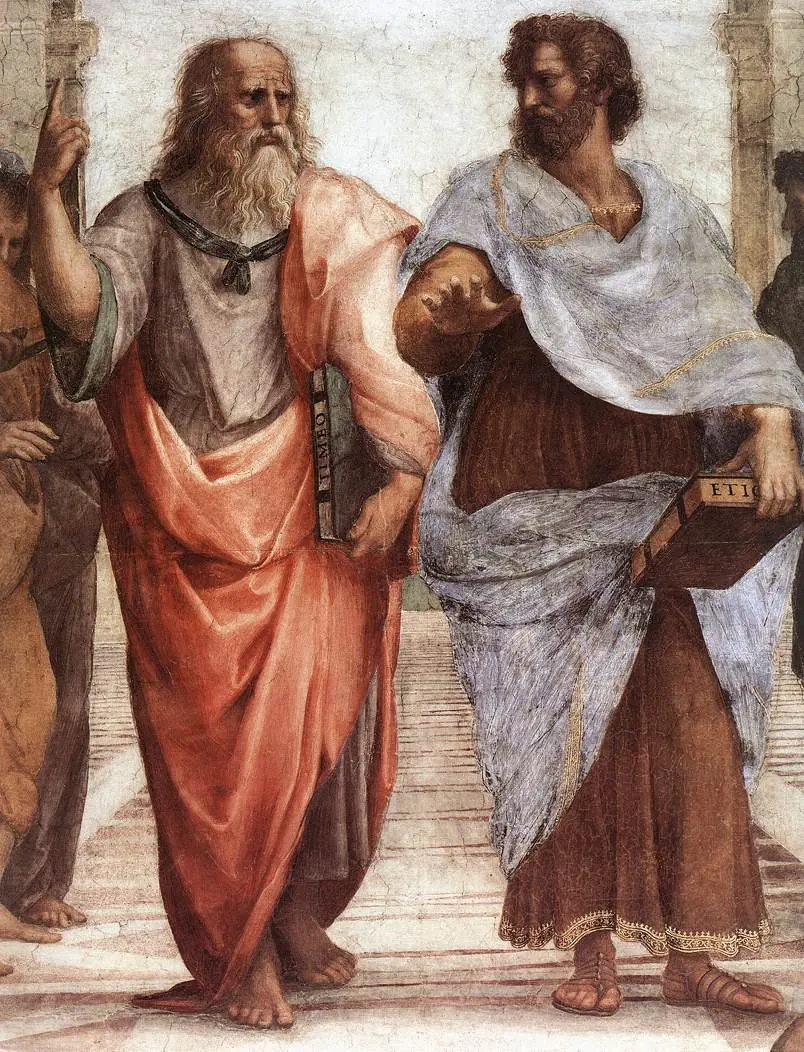
Plato was an Athenian philosopher who lived from around 428 to 348 BC. He was a student of Socrates and the teacher of Aristotle, placing him at the center of the three thinkers who shaped Western philosophy. Around 387 BC he founded a school called the Academy in a grove outside Athens, which operated in some form for more than 900 years and gave the word "academic" to every language that borrowed it. His best-known work, The Republic, argues that only trained philosophers should govern. In 1929, the philosopher Alfred North Whitehead wrote that the entire European philosophical tradition "consists of a series of footnotes to Plato."
Plato's early life and the Academy
Plato was born into one of Athens' most connected families. Through his mother, Perictione, he was related to Solon, the lawgiver who had laid the foundations of Athenian democracy more than a century and a half earlier. A relative on his mother's side, Critias, became one of the Thirty Tyrants, the oligarchic junta that ruled Athens briefly after Sparta defeated it in the Peloponnesian War in 404 BC. According to the biographer Diogenes Laertius, writing centuries later, Plato's birth name was Aristocles. "Plato" was a nickname given by his wrestling coach, meaning "broad," probably a reference to his build.
As a young man Plato studied under Socrates, who questioned everything and wrote nothing down. In 399 BC, Athens put Socrates on trial for corrupting the youth and introducing new gods. A jury of about 500 citizens convicted him and sentenced him to death by drinking hemlock. Plato was around 29 years old.
The execution convinced Plato that Athenian democracy was dangerously flawed. A government that killed its wisest citizen by majority vote, he believed, proved that popular opinion was not fit to rule. From that point on, his work turned to a single question: how to organize a state so that knowledge, not popular opinion, held power. Around 387 BC he founded the Academy in Athens. Aristotle arrived there at the age of 17 and stayed for twenty years, until Plato's death.
Plato also tried to put his ideas into practice. He visited the Greek city of Syracuse in Sicily at least three times, hoping to advise its rulers. According to ancient accounts, the first visit ended with the tyrant Dionysius I handing Plato over to a Spartan envoy who sold him into slavery on the island of Aegina. A man named Anniceris of Cyrene paid to free him. Plato returned twice more at the invitation of Dionysius II, but court politics defeated him each time.
What Plato argued in The Republic
The Republic is a long dialogue in which Socrates and several companions discuss what justice is and what a just city would look like. Plato's answer starts with a theory about knowledge itself, now known as the theory of Forms.
Plato argued that the physical things we see, chairs, circles, acts of justice, are flawed reflections of perfect, changeless originals he called Forms. The Forms cannot be seen or touched. They can be known only through disciplined reasoning. He illustrated the idea with the Allegory of the Cave. Ordinary people are like prisoners chained underground who see only shadows on a wall and take them for real objects. One prisoner is freed, climbs out into daylight, and for the first time understands things as they actually are. That prisoner stands for the philosopher.
Plato applied this theory to politics. If most people confuse shadows with the real thing, they cannot be trusted to govern. Plato compared the state to a ship: you would not hand the helm to sailors who knew nothing about navigation. A properly run city, he argued, should be led by philosopher-kings, rulers chosen in youth and educated for decades in mathematics and dialectic before taking power. These rulers would own no private property and keep no families of their own. Below them would stand a class of guardian soldiers, and below the guardians, the producers: farmers, craftsmen, and traders.
Was Plato against democracy?
Plato distrusted Athenian democracy, and he said so plainly. He had watched it execute Socrates, the person he considered the wisest man in Athens, by majority vote. In The Republic he ranked democracy as the second-worst form of government, better only than tyranny. He believed democracy let ignorance and appetite drive decisions that required knowledge, and that it would eventually collapse into tyranny when a clever demagogue exploited the disorder.
In 1945, as the Second World War ended, the philosopher Karl Popper published The Open Society and Its Enemies, whose first volume attacks The Republic. With the examples of Nazi Germany and the Soviet Union still fresh, Popper called it an early blueprint for totalitarianism. He pointed to its rigid caste system, its censorship of art and poetry, its state-managed breeding, and its rulers who answered to nobody.
Plato's defenders respond that Popper projected a twentieth-century nightmare onto a fourth-century thought experiment. Plato was pointing out what goes wrong in a democracy, they argue, not drawing up plans for a police state. The debate has not been settled. It returns whenever the question of whether expertise should override popular opinion becomes urgent.
How Plato shaped Western thought
Plato wrote about 35 dialogues, most featuring Socrates as the main character. His work set the terms for Western philosophy, ethics, and political theory for the next two thousand years. Christian theologians borrowed his concept of eternal Forms to describe the relationship between God and the physical world. The Renaissance rediscovered his writings. The Academy he founded is considered an ancestor of the university. The questions Plato asked, what is justice, what is knowledge, who should rule, are still the ones that matter most.