
Balkan Wars
The Balkan Wars were two wars in 1912 and 1913 that ended almost all Ottoman rule in Europe and reshaped southeastern Europe before World War I.
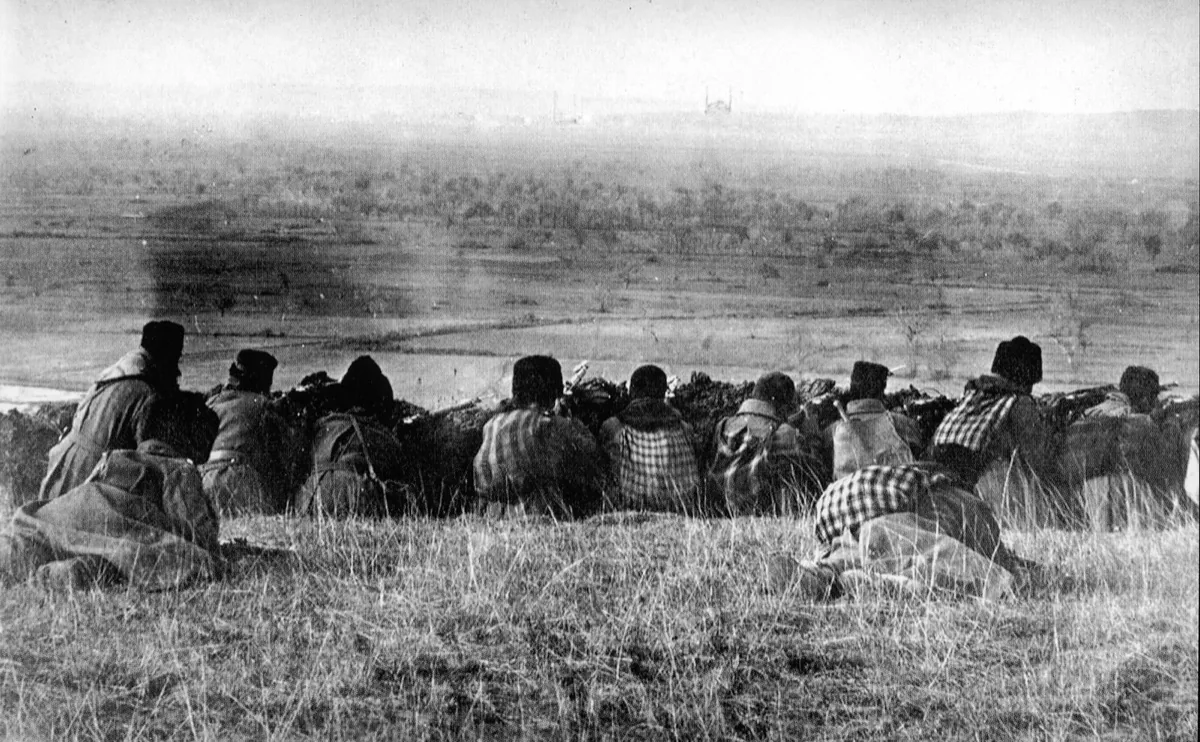
The Balkan Wars were two wars fought in southeastern Europe in 1912 and 1913. In the first war, Serbia, Bulgaria, Greece, and Montenegro formed an alliance called the Balkan League and defeated the Ottoman Empire in seven months, taking nearly all of its remaining European territory. In the second war, the allies turned on each other. Bulgaria attacked Serbia and Greece over how to divide the conquered land and lost most of what it had gained. The two wars killed more than 200,000 soldiers and civilians and ended five centuries of Ottoman control over the Balkans. Within a year, the tensions they created helped start World War I.
How the Balkan League defeated the Ottoman Empire
By 1912, the Ottoman Empire was losing control of southeastern Europe. Italy had taken Libya from it in 1911, and Albanian and Macedonian insurgencies were tying down its remaining forces. The empire was widely seen as the sick man of Europe, and its Balkan neighbors saw a chance to take the remaining Ottoman provinces for themselves.
Serbia, Bulgaria, Greece, and Montenegro had competing claims to the same territory, especially Macedonia. With Russian encouragement, they set aside their differences and formed the Balkan League. In October 1912, the League attacked.
Most European governments expected the Ottoman army to hold. The opposite happened. Bulgarian forces destroyed the Ottoman armies in Thrace and advanced to within about 40 kilometers of Istanbul before being stopped at the Catalca defense line. Serbian forces won a decisive battle at Kumanovo on October 23 and 24, 1912, then swept through Macedonia and Kosovo. Greek forces captured Salonika and Ioannina and dominated the Aegean Sea.
By spring 1913, the Ottoman fortress cities of Adrianople and Scutari had surrendered. The Treaty of London, signed on May 30, 1913, stripped the Ottomans of nearly all their European territory. The great powers then demanded the creation of an independent Albania, largely because Austria-Hungary was determined to keep Serbia from reaching the Adriatic coast.
How Bulgaria lost most of what it won
The creation of Albania took away the coastline Serbia had expected to gain. Serbia demanded compensation in Macedonia instead, in territory that Bulgaria considered its own. Bulgaria had done the heaviest fighting in the first war and felt cheated by the outcome.
On June 29, 1913, Bulgaria attacked its former allies Serbia and Greece without a formal declaration of war. The decision was disastrous. Serbia and Greece held their ground and counterattacked. Romania, neutral during the first war, sent its army into Bulgaria from the north. The Ottoman Empire marched back into Thrace and retook Adrianople, led by Enver Pasha.
In less than five weeks, Bulgaria asked for an armistice. Under the Treaty of Bucharest, signed on August 10, 1913, Bulgaria gave up much of the territory it had gained. Serbia and Greece split most of Macedonia, and Romania received southern Dobruja. Bulgaria kept a narrow strip of Aegean coastline and was left with a lasting sense of injustice.
Who won the Balkan Wars?
Serbia was the biggest winner. Its territory grew from about 48,000 to 88,000 square kilometers, and its population grew by 1.6 million people. Serbia came out of the wars with enormous confidence, which alarmed its larger neighbor Austria-Hungary.
Greece gained southern Macedonia, including the major port of Salonika. Romania gained southern Dobruja with little fighting. The Ottoman Empire lost almost everything it held in Europe but retook Adrianople and a strip of eastern Thrace during the second war.
Bulgaria was the biggest loser. It had done more fighting than any other Balkan state in the first war and came out of the second having lost most of what it had won.
The human cost went beyond the battlefields. An investigation organized by the Carnegie Endowment for International Peace in 1913 found evidence of massacres, forced expulsions, and burned villages carried out by every army involved. The report, published in 1914, became one of the first detailed records of the kind of organized violence that would later be called ethnic cleansing. Several hundred thousand Muslims were expelled or fled from the Balkans to Anatolia. That mass displacement helped drive the rise of Turkish nationalism in the years that followed.
The Balkan Wars and World War I
The Balkan Wars are often treated as background to World War I. They were a direct cause of it.
Austria-Hungary looked at Serbia, now nearly twice its former size and backed by Russia, and saw a growing threat on its southern border. Austrian leaders had already concluded before 1914 that Serbia could only be checked by war. The assassination of Archduke Franz Ferdinand by Gavrilo Princip in Sarajevo in June 1914 gave Austria-Hungary the occasion to act, but the conclusion had already been reached.
Russia had watched the Balkan League, a coalition it had helped create, win the first war without much Russian control over the outcome. When Austria-Hungary moved against Serbia in 1914, Russia concluded that standing aside again was not an option.
Bulgaria, humiliated and determined to retake Macedonia, entered World War I on the side of Germany and Austria-Hungary in 1915. The Ottoman Empire, having lost its European provinces to a Russian-backed coalition, found a new protector in Germany. The wars did not just come before World War I. They helped create the alliances and the grievances that made it happen.