
Archduke Franz Ferdinand
Archduke Franz Ferdinand was the heir to the Austro-Hungarian throne whose assassination in Sarajevo in 1914 triggered World War I.
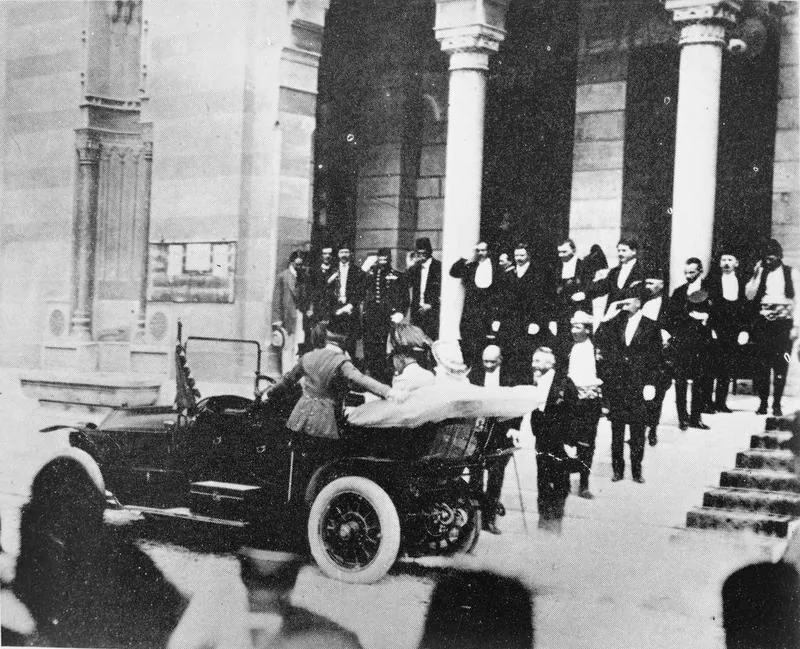
Archduke Franz Ferdinand was the heir to the throne of Austria-Hungary, the empire ruled by the Habsburg dynasty. On June 28, 1914, a 19-year-old Bosnian Serb named Gavrilo Princip shot Franz Ferdinand and his wife Sophie in the streets of Sarajevo. Within six weeks, the assassination pulled most of the major European powers into war. Franz Ferdinand was not popular at court. His contemporaries described him as suspicious, short-tempered, and difficult to work with. But he was also the most prominent voice in the empire for giving its Slavic peoples a political voice, which makes his murder by a Slavic nationalist one of the sharpest ironies of the twentieth century.
How Franz Ferdinand became heir to the Habsburg throne
Franz Ferdinand was born on December 18, 1863, in Graz, Austria. He was not raised to be emperor. His uncle, Emperor Franz Joseph, had a son, Crown Prince Rudolf, in line to succeed him. In 1889, Rudolf killed himself at his hunting lodge at Mayerling. Franz Ferdinand's father, Archduke Karl Ludwig, became next in line, but Karl Ludwig died of typhoid fever in 1896. Franz Ferdinand, at 32, became the presumptive heir.
He was an obsessive hunter who kept meticulous records and killed nearly 275,000 animals over his lifetime. But the trait that caused Franz Ferdinand the most trouble at court was his choice of wife. In 1900, he married Sophie Chotek, a countess from a Bohemian noble family that the Habsburg court considered beneath him. Emperor Franz Joseph permitted the marriage only as a morganatic union. Franz Ferdinand had to swear a public oath that his children would never inherit the throne. Sophie was denied the rank and ceremonial seat beside her husband that an imperial wife would normally have. At most state events, she could not ride in his carriage or sit next to him. Franz Ferdinand loved her and resented the arrangement deeply.
Franz Ferdinand's plan to reform the empire
The 1867 compromise that created the dual monarchy of Austria-Hungary divided authority between the empire's German-speaking and Hungarian elites. That arrangement left the empire's Slavic peoples, roughly half the total population, without a real political voice. By the early 1900s, Slavic resentment was pulling the empire apart.
Franz Ferdinand wanted to fix this problem. His circle floated several reform proposals, the most ambitious being a plan called the United States of Greater Austria. The Romanian jurist Aurel Popovici drafted it in 1906. It would have reorganized the empire into about fifteen states based on ethnicity, each with its own autonomy under the crown.
Serbian nationalists saw this plan as a threat. Their goal was to bring the South Slavic peoples together into an independent state under Serbian leadership. A reformed empire that gave its Slavs genuine autonomy might have made that project unnecessary. Franz Ferdinand was more dangerous to Serbian nationalists than a ruler who would simply oppress the Slavs, because his reforms could take away the reason for rebellion. That reasoning helped lead to the plot that killed him.
The assassination of Franz Ferdinand in Sarajevo
Franz Ferdinand traveled to Sarajevo in late June 1914 to inspect military exercises in Bosnia, which Austria-Hungary had annexed in 1908. Sophie came with him. A military inspection was one of the rare occasions where court protocol relaxed enough for Sophie to appear openly at Franz Ferdinand's side.
The visit fell on June 28, which is Vidovdan, or St. Vitus's Day. For Serbs, the date marks the anniversary of their medieval defeat at the Battle of Kosovo in 1389. It is one of the most sacred dates in Serbian national identity, and an imperial parade through Sarajevo on Vidovdan struck Serbian nationalists as a deliberate insult.
Six young assassins, most of them Bosnian Serbs armed by a Serbian nationalist network called the Black Hand, positioned themselves along the motorcade route. Early in the procession, one of them threw a bomb that bounced off Franz Ferdinand's car and injured people in the vehicle behind. Franz Ferdinand continued to city hall. After the reception, his driver was supposed to take a different route to the hospital to visit the wounded, but nobody clearly told the driver about the change. The driver turned onto the originally planned street, realized the mistake, and stopped to reverse. The car stalled almost directly in front of Princip, who was standing near a delicatessen on the corner. Princip stepped forward and fired twice at close range. He hit Franz Ferdinand in the neck and Sophie in the abdomen. Sophie died in the car. Franz Ferdinand's last reported words to his wife were a plea: "Sophie, Sophie, don't die. Live for our children." He died minutes later.
Why did Franz Ferdinand's assassination start World War I?
Franz Ferdinand's assassination did not cause the war by itself. It gave the war party in Vienna the pretext it had been looking for. Austria-Hungary's chief of staff, Conrad von Hötzendorf, had been pushing for a preventive war against Serbia for years, proposing it at least twenty-five times between January 1913 and January 1914 alone. Franz Ferdinand had personally opposed Conrad von Hötzendorf, arguing repeatedly that a war with Serbia would be reckless. With Franz Ferdinand dead, that restraining voice was gone. His death was more useful to the war party than his life had been.
On July 23, Austria-Hungary sent Serbia an ultimatum with ten demands. The demands were written so that Serbia would have to reject them. Serbia rejected only one of the ten outright. Austria-Hungary declared war on July 28.
The European alliance system then drew in one country after another. Russia mobilized in defense of Serbia. Germany, allied with Austria-Hungary, declared war on Russia and then on France. Germany's war plan, the Schlieffen Plan, sent its army through neutral Belgium, which brought Britain into the war. Within six weeks of Franz Ferdinand's death, most of Europe was fighting.
Franz Ferdinand was the one senior Habsburg figure who had consistently argued against war with Serbia and who had pushed to give the empire's Slavs more autonomy. His death removed the strongest voice for restraint in Vienna and gave the war party the occasion it needed.