
Sick Man of Europe
The "sick man of Europe" was a 19th-century label for the declining Ottoman Empire, coined by Russia's Tsar Nicholas I.
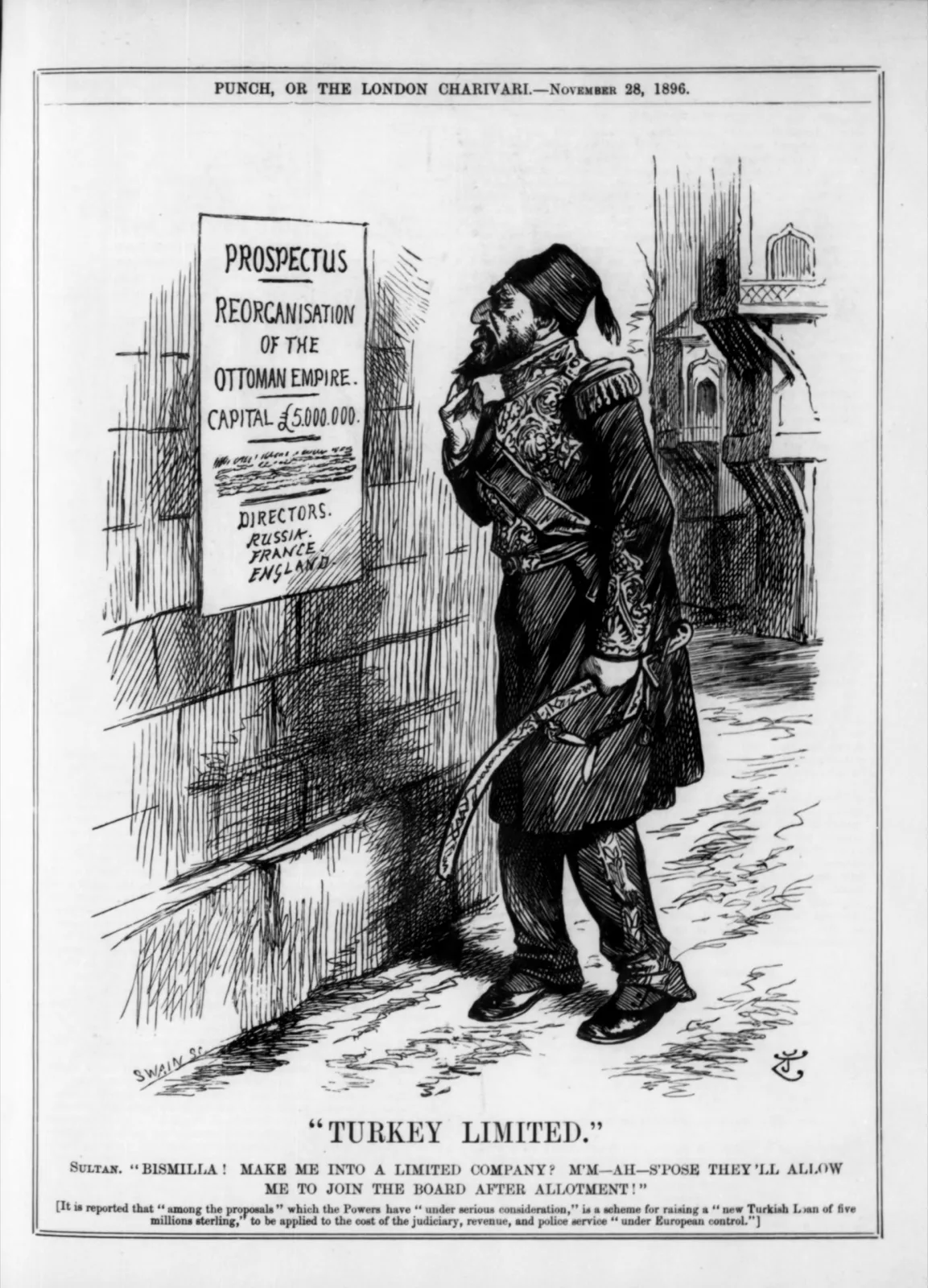
The "sick man of Europe" was a label Europeans used for the Ottoman Empire through the second half of the 19th century. At its peak the empire had ruled southeastern Europe, the Middle East, and North Africa. In January 1853, Russia's Tsar Nicholas I described the Ottoman Empire as "a sick man, a very sick man" in a conversation with Sir Hamilton Seymour, the British ambassador in St. Petersburg. Nicholas proposed that the great powers should quietly plan to divide the empire's lands. The phrase caught on, and for the rest of the century the central question in European diplomacy was what would happen when the Ottoman Empire finally collapsed and who would take its territory. Diplomats called this the Eastern Question, and it drove alliances, wars, and treaties for decades.
How the Ottoman Empire lost its grip
The empire had been losing territory since the late 17th century, but the losses accelerated after 1800. Greece fought a war of independence in the 1820s, and the European powers recognized it as a sovereign state in 1830. Over the following decades, nationalist movements spread across the Balkans as Serbs, Romanians, Bulgarians, and Montenegrins pushed to form their own states.
The Ottoman government tried to hold the empire together with the Tanzimat reforms, a program of modernization that ran from 1839 to 1876. The Tanzimat introduced new legal codes, secular schools, and equal rights for non-Muslim subjects. The reforms were genuine, but they could not keep up with the spread of nationalism. By the Congress of Berlin in 1878, Serbia, Romania, and Montenegro were fully independent. Bulgaria was nearly lost as well.
The empire's finances were collapsing too. The Ottoman government had taken its first foreign loan in 1854, to help pay for the Crimean War. By the mid-1870s the foreign debt had reached roughly £200 million, and debt payments consumed more than half the government's revenue. In October 1875 the empire defaulted. In 1881, European creditors set up the Ottoman Public Debt Administration, a foreign body that collected certain Ottoman taxes and sent the money directly to bondholders.
How the great powers kept the Ottoman Empire alive
The Ottoman Empire survived as long as it did partly because its rivals could not agree on how to divide it. Russia wanted control of the straits at Constantinople, the narrow passage from the Black Sea into the Mediterranean. A Russian fleet in the Mediterranean would have changed the balance of power across southern Europe and the Middle East.
Britain and France spent decades supporting the Ottoman Empire to keep Russia away from the straits. Britain's concern was specific: if Russia controlled the passage, it could threaten the sea route to India, the most important connection in the British Empire. London and Paris preferred a weak but intact Ottoman Empire to a strong Russia on the Mediterranean. The Crimean War, from 1853 to 1856, was their largest intervention. Britain and France sent armies to fight Russia in defense of Ottoman territory.
The arrangement held until World War I. The Ottoman Empire entered the war on the side of Germany and Austria-Hungary and lost. The powers then did what Nicholas I had proposed more than sixty years earlier: they divided the empire's lands. Britain and France divided the territory between themselves under the Sykes-Picot agreement, and the postwar mandate system turned their claims into borders. Those lines became the boundaries of modern Iraq, Syria, Lebanon, and Jordan.
Who called the Ottoman Empire the sick man of Europe?
Russia's Tsar Nicholas I used the phrase most famously in a series of conversations with Sir Hamilton Seymour, Britain's ambassador in St. Petersburg, in January 1853. Nicholas was blunt by nature. The first act of his reign had been putting down the Decembrist revolt in December 1825, an uprising of army officers who demanded a constitution, and he spent nearly three decades defending autocracy across Europe. He told Seymour, "We have a sick man on our hands, a man gravely ill," and proposed that Britain and Russia should plan together for what would happen when the empire fell apart.
Nicholas was not being generous. He wanted the empire's Balkan provinces under Russian protection, and he was asking Britain to agree. Britain refused, and the disagreement helped push the two empires toward the Crimean War within months. The phrase survived the war and became the standard description of the Ottoman Empire for the rest of the century. Neither Nicholas nor Seymour actually said "of Europe" in the original conversation. That part was added later as the expression passed into common use.
The sick man label after the Ottomans
The Ottoman Empire collapsed after World War I, but the label outlived it. Since then, journalists and politicians have used "the sick man of Europe" for any European country in prolonged economic trouble. Britain carried the label through much of the 1970s, when strikes, inflation, and slow growth made it the weakest major economy in Western Europe. Germany was called the sick man around 1999 to 2005, when the costs of reunification and a rigid labor market kept growth stagnant. Germany received the label again after 2022, when the loss of cheap Russian natural gas and a weakening industrial base raised the same concerns.
Each time, the label carries the same meaning Nicholas I intended: a country in decline whose troubles are about to become everyone else's problem.