
Budapest Memorandum
The Budapest Memorandum was a 1994 agreement in which Ukraine gave up its nuclear weapons for security assurances from Russia, the US, and Britain.
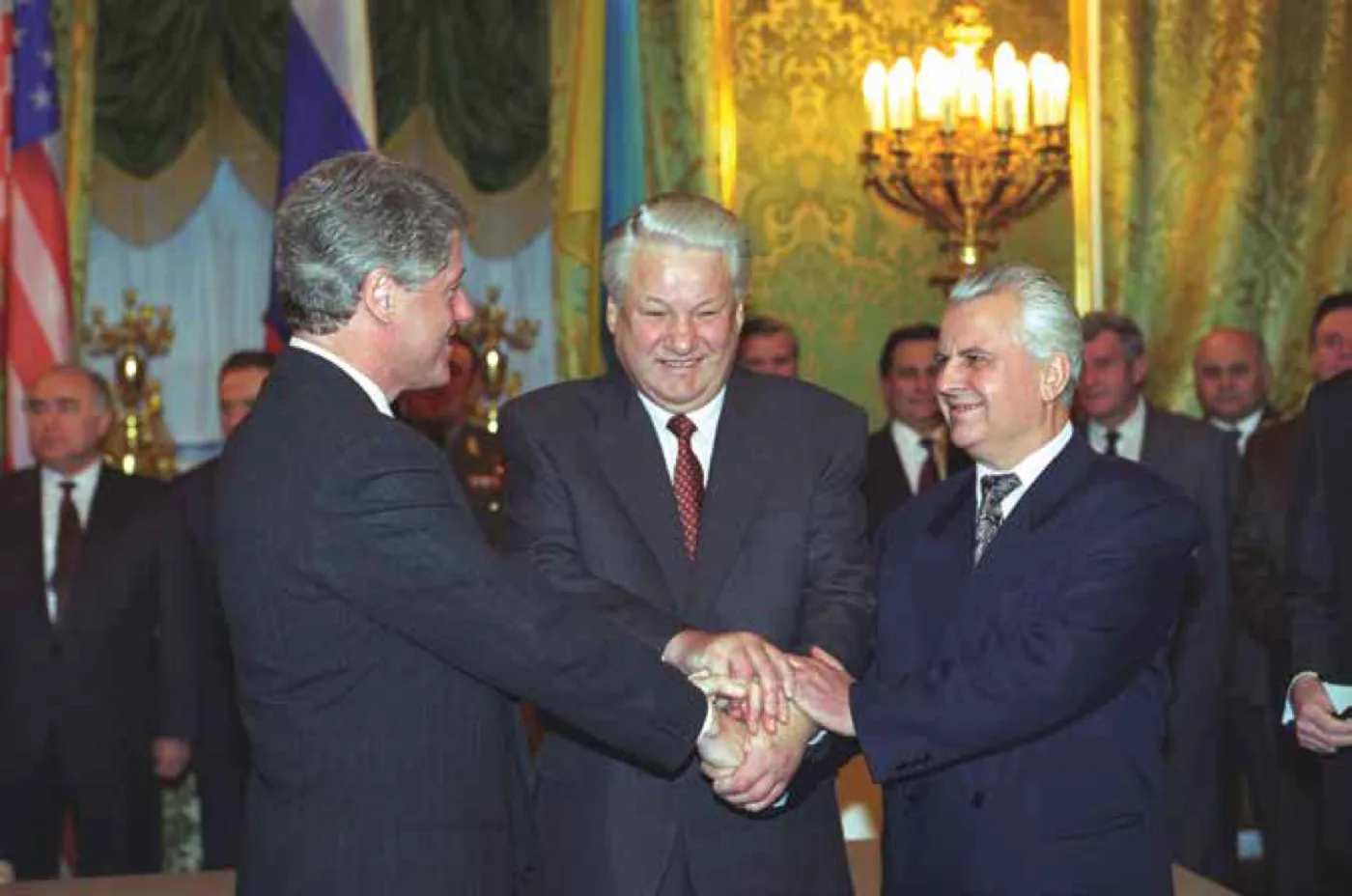
The Budapest Memorandum is a set of security assurances that the United States, Britain, and Russia gave to Ukraine on December 5, 1994. In exchange, Ukraine agreed to give up the roughly 1,900 strategic nuclear warheads it had inherited when the Soviet Union collapsed in 1991, the third-largest nuclear arsenal in the world. No country had ever voluntarily given up a nuclear arsenal so large. The three powers pledged to respect Ukraine's sovereignty, independence, and existing borders, and to refrain from threatening or using force against it. The memorandum used the word "assurances," not "guarantees." That distinction meant no signatory was obligated to defend Ukraine if another broke its pledges. Russia violated those pledges in 2014 and again in 2022.
How Ukraine inherited a nuclear arsenal
When the Soviet Union dissolved in December 1991, Ukraine found itself holding about 1,900 strategic nuclear warheads, along with 176 intercontinental ballistic missiles and 44 strategic bombers to deliver them. The arsenal was larger than the combined nuclear forces of Britain, France, and China. But Ukraine had not built these weapons and could not use them. The launch codes were held in Moscow, and maintaining the warheads would have cost billions that the newly independent country did not have.
Both the United States and Russia wanted the weapons removed. The United States feared that a new state might lose control of nuclear material. Russia did not want an armed rival on its border. Ukraine had its own reasons to cooperate: it wanted Western economic aid, diplomatic recognition, and the standing in the international order that voluntary disarmament would bring. For the full story of how Ukraine made this decision, see Why did Ukraine give up the world's third-largest nuclear arsenal?
How the memorandum was negotiated
The path to the Budapest Memorandum took nearly three years. In January 1994, Ukraine's president Leonid Kravchuk, US president Bill Clinton, and Russian president Boris Yeltsin signed a Trilateral Statement in Moscow committing to the broad terms: Ukraine would transfer its warheads to Russia for dismantlement, and the three powers would provide security assurances in return.
Ukraine's negotiators pushed for the strongest possible language. They wanted security "guarantees," a word that in diplomacy implies an obligation to defend. The United States refused. American officials insisted on "assurances," which specify what the signatories will not do (threaten force, violate borders) but do not promise what they will do if those commitments are broken. The distinction was complicated by the fact that Ukrainian and Russian have a single word for both "assurance" and "guarantee." US officials read a statement into the negotiating record clarifying that wherever the Ukrainian and Russian texts of the Trilateral Statement used that word, it carried the weaker English meaning.
The final memorandum was signed on December 5, 1994, at the CSCE summit in Budapest. Ukraine's president by then was Leonid Kuchma, who until 1992 had been the general director of Yuzhmash, the largest missile factory in the Soviet Union. Kuchma signed alongside Clinton, Yeltsin, and British prime minister John Major. Parallel memorandums were signed the same day for Belarus and Kazakhstan, which had also inherited Soviet nuclear weapons. China and France gave separate, somewhat weaker assurances. The United States funded part of the dismantlement through the Nunn-Lugar Cooperative Threat Reduction program. By 1996, the last nuclear warhead had left Ukrainian soil.
Was the Budapest Memorandum legally binding?
No. The Budapest Memorandum is not a treaty, and no legislature ratified it. It created no legal obligation for any signatory to defend Ukraine. There was no enforcement mechanism, no automatic penalty for breaking it, and no commitment to treat an attack on Ukraine as an attack on the other signatories. The signatories promised to respect Ukraine's borders, but they did not promise to protect them. Ukrainian negotiators had pushed for a binding defense commitment during the negotiations. The United States refused, in part because that would have resembled a NATO-style alliance and was more than it was willing to take on.
For about twenty years, the difference between "assurances" and "guarantees" did not matter in practice. The memorandum was widely considered a success for nuclear non-proliferation, and Ukraine's disarmament was held up as a model.
How Russia broke the Budapest Memorandum
In March 2014, Russia annexed Crimea, breaking the pledge it had signed twenty years earlier. In February 2022, Russia launched a full-scale invasion of Ukraine. Russia argued that the memorandum no longer applied because it considered Ukraine's post-2014 government illegitimate. The United States and Britain rejected that argument.
The other signatories responded with economic sanctions and military aid, including weapons and training, but did not send their own troops. That response was consistent with what the word "assurances" had always meant. The memorandum had never required them to fight.
Ukraine fulfilled every obligation it took on in 1994. It gave up every warhead, acceded to the Non-Proliferation Treaty without nuclear weapons, and dismantled its delivery systems. The country that broke the agreement was the one that received the warheads. The memorandum is now one of the most studied examples of what happens when a country gives up nuclear weapons for assurances that carry no obligation to defend.