
Buffer State
A buffer state is a small country between two larger powers, kept independent so they do not share a direct border.
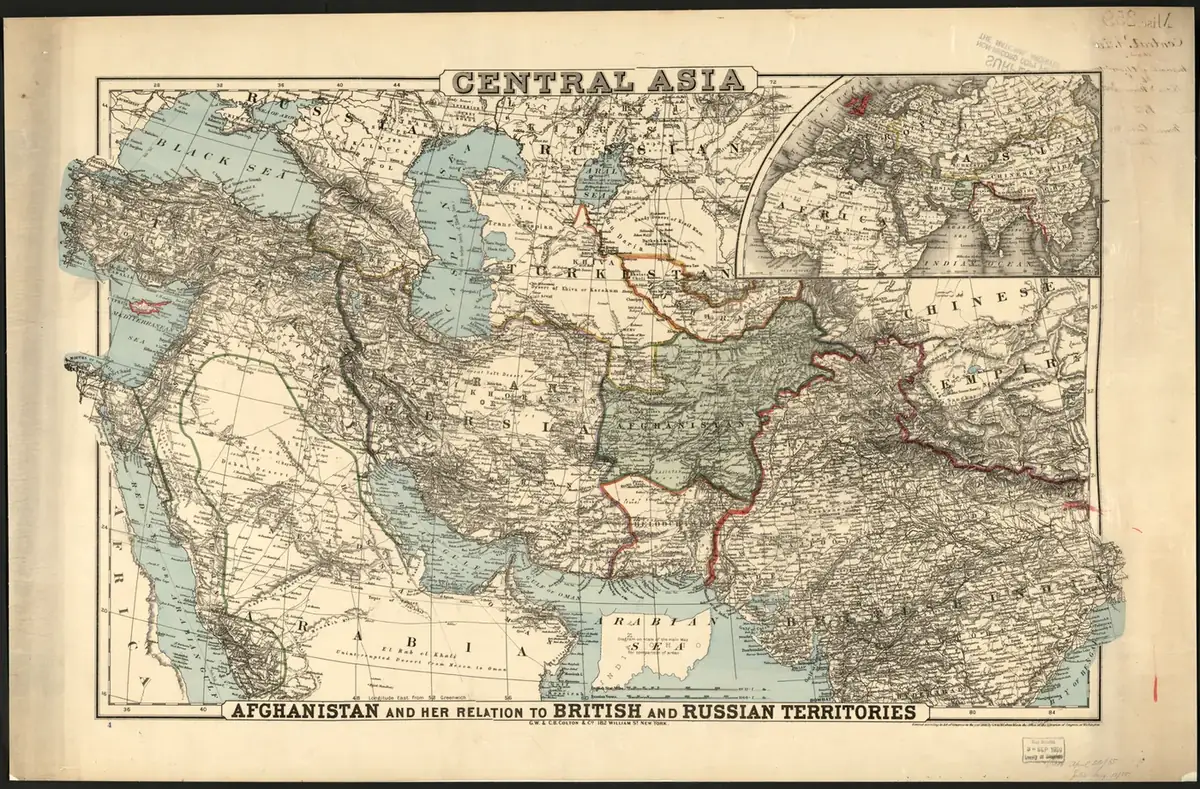
A buffer state is a small, weak country that sits between two rival powers to keep them from sharing a border. Two great powers with a common frontier are in constant tension, because each new fort or garrison one side builds looks like preparation for attack to the other. A country placed between them lowers that tension. Neither side risks a surprise attack, both gain warning time, and neither faces the other's military across a direct frontier.
A buffer state pays for this arrangement with its freedom. It cannot choose a side, and its independence lasts only as long as both neighbors would rather have a gap than a common border. When one of them decides the gap is no longer worth preserving, the guarantees prove worth very little. Afghanistan, Belgium, and Poland have all learned this.
How Afghanistan became a buffer state
During the 1800s, the British and Russian empires pushed toward each other across Central Asia in the strategic competition known as the Great Game. Britain controlled India to the south. Russia was expanding through the khanates of Central Asia to the north. Rather than let their empires meet, the two agreed to leave Afghanistan, a mountainous kingdom, between them.
In 1893, Sir Henry Mortimer Durand negotiated a line between Afghanistan and British India that fixed Afghanistan's eastern border. Two years later, in 1895, a joint boundary commission drew Afghanistan's northern border with Russia in the Pamir mountains. The commission deliberately created the Wakhan Corridor, a narrow strip of high mountain valley less than 15 kilometers wide at its narrowest, to ensure that no stretch of Russian territory bordered British territory. The shape of Afghanistan was decided largely by two outside empires. Its elongated form on the map exists because both sides wanted a gap between them.
The buffer role did not keep Afghanistan safe. Britain invaded three times, in 1839, 1878, and 1919. The Soviet Union invaded in 1979 and fought for nearly ten years. The United States invaded in 2001 and stayed for twenty. A country set aside so that two empires would not have to fight each other has been one of the most invaded places on Earth.
How Belgium's buffer guarantee collapsed
Belgium was created in 1830 when it broke away from the Netherlands. In 1839, Britain, France, Prussia, Austria, and Russia signed the Treaty of London, which recognized Belgium's independence and required it to remain permanently neutral. The point was to separate France from the German states and to prevent any single power from controlling the English Channel ports.
The guarantee held for 75 years. In August 1914, Germany invaded Belgium on its way to attack France. Germany's chancellor, Theobald von Bethmann-Hollweg, dismissed the Treaty of London as "a scrap of paper." The invasion gave Britain its legal reason to enter the First World War. The fighting that followed was waged, in part, across Belgian soil. Belgium's neutrality had been guaranteed by five great powers. When one of them decided the buffer no longer served its interests, the guarantee did not stop the army.
Examples of buffer states
Afghanistan and Belgium are the best-known cases, but buffer states have appeared across the world.
Siam, now Thailand, was the only Southeast Asian country to avoid European colonization. Britain held Burma to the west and France held Indochina to the east, and both preferred a gap between their territories. Siam's King Rama V, who ruled from 1868 to 1910, played the two empires against each other. He traveled to Europe in 1897 to negotiate directly with their governments and gave up outlying provinces to both sides to preserve the core of Siam's independence.
During the Cold War, Finland had a functioning democracy but could not join NATO or any Western alliance, because the Soviet Union insisted on keeping Finland neutral. This arrangement gave rise to the term Finlandization, meaning a country that is formally independent but cannot choose its own alliances. Nepal and Bhutan sit between India and China and serve a similar role today.
Poland spent the eighteenth century as a buffer between Russia, Prussia, and Austria. All three partitioned it out of existence by 1795. Korea lay between China, Russia, and Japan. Japan annexed Korea in 1910 after defeating both China and Russia in wars fought partly over control of the Korean peninsula.
Is Ukraine a buffer state?
The dispute over Ukraine since 2014 is, in part, a question of whether Ukraine is a buffer state. Russia considers Ukraine a necessary buffer between itself and NATO, and treats Western efforts to bring Ukraine into the alliance as a threat to Russian security. Ukraine's position is that a nation of tens of millions of people is not an object to be placed between empires. The security a buffer gives its neighbors comes at the cost of the buffer's own insecurity.
Both arguments follow their own logic, which is what makes buffer state disputes so difficult to settle. The country assigned the buffer role rarely chooses it. When the arrangement breaks down, the war is fought on the buffer's territory.