
The Great Game
The Great Game was the rivalry between Britain and Russia for influence over Central Asia, Afghanistan and Persia, from the 1830s to 1907.
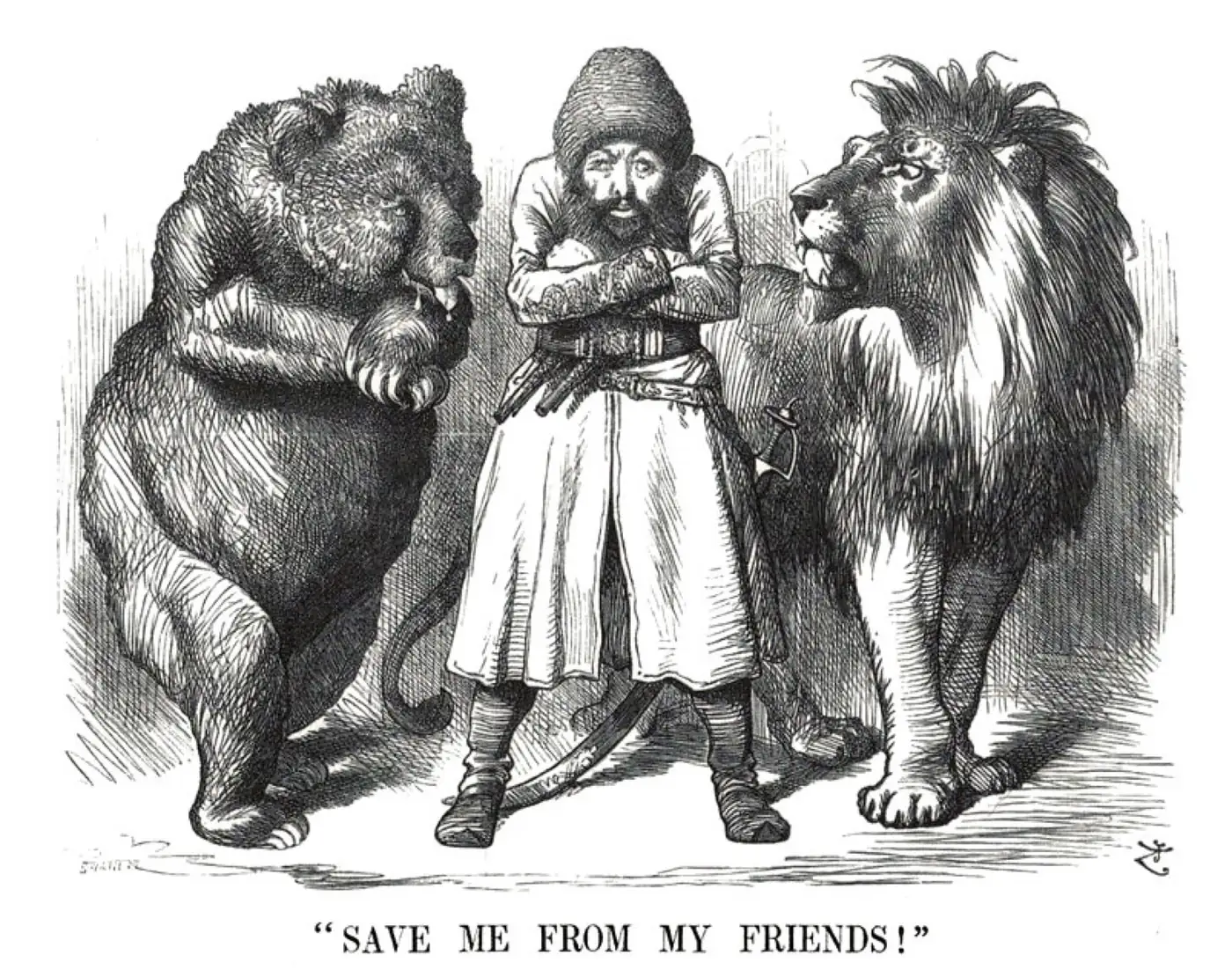
The Great Game was the rivalry between the British and Russian empires for control of Central Asia, Afghanistan and Persia from the 1830s to 1907. Britain held India, the most valuable territory in its empire. Russia was expanding southward, and each year the distance between the two empires' frontiers shrank. At the start of the nineteenth century, about two thousand miles separated them. By the end, only a few hundred did. British planners feared a Russian army marching through the Afghan mountain passes into India. That fear, more than any actual invasion attempt, was what drove the Great Game. The rivalry produced two wars in Afghanistan, a near-war over a patch of Turkmen desert, and decades of espionage across the mountains between the Caspian Sea and the Hindu Kush. It ended not in victory for either side but in an agreement, when both powers decided that Germany was the bigger threat.
How Russia closed in on British India
Throughout the 1800s, Russia was expanding, gaining, by one estimate, about fifty square miles of new territory every day. It had taken the Caucasus by the 1860s. Then it conquered the khanates of Central Asia one by one. Russian armies captured Tashkent in 1865 and Samarkand in 1868. They took Khiva in 1873 and absorbed Kokand in 1876. Each new conquest brought Russia's frontier closer to British India.
British strategists spent decades imagining a Cossack army descending through the Afghan mountain passes into the plains of northern India. Russia never seriously attempted the march, but the possibility shaped British policy across the entire region. Britain's strategy relied on Afghanistan and Persia as buffer states, countries that neither empire would let the other dominate.
The day-to-day work of the Great Game fell to young officers and spies. British agents crossed the mountains posing as horse traders, sketching passes and measuring altitudes with hidden instruments. Russian diplomats worked to win over the rulers of Bukhara and Khiva. Both sides treated Afghanistan and Persia less as independent countries than as territory to be managed. Their rulers were bribed, threatened and sometimes deposed.
The Afghan wars and the Panjdeh crisis
Britain went to war in Afghanistan in 1839 to replace its ruler with one friendlier to British interests. The invasion succeeded, but the occupation did not last. In January 1842, a British column of about 4,500 soldiers and 12,000 camp followers marched out of Kabul under a promise of safe passage. Over the next week, Afghan forces attacked the column in the snow-covered passes between Kabul and Jalalabad. Of the roughly 16,500 people who set out, one European reached Jalalabad: William Brydon, an assistant surgeon, who rode through the city's gates on a dying horse. It remains one of the worst defeats Britain suffered in its imperial wars.
Britain fought a second war in Afghanistan in 1878. Neither campaign conquered the country, and Afghanistan remained the contested ground at the center of the rivalry.
In 1885, Russian troops seized the Panjdeh oasis on the Afghan-Turkmen border, a place so obscure that few people in London could find it on a map. The British Parliament voted emergency war funding. But neither side wanted a direct fight, and the crisis was settled by negotiation. Russia kept Panjdeh.
How did the Great Game end?
By the early 1900s, both Britain and Russia were more worried about the rise of Germany than about each other. Russia had also lost a war to Japan in 1905 and faced revolution at home, and had less appetite for confrontation in Central Asia.
On August 31, 1907, Britain and Russia agreed to a treaty in St. Petersburg, the Anglo-Russian Convention. It gave Russia influence over northern Persia and Britain influence over the south, with a neutral strip between them. Russia gave up its claims on Afghanistan. Both powers agreed to stay out of Tibet. The Persians were not consulted about the partition of their own country.
The convention turned rivals into allies. Within seven years they were fighting on the same side in the First World War. The borders of Central Asia, and of Afghanistan in particular, still run roughly where British and Russian surveyors drew them during the rivalry.
Who coined the term "the Great Game"?
Arthur Conolly, a British intelligence officer, used the phrase in a letter in 1840, but he meant Britain's chance to reform Afghanistan, not the contest with Russia. Conolly did not live to see how it ended. In 1841, he traveled to the city of Bukhara to try to free a fellow British officer, Colonel Charles Stoddart, who had been imprisoned by the emir. Both men were captured and beheaded in the square outside the emir's fortress.
The term became widely known decades later through Rudyard Kipling's novel "Kim," published in 1901, which tells the story of an orphaned boy drawn into British espionage on the Indian frontier. The phrase outlived the rivalry it described. The Soviet war in Afghanistan in the 1980s, and the contest over Central Asian pipelines and military bases in the 2000s, are both called new great games. The geography and the strategic value of Central Asia stay the same even when the players change.