
Conscription
Conscription is compulsory military service, first used in its modern form in France in 1793 and still practiced in dozens of countries today.
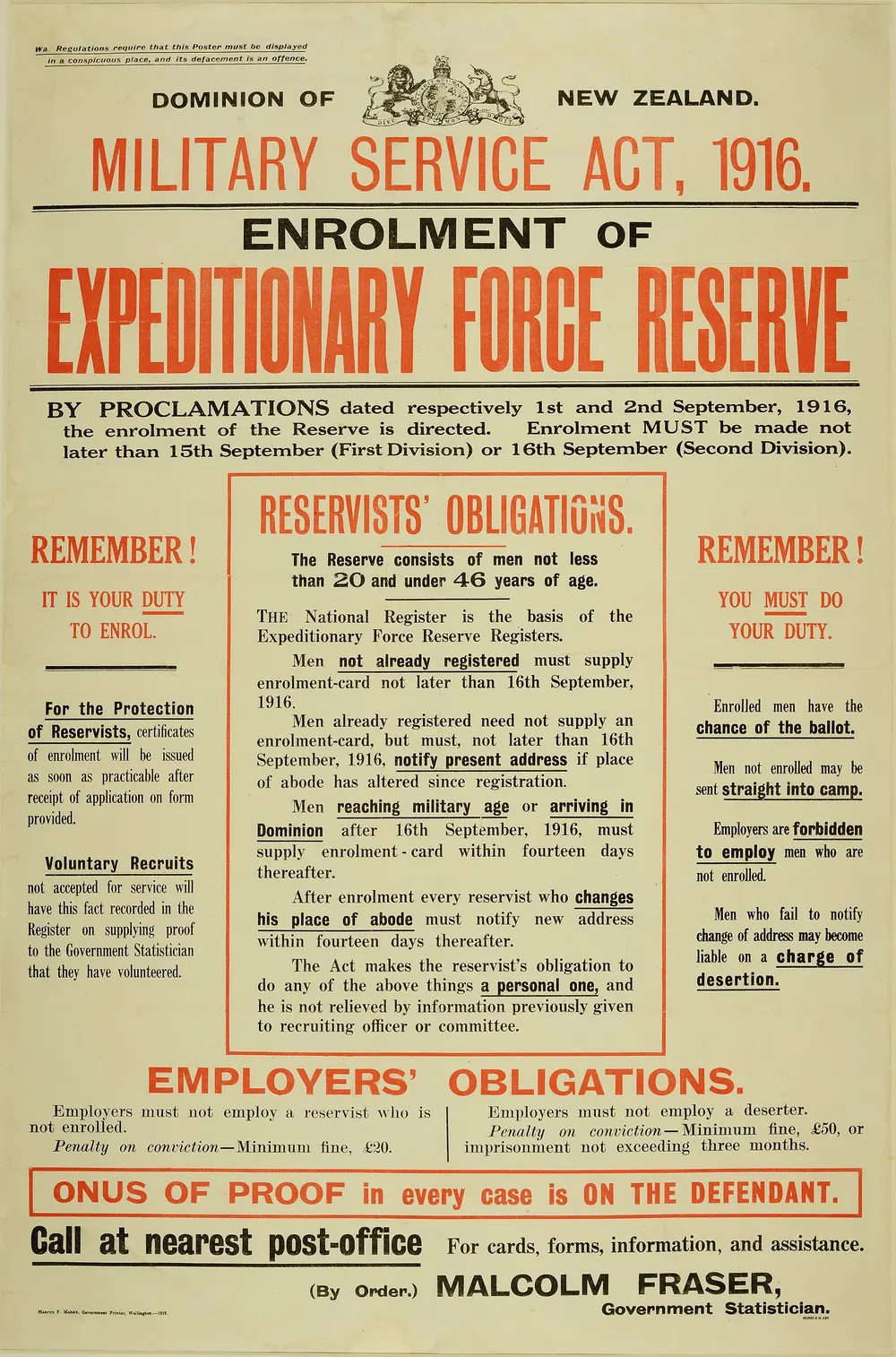
Conscription is compulsory military service: the requirement that citizens serve in a country's armed forces whether they volunteer or not. The idea is ancient, but its modern form dates to August 23, 1793, when France's revolutionary government declared the levée en masse. The decree put the entire nation on a war footing. Young men were to fight. Married men were to forge weapons. Women were to make tents. Children were to shred old linen into bandages. Within a year, France had roughly 800,000 soldiers under arms. No European state had ever assembled an army that large. The professional armies of France's neighbors could not match that number, no matter how well trained they were. Conscription changed how wars were fought, and it changed the relationship between governments and the people they governed.
How France's draft changed warfare
Before 1793, European armies were small and professional. Soldiers were expensive to train and hard to replace, so commanders maneuvered carefully to avoid battle. Losing an army could set a country back for a decade.
Conscription changed that. A conscript cost the state little beyond food, a uniform, and a musket. He could be replaced the following year by the next group of twenty-year-olds. Napoleon could accept casualty rates that would have destroyed his opponents, because France's population let him refill his ranks each year. His enemies eventually adopted the same system. Prussia introduced universal military service in 1814, and after Prussia defeated France in the Franco-Prussian War of 1870–1871, every major continental European state built its army around conscription: universal service followed by years in a trained reserve.
That system shaped the start of World War I. By 1914, each of the major continental powers could call up millions of trained reservists within weeks. These were not professional soldiers waiting in barracks. They were farmers and factory workers who had done their service years earlier and could be called back. Once Russia began mobilizing its reserves in July 1914, Germany's war plan, the Schlieffen Plan, required an immediate response. The mobilization timetables moved faster than diplomacy, and there was no time left to negotiate.
How conscription built nations and voters
States that demanded years of service from young men, and sometimes their lives, offered something in return: political membership. The vote, public schooling, welfare, and a claim on the nation all came with the obligation to serve. In most European countries, the expansion of voting rights and the growth of conscript armies happened at the same time. Britain extended the vote to all men over 21 in 1918, the year World War I ended, after four years in which millions of working-class men had fought and hundreds of thousands had died. The argument that a man fit to die for his country was fit to vote for its government became hard to refuse once the casualties came in.
Conscription also built nations in a practical sense. In France, the army turned speakers of Breton, Occitan, and Alsatian into Frenchmen. In Italy after unification in 1861, military service helped spread standard Italian among recruits who had grown up speaking Neapolitan or Sicilian. Conscripts learned a flag, a national history, and a shared set of enemies.
Which countries still have conscription?
Since the 1970s, country after country has ended the draft. The United States ended conscription on January 27, 1973, after the Vietnam War showed the political cost of drafting men to fight an unpopular war. President Richard Nixon had promised to end the draft during his 1968 campaign, and the military shifted to an all-volunteer force. Most of Western Europe suspended conscription after 1990, when the Soviet threat that had justified it disappeared.
Not every country followed. Israel, South Korea, Singapore, Switzerland, and Finland all held on to the draft. All are small countries facing threats that outnumber them, and none can rely on volunteers alone.
Modern military technology also worked against the draft. Fighter jets, submarines, and cyber operations require years of specialized training. A conscript who serves for one or two years is barely useful in those roles. Most Western militaries concluded that a smaller force of professionals was more effective than a large army of short-term conscripts. American men are still required to register with the Selective Service System when they turn 18, but no one has been drafted since 1973.
Is conscription coming back in Europe?
Since Russia's full-scale invasion of Ukraine in February 2022, the debate has reopened. Ukraine declared general mobilization on the day of the invasion and eventually put roughly a million people in uniform. Russia called up 300,000 reservists in September 2022 and has since relied on prison recruitment and financial incentives to avoid ordering a general mobilization.
The shock reached Western Europe. Latvia reinstated conscription in January 2024. Croatia voted in October 2025 to bring back mandatory service starting in 2026. Germany's parliament approved a new voluntary military service system in December 2025. By 2026, ten EU countries had some form of compulsory military service.
Most of the new programs are shorter and more selective than Cold War-era drafts, and several are voluntary in practice. But the basic problem conscription solves remains what it was in 1793: a country that relies entirely on volunteers has a limit on the wars it can fight.