
Schlieffen Plan
The Schlieffen Plan was Germany's strategy to defeat France in six weeks by invading through Belgium, then turn its army against Russia.
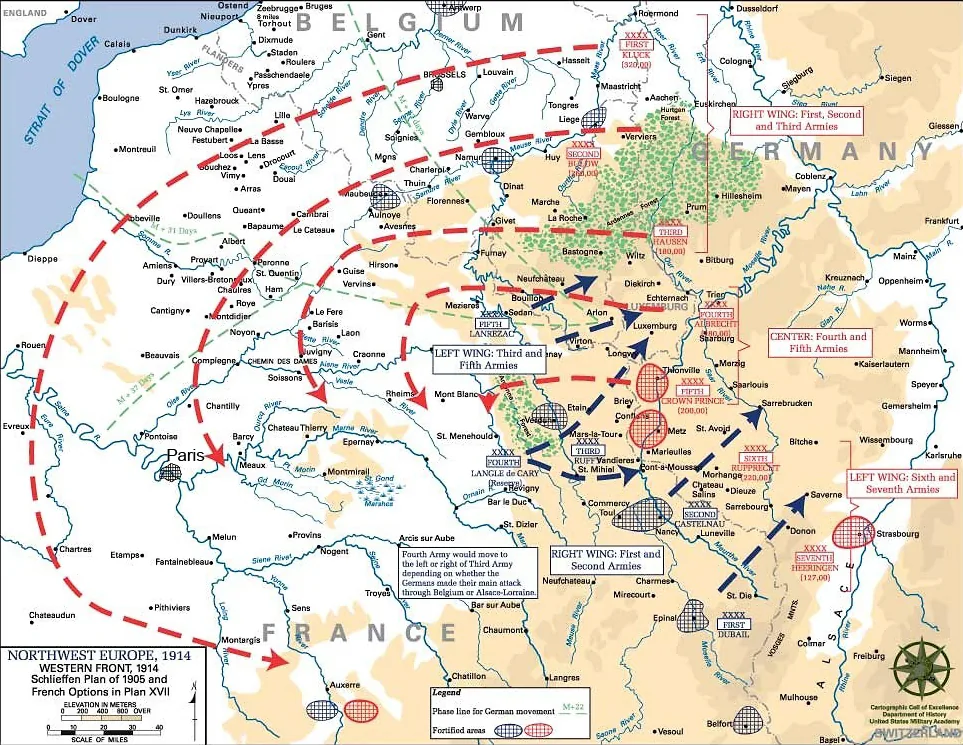
The Schlieffen Plan was Germany's strategy for fighting France and Russia at the same time without splitting its army equally between them. Germany would send most of its forces west first, march through neutral Belgium, loop around Paris, and force France to surrender in about six weeks. Then it would move those troops east by railroad to face Russia before Russia's slower army could fully mobilize. Count Alfred von Schlieffen, who led Germany's General Staff from 1891 to 1906, described the concept in a December 1905 memorandum. When Germany tried to carry it out in August 1914, the plan failed. The invasion of Belgium brought Britain into the war, and the quick victory Schlieffen had imagined became four years of trench warfare.
How Schlieffen designed the plan
Germany's problem was geography. After unification in 1871, Germany sat between two rival powers: France to the west and Russia to the east. France wanted to reverse its defeat in the Franco-Prussian War and recover the provinces of Alsace and Lorraine. Russia was allied with France. If war came, Germany would have to fight both at once.
Alfred von Schlieffen became chief of the General Staff in 1891 and spent the next fourteen years working on the problem. He was the son of a Prussian officer, withdrawn and obsessive about his work. His wife, his cousin Anna, had died in childbirth in 1872 after just four years of marriage. He had no hobbies and no interest in court life. Every Christmas Eve, his gift to his subordinates was a war problem they had to solve and return to him by Christmas Day.
Schlieffen's answer rested on speed. France's border with Germany in Alsace-Lorraine was heavily fortified, so a direct attack would stall. Instead, Germany would concentrate most of its strength on the right wing of its army, march northwest through Belgium and Luxembourg, swing west and south of Paris, and catch the French forces from behind while they faced the wrong direction. Schlieffen reportedly wanted the soldier at the far end of the line close enough to the English Channel to brush it with his sleeve. The whole concept rested on timing. Tsar Nicholas II's Russia would need about six weeks to mobilize its large army. Germany could use those weeks to beat France, then shift its troops east by railroad before the Russians advanced.
Schlieffen wrote the memorandum in December 1905 and retired on January 1, 1906. He died in Berlin in January 1913, a year and a half before anyone tried to carry out his plan.
How the plan unraveled in 1914
Schlieffen's successor was Helmuth von Moltke the Younger, the nephew of the elder Helmuth von Moltke, who had commanded Prussia's armies in the Franco-Prussian War. The younger Moltke accepted the job reluctantly and then changed the plan. He worried about leaving German territory exposed, so he moved troops from the all-important right wing to the left wing along the French border. He also decided not to invade the Netherlands, keeping it neutral so Germany could still trade through Dutch ports.
These changes meant the right wing was weaker when it mattered most. But the plan had a larger problem built into it: it required Germany to invade Belgium, whose neutrality the great powers of Europe, including Prussia, had pledged to protect under the Treaty of London in 1839.
On August 4, 1914, Germany invaded Belgium. The German chancellor, Theobald von Bethmann-Hollweg, dismissed the treaty as "a scrap of paper." Britain declared war on Germany the same day.
The German army advanced quickly at first but outran its supply lines. Soldiers were exhausted after weeks of forced marching in summer heat. Belgian resistance slowed the right wing, and the weakened force could not close the trap around Paris. In the First Battle of the Marne, from September 5 to 12, French and British forces counterattacked through a gap in the German lines and stopped the advance. Both sides dug in. The six-week war became four years of attrition.
Moltke, Germany's chief of the General Staff, suffered a nervous breakdown and was quietly relieved of command on September 14, 1914. He died in 1916.
Why did the Schlieffen Plan fail?
The Schlieffen Plan failed because it depended on everything going right, and almost nothing did. The German right wing, weakened by Moltke's redeployments, was not strong enough to encircle Paris. Belgium resisted longer than expected, which slowed the advance and gave France and Britain time to react. Germany's supply lines could not keep up with an army marching hundreds of kilometers on foot. And the plan's own logic guaranteed a wider war, because invading Belgium brought the British Empire in as an enemy.
After 1918, German officers blamed Moltke for ruining Schlieffen's design. In 1999, the historian Terence Zuber argued the opposite: that the famous plan was mostly invented after the war by officers looking for a dead man to blame instead of their own decisions. Most historians today take a middle position. Schlieffen's 1905 document outlined possibilities rather than a fixed war plan, and both the concept and its execution had serious problems.
The plan's most lasting consequence was not military but diplomatic. Kaiser Wilhelm II and his generals treated Belgium's neutrality as a detail to be ignored when it was inconvenient. A strategy designed to defeat two enemies in sequence instead added the British Empire to the list of enemies Germany had to fight, and helped turn a dispute between Austria-Hungary, Serbia, and Russia into a world war.