
Franco-Prussian War
The Franco-Prussian War of 1870-1871 destroyed the French Second Empire, unified Germany, and created the rivalry that led to World War I.
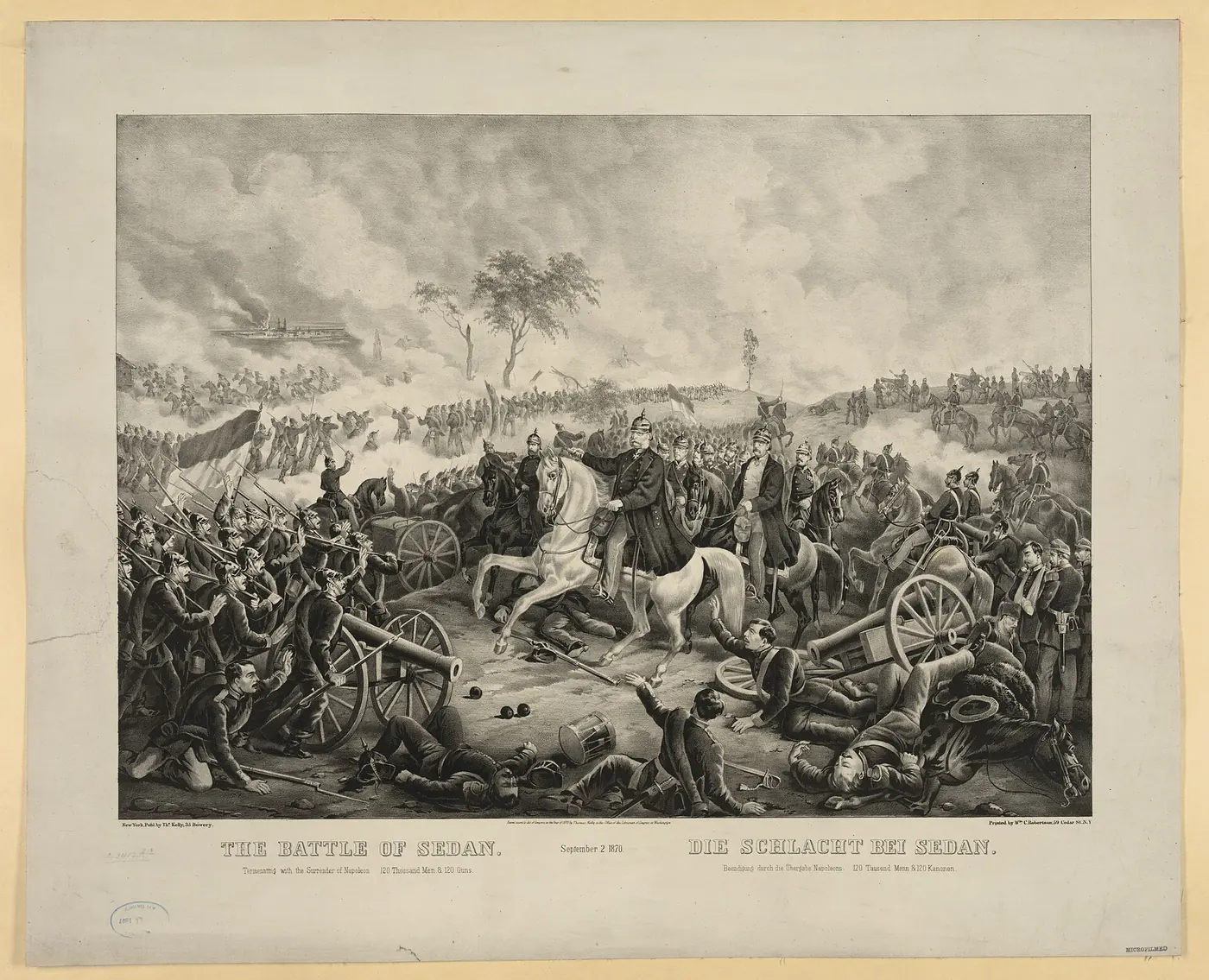
The Franco-Prussian War was fought between France and a coalition of German states led by Prussia from July 1870 to May 1871. France entered the war as the strongest military power on the European continent. Ten months later it had lost its emperor, its capital, two eastern provinces, and its standing. Prussia's chancellor, Otto von Bismarck, had wanted the war and had arranged for France to start it. His goal was to unite Germany under Prussian leadership, and he succeeded. On January 18, 1871, before the fighting was over, Wilhelm I was declared the first German Emperor in a ceremony at Versailles, held in the palace's Hall of Mirrors. The location was chosen on purpose, to humiliate France.
How Bismarck provoked the Franco-Prussian War
Bismarck had already brought the northern German states under Prussian control by beating Austria in a short war in 1866. But the southern states, especially Catholic Bavaria, did not want to join a Protestant, Prussian-led nation voluntarily. Bismarck calculated that a war with France would give them a common enemy and pull them in. He needed France to be the aggressor.
The pretext came in 1870. The Spanish throne was vacant, and a Hohenzollern prince, a relative of the Prussian king, was offered the crown. France objected. Having a branch of Prussia's royal family on the thrones in both Berlin and Madrid looked like encirclement.
The French ambassador met King Wilhelm I at the spa town of Ems and asked for a guarantee that no Hohenzollern would ever accept the Spanish throne. Wilhelm politely declined. A telegram reporting the meeting was sent to Bismarck in Berlin. Bismarck shortened and rewrote the telegram before releasing it to the press. In the edited version, the French ambassador had made an unreasonable demand, and the Prussian king had dismissed him. The edited message, known as the Ems Dispatch, worked exactly as Bismarck intended. The French press and public were outraged, and France declared war on July 19, 1870.
How Prussia defeated France
The war's outcome was decided in its first six weeks. Prussia had advantages France could not match: a general staff that had planned the campaign in advance, railway schedules for moving troops to the front, mass conscription that gave it a deep pool of trained reservists, and modern Krupp steel cannons that loaded from the breech. France had professional soldiers and a superior rifle, the Chassepot, which could hit targets at twice the range of its Prussian counterpart. But France had no mobilization plan and no coordinated strategy.
Two French armies were encircled almost at once. At the Battle of Sedan on September 1, 1870, the main French field army was surrounded and pounded by artillery until it surrendered. About 104,000 French soldiers were captured, along with Emperor Napoleon III. The emperor was 62 years old and so ill with bladder stones that he could barely sit on his horse. Two days after Sedan, Napoleon III's government fell and Paris declared a republic.
The new republic refused to surrender. Paris was besieged from September 1870 to January 1871. Food ran so short that Parisians ate the animals from the city zoo. Improvised French armies continued fighting outside the capital but could not break through.
How did the Franco-Prussian War end?
Paris surrendered in late January 1871. The Treaty of Frankfurt, signed in May 1871, required France to give up Alsace and about a quarter of Lorraine. It also required France to pay an indemnity of five billion francs, roughly $26 billion in today's money. German troops would occupy parts of France until the debt was paid. France raised the money through two enormous bond issues and paid it all by September 1873, ahead of schedule.
Bismarck's generals had insisted on annexing Alsace-Lorraine as a military buffer. Prussia's chancellor, Bismarck, doubted the annexation was worth the damage it would cause. Events proved him right: the lost provinces made France a permanent enemy of Germany.
In March 1871, before the treaty was even signed, Paris rose in revolt. The city had been humiliated by the siege and was still heavily armed. Parisians rebelled against the new national government and set up the Paris Commune. French troops crushed it in late May during a week of street fighting called the Bloody Week. Between 10,000 and 20,000 Parisians were killed.
The Franco-Prussian War and World War I
The war created a new Europe. A united Germany sat in the center of the continent with its strongest army and its fastest-growing industrial economy. None of its neighbors solved that problem peacefully.
France never accepted the loss of Alsace-Lorraine. Recovering the provinces became a central goal of French politics, and when World War I began in 1914, it was among France's first stated war aims. For twenty years after the war, Bismarck built a system of alliances designed to keep France isolated. After Bismarck left office in 1890, those alliances frayed, and France found partners in Russia and eventually Britain.
The Franco-Prussian War also taught military planners a misleading lesson. The fighting in 1870 had been short, mobile, and decided by fast mobilization and offensive action. Every European general staff built its next war plan on that model. Germany's Schlieffen Plan assumed a quick victory in the west before turning east to face Russia. But by 1914, machine guns, barbed wire, and rapid-firing artillery had made offensive warfare enormously costly. The plans designed to repeat 1870 produced the trench warfare of World War I instead.
The Treaty of Versailles that ended World War I was signed in the same Hall of Mirrors where the German Empire had been proclaimed 48 years earlier. The French chose the location deliberately.