
Crusades
The Crusades were wars between European Christians and Muslim forces for control of Jerusalem and the Holy Land from 1095 to 1291.
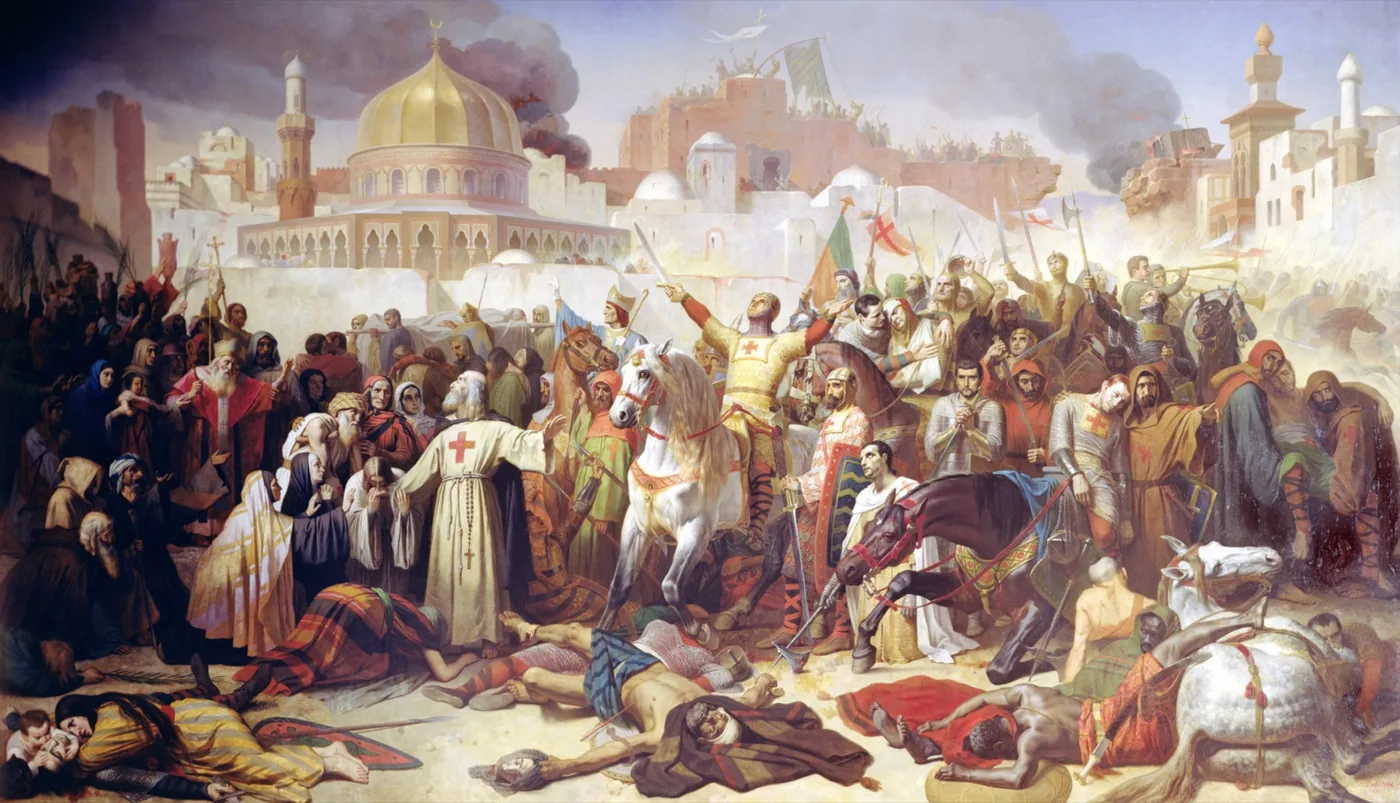
The Crusades were two centuries of warfare between European Christians and Muslim powers over control of Jerusalem and the lands around it. They began in 1095, when Pope Urban II called on Western knights to march east, and ended in 1291, when Muslim armies captured the last major Crusader stronghold. The wars killed an estimated one to three million people, planted a few Christian kingdoms on the Levantine coast that lasted no more than two centuries, and poisoned relations between Christianity and Islam for generations. The word "Crusade" still carries political weight today. Western leaders have used it to describe grand causes, and jihadist groups have used it to frame Western military campaigns as a continuation of the medieval wars.
How Pope Urban II launched the First Crusade
In 1071, Seljuk Turks defeated the Byzantine Empire at the Battle of Manzikert and overran most of its territory in Asia Minor. The empire, once the strongest Christian power in the world, was suddenly fighting for survival. In 1095, the Byzantine emperor Alexios I sent envoys to Pope Urban II asking for military help.
Urban saw an opportunity. On November 27, 1095, he stood before a council of bishops at Clermont in southern France and called on Western knights to help their fellow Christians and to free Jerusalem from Muslim rule. He promised full forgiveness of sins to anyone who took the journey. The crowd reportedly answered with the cry "God wills it." Urban was a Frenchman, born Odo of Lagery, and had spent years building alliances across the church before risking this gamble.
Tens of thousands of people took the cross, meaning they pledged to go on Crusade. Their motives varied. Some were driven by genuine religious devotion. Others wanted land, wealth, or adventure. Younger sons who had no inheritance saw a chance to gain titles. The papacy wanted to channel Europe's quarrelsome warrior class toward a common cause.
The First Crusade succeeded against long odds. The Crusaders broke through Jerusalem's walls in July 1099 and killed many of the city's Muslim and Jewish inhabitants. They established four Crusader states in the region: the Kingdom of Jerusalem, the County of Tripoli, the Principality of Antioch, and the County of Edessa.
How the Crusader states fell
Holding the conquered territory proved harder than taking it. The Crusader states had a Muslim majority ruled by a thin layer of European Christians, and they depended on reinforcements from Europe, thousands of miles away by sea.
In 1187, Saladin, a Kurdish-born general who had united Egypt and Syria, destroyed the main Crusader force at Hattin, near the Sea of Galilee. He then retook Jerusalem. Unlike the Crusaders in 1099, Saladin did not order a general massacre. He allowed most of the city's Christian inhabitants to leave after paying a ransom, and he let the elderly poor go free.
The fall of Jerusalem prompted the Third Crusade, led by King Richard I of England, known as Richard the Lionheart. Richard had been leading armies since he was 16 and was already a seasoned commander. He won battles along the coast and helped capture the port city of Acre, but he never retook Jerusalem. In 1192, he negotiated a truce with Saladin that allowed Christian pilgrims to visit the city.
Later Crusades either failed or went badly wrong. The Fourth Crusade, launched in 1202, never made it to the Holy Land. The Crusaders owed Venice a large debt for transporting them by sea. A Byzantine prince offered to pay it if they helped him seize the throne in Constantinople. When the promised money did not come, the Crusaders sacked the city. Constantinople was Christendom's largest and richest city. It was also the capital of the empire that the Crusades were originally supposed to protect. The destruction weakened the Byzantine Empire so badly that it never fully recovered.
Muslim forces retook the remaining Crusader strongholds one by one over the following decades. In 1291, Mamluk armies besieged the port city of Acre with the largest Muslim force assembled in the entire two centuries of Crusading warfare. Acre fell on May 18, and some of the surviving defenders fled by sea to Cyprus. The goal of a permanent Christian kingdom in the Holy Land was abandoned.
How many Crusades were there?
Historians traditionally number eight or nine major Crusades, though the count depends on which expeditions are included. The first five are agreed on by most scholars. After that, numbering varies because later expeditions were smaller, overlapping, or directed at targets other than the Holy Land. Popes eventually directed Crusades against heretics and political rivals within Europe itself.
The most important were the First Crusade (1096-1099), which captured Jerusalem; the Third Crusade (1189-1192), which failed to recapture it; and the Fourth Crusade (1202-1204), which sacked Constantinople instead. Italian merchant cities, especially Venice and Genoa, grew rich throughout the Crusading era by transporting armies and by monopolizing trade with the East.
Why the word Crusade still matters
For centuries, the Crusades held a much larger place in European memory than in the Muslim world, where they were remembered as just one of many waves of invaders. That changed in the nineteenth and twentieth centuries, as European powers took control of parts of the Middle East and the word "Crusade" was revived as a symbol.
Western leaders have reached for the word to describe a grand cause. In September 2001, President George W. Bush called the war on terrorism "this crusade," a phrase that drew immediate criticism in the Muslim world and that the White House quickly walked back. Jihadist movements have used the word from the other side. In 1998, Osama bin Laden and his allies issued a declaration of war. They signed it as the "World Islamic Front for Jihad against Jews and Crusaders."
The fighting ended over 700 years ago, but the word still appears in political speeches and recruitment propaganda on both sides.