
Byzantine Empire
The Byzantine Empire was the Greek-speaking eastern half of the Roman Empire, centered on Constantinople from 330 to 1453.
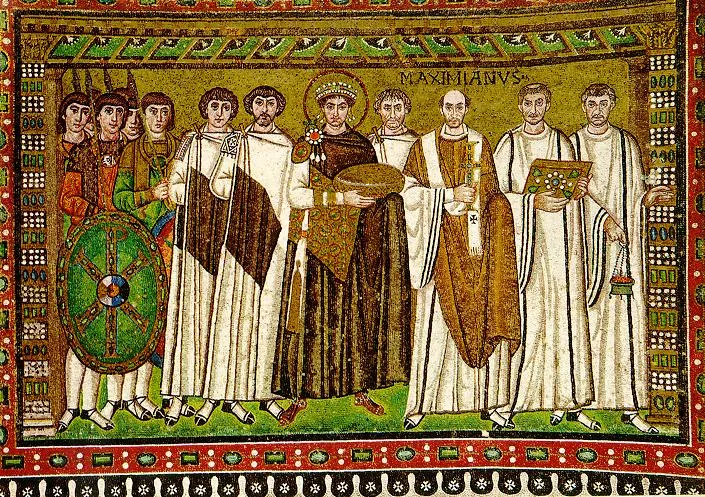
The Byzantine Empire was the eastern half of the Roman Empire. After the western half collapsed in 476, the eastern half, richer and Greek-speaking, continued for almost another thousand years. Its capital was Constantinople, the city that Emperor Constantine founded in 330 on the site of an old Greek town called Byzantion. At its height the city had roughly half a million people. It was the largest and wealthiest city in the Christian world. The empire's people never called themselves Byzantine. They called themselves Romaioi, meaning Romans, and traced their state in an unbroken line from Augustus. The name "Byzantine" was coined by European historians about a century after the empire fell.
How Constantinople survived for a thousand years
Constantine chose the site for its position on the Bosphorus, the narrow strait between Europe and Asia. The city sat on a peninsula defended on three sides by water. In the fifth century, Emperor Theodosius II built triple land walls across the peninsula's western approach: a moat, then a low outer wall, then an inner wall 12 meters high and nearly 5 meters thick. The walls held for the better part of a thousand years.
While western Europe broke into small kingdoms after Rome's fall, Constantinople thrived as a trading center between the Mediterranean and the Black Sea. Its hippodrome seated tens of thousands of spectators for chariot races. For centuries the empire fought off invasions by Persia, the Arab caliphates, and the Seljuk Turks, keeping them from pushing farther into Europe.
Justinian and the height of the Byzantine Empire
The empire reached its greatest extent under Justinian I, who ruled from 527 to 565. Justinian came from peasant stock in the Balkans. His uncle Justin, an illiterate soldier who later rose to become emperor, brought his nephew to Constantinople for an education. Justinian married Theodora, a former actress and the daughter of a bear-keeper at the hippodrome. She became one of his closest political advisers. Justinian's generals reconquered North Africa, Italy, and parts of Spain, briefly reuniting much of the old Roman world.
Justinian had Roman law collected and organized into a single code, the Corpus Juris Civilis, completed between 529 and 534. It gathered centuries of legal rulings into one system and became the foundation of most continental European legal traditions.
Justinian also commissioned Hagia Sophia, completed in 537 after less than six years of construction. According to legend, he said upon entering the finished building: "Solomon, I have surpassed thee." The dome remained one of the largest in the world for nearly a thousand years.
Byzantine engineers also developed Greek fire, a liquid weapon that burned on water. Crews sprayed it from bronze tubes mounted on the bows of warships. The exact recipe was a state secret, and no rival power managed to copy it. Greek fire helped Constantinople's navy destroy enemy fleets for centuries.
Why did the Byzantine Empire fall?
The decline took centuries. In 1054, disputes over doctrine and papal authority produced the Great Schism, the permanent split between the Roman Catholic Church in the west and the Eastern Orthodox Church.
In 1204, the Fourth Crusade, an army of French and Venetian crusaders raised to fight in the Holy Land, turned on Constantinople instead. The crusaders stormed the city, looted it for three days, and killed around 2,000 civilians. They shipped bronze statues and church relics back to Europe. The four bronze horses from the hippodrome went to Venice, where they still stand at St. Mark's Basilica. The empire that remained was far smaller, a few provinces clustered around a capital too large for them.
By the fifteenth century the Byzantine Empire was effectively a city-state. In 1453, Ottoman sultan Mehmed II, 21 years old, arrived with a large army and a set of enormous cannons cast by a Hungarian engineer named Orban. The largest cannon could hurl a stone ball weighing over 250 kilograms more than a mile. After a 55-day siege, Ottoman troops broke through the walls on May 29, 1453. Constantinople fell, and the empire ended after 1,123 years.
What the Byzantine Empire left behind
For a thousand years, Byzantine monks copied and preserved the works of Plato, Aristotle, Euclid, and other ancient Greek writers whose works had largely disappeared from western Europe. When the Ottomans advanced during the fourteenth and fifteenth centuries, Greek scholars brought these manuscripts west to Italy, helping to spark the Renaissance rediscovery of classical learning.
The empire also passed its faith and its alphabet to the Slavic world. Russia adopted Orthodox Christianity and the Cyrillic script. After the city fell, Russian rulers claimed Moscow as the "Third Rome," heir to an empire that had outlived its founders by a thousand years.
Byzantine law, preserved in Justinian's code, shaped the legal systems of continental Europe. The Orthodox churches the empire planted still have roughly 220 million members. The empire is gone, but its law, its alphabet, its faith, and the ancient books it preserved all outlasted it by centuries.