
Jihad
Jihad is an Arabic word meaning striving or exertion, covering a spectrum from personal moral struggle to armed warfare.
Jihad is an Arabic word meaning "striving" or "exertion." Its most common Quranic form is "jihad fi sabil Allah," which translates to effort in the cause of God. The word covers a range from private moral discipline to armed warfare. It is not a synonym for "holy war." Arabic has a distinct term for that concept, harb muqaddasa, but the classical Islamic literature barely uses it.
The question of where a given situation falls on that range is a question about authority. For most of Islamic history, classical scholars and the caliphate controlled the answer. In the twentieth century, after the caliphate was abolished, new figures with no traditional standing claimed the right to declare jihad. The established religious scholars overwhelmingly rejected those claims. The central argument over jihad today is between a scholarly tradition that set limits on warfare and a modern movement that stripped away those limits while keeping the word.
How classical scholars governed jihad
Under the rules developed by classical jurists of Islamic law, armed jihad carried the status of a collective obligation, fard kifaya. If enough members of the Muslim community fought, the rest were excused. That status shifted to an individual duty, fard ayn, required of every Muslim, when an enemy invaded Muslim lands.
The jurists set conditions. Only a legitimate authority, the caliph or another Muslim ruler, could declare armed jihad. Certain categories of people, including women, children, the elderly, clergy, and those who worked the land, were protected from attack. Any truce or surrender terms that were offered had to be honored. Destruction of crops and animals without military necessity was forbidden. These rules were violated regularly, but the ulama enforced them in their writings and rulings.
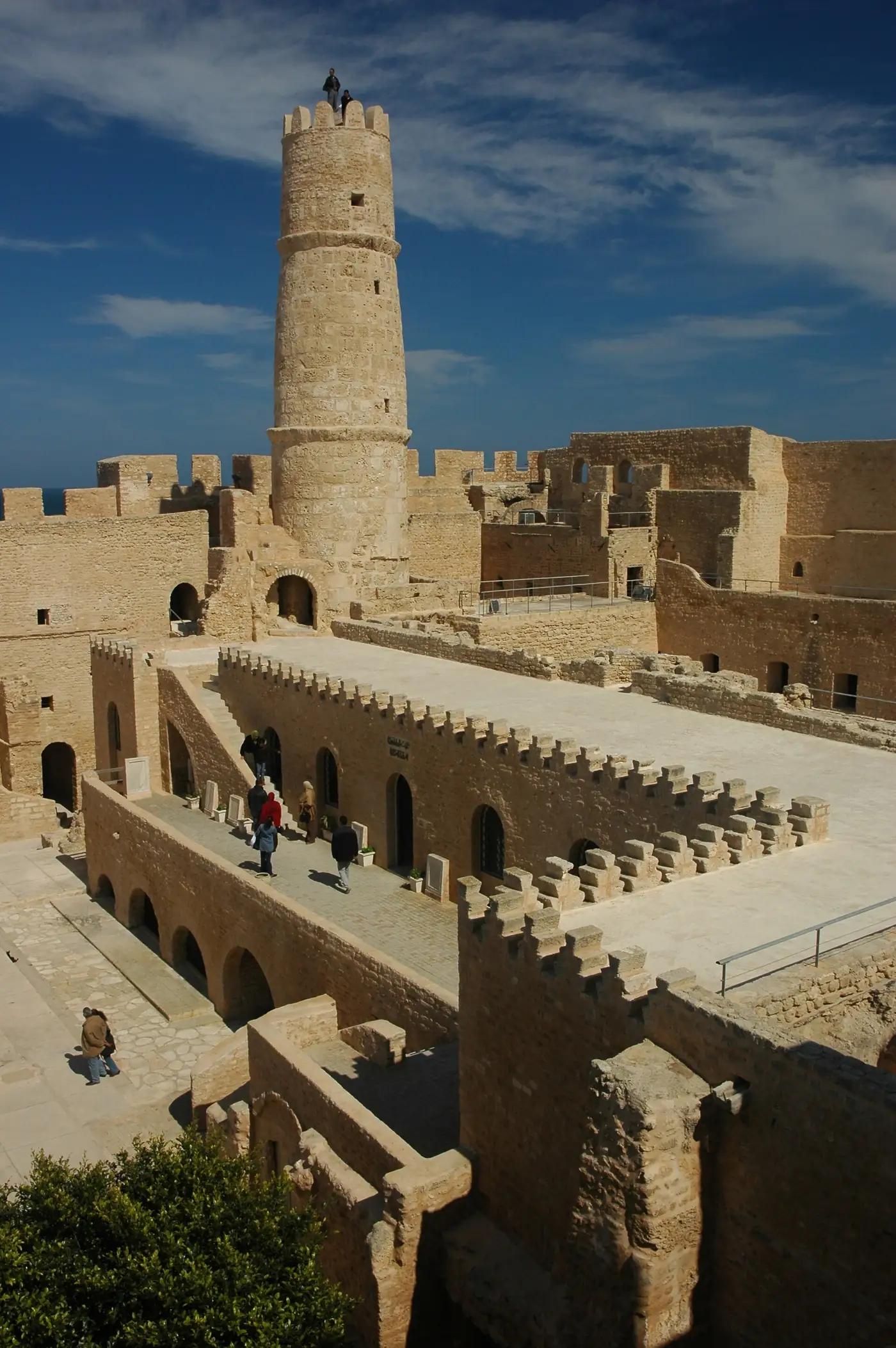
The institution of the ribat shows how the spiritual and military sides of jihad coexisted. A ribat was a garrison built on the edge of Muslim territory, part military outpost and part monastery. Volunteers served a rotation of guard duty, prayer, and study. They were built across coastal North Africa and on the edges of Central Asia. One of the oldest surviving ones, at Monastir in Tunisia, dates to 796. Serving time at a ribat was considered a devotional act.
How jihad became a modern political cause
In the twelfth century, preachers based in Damascus and Aleppo brought jihad back as a rallying cry. Their target was not Christians but Muslim rulers who were making deals with the Crusader states instead of fighting them. The preachers used the concept to shame these rulers into action, and the campaign helped produce the rise of Saladin, who united Muslim forces and retook Jerusalem in 1187.
The classical system had a built-in answer to the question of who could declare jihad: the caliph. On March 3, 1924, Turkey's Grand National Assembly abolished the Ottoman caliphate. The office that jurists had recognized as the legitimate authority for declaring jihad no longer existed. After 1924, the question of who had the right to issue such a declaration was open.
Sayyid Qutb, an Egyptian thinker executed in 1966, claimed that rulers who called themselves Muslim had fallen back into a state of pre-Islamic ignorance, which he called jahiliyyah, and that fighting them was justified. Muhammad abd al-Salam Faraj took the argument a step further. In 1981, Faraj wrote a pamphlet called "The Neglected Duty," arguing that armed jihad was an obligation most Muslims had abandoned. Copies of the pamphlet spread through the cell that killed Egyptian President Anwar Sadat that October. Faraj was executed in 1982.
Osama bin Laden went further still. In declarations issued in 1996 and 1998, he asserted that every individual Muslim had a personal obligation to kill Americans and their allies. Bin Laden had no scholarly credentials. The vast majority of recognized ulama dismissed his declarations as a claim to authority that no individual had the right to make.
Does jihad mean holy war?
No. Jihad means "striving" or "exertion." Arabic has its own term for "holy war," harb muqaddasa, but that phrase barely appears in the classical literature. In Western usage, jihad is often treated as a direct translation of "holy war," but this collapses the word's full range of meanings into a single military definition.
Muslims have understood jihad as covering far more than warfare for fourteen centuries. The Sufi tradition built centuries of spiritual literature around jihad as an inner struggle against the self. Armed groups in the twentieth and twenty-first centuries claimed the word exclusively for warfare. Treating jihad as though it means only armed conflict accepts their narrower definition and sets aside the longer tradition.
What is the difference between greater and lesser jihad?
A well-known hadith describes the Prophet Muhammad returning from battle and telling his companions that they had moved from the "lesser jihad," armed struggle, to the "greater jihad," the effort to master one's own desires and shortcomings. The Sufi tradition embraced this teaching and built centuries of spiritual practice around it.
Hadith specialists, however, generally classify this report as weak (da'if), meaning its chain of transmission is not reliable. Scholars including Ibn Taymiyyah and al-Albani have challenged its authenticity, and it does not appear in any of the major hadith collections. Despite this, the distinction between an inner, spiritual jihad and an outer, physical one has remained a lasting part of Islamic thought. Many Muslims today understand jihad primarily as a personal moral struggle rather than a call to arms.