
Saladin
Saladin was the Kurdish sultan who united Egypt and Syria, took Jerusalem from the crusaders in 1187, and fought Richard the Lionheart to a draw.
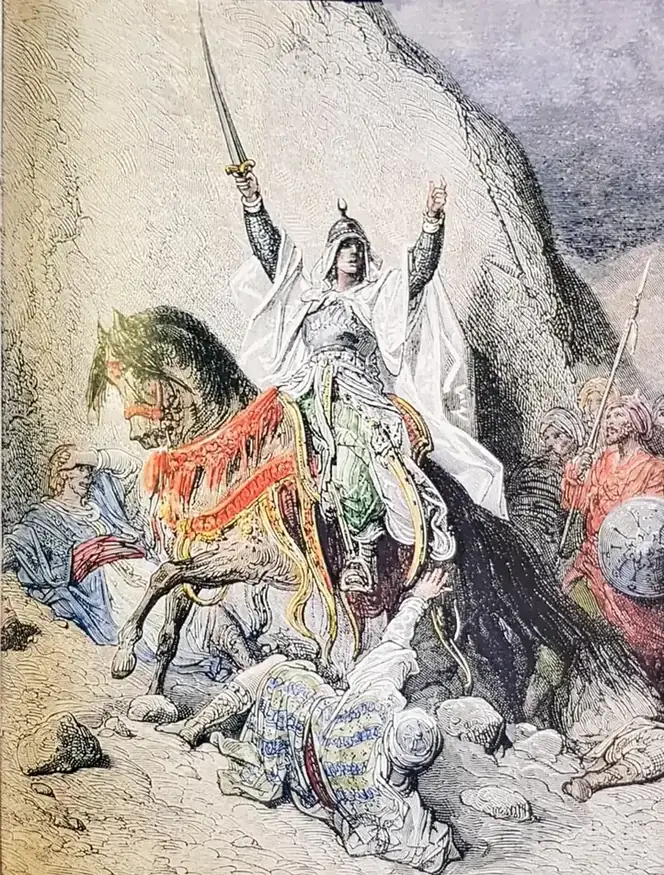
Saladin was a Kurdish Muslim sultan who united Egypt and Syria and took Jerusalem from the crusaders in 1187. His full name was Salah al-Din Yusuf ibn Ayyub. He was born around 1137 in Tikrit, a city in present-day Iraq, and died in Damascus in 1193. When his army took Jerusalem, he chose not to repeat the massacre the crusaders had carried out eighty-eight years before. He agreed to terms with the defenders, setting ransoms and freeing thousands who could not afford to pay. That restraint made him famous in Europe as well as the Muslim world. Christian chroniclers who opposed everything Saladin stood for wrote admiringly of his mercy and his word.
How Saladin united Egypt and Syria
Saladin grew up in a Kurdish family that worked for Turkish military commanders. As a young man he traveled to Egypt with his uncle Shirkuh's expedition, serving as a low-ranking officer. By his own account, he had no desire to make the journey. But he advanced fast. He became vizier of the Fatimid caliphate in Cairo in 1169, and two years later he abolished the caliphate itself, bringing two centuries of Shia governance in Egypt to an end and placing the country under Sunni authority.
After Nur al-Din, his overlord in Syria, died in 1174, Saladin took Damascus for himself. Over the next twelve years he fought a series of wars against rival Muslim princes, above all the Zengids of Aleppo and Mosul, until he controlled both Egypt and Syria. His rivals charged that he used the banner of holy war as a pretext to build a personal dynasty. But the strategy had a military logic. For nearly a century, the crusader kingdoms had kept themselves alive by setting Cairo and Damascus against each other. Only a ruler who held both could challenge them.
How Saladin took Jerusalem
After a crusader baron named Reynald of Chatillon attacked a Muslim caravan and violated the truce, Saladin invaded the Kingdom of Jerusalem. On July 4, 1187, he lured the full crusader army into the waterless hills near the Sea of Galilee and destroyed it at the Battle of Hattin. Saladin captured the King of Jerusalem and seized the True Cross, the crusaders' most valued relic. With almost no fighting men left to defend the kingdom, Jerusalem surrendered on October 2, 1187. Nearly every other crusader stronghold in the kingdom fell in the months that followed. Only Tyre held out.
When the crusaders took Jerusalem in 1099, they had killed many of the people inside. Saladin did not do the same. He set ransoms for the population. Those who paid left freely. He released thousands who could not afford the price, and his brother al-Adil secured the freedom of a thousand additional captives. Christian chroniclers across Europe, even those who despised Saladin, recorded this restraint with admiration. It became the foundation of his lasting reputation in the West.
Saladin and Richard the Lionheart
Europe responded with the Third Crusade, led by three kings. Frederick Barbarossa of Germany drowned crossing a river on the march. Philip II of France left after a few months. Richard I of England, the Lionheart, remained and took command. Richard captured the port of Acre, beat Saladin at the Battle of Arsuf, and twice advanced to within sight of Jerusalem. Both times he withdrew. Richard recognized that holding the city would be impossible once his forces returned to Europe.
The two sides agreed to the Treaty of Jaffa in 1192. Saladin kept Jerusalem, and Christian pilgrims received the right to visit the holy sites.
How did Saladin die?
Saladin died in Damascus on March 4, 1193, at about 55 years old. He had been ill with a fever for two weeks. A modern doctor who has examined the historical accounts believes typhoid was the most likely cause, though no one can be certain at this distance. By most accounts, he had given away so much of his personal fortune over his lifetime that there was not enough left to pay for his funeral. The money had to be borrowed. He is buried in a mausoleum beside the Umayyad Mosque in Damascus.
His empire did not survive him intact. His sons split it among themselves, and his brother al-Adil eventually reunited Egypt and Syria. The Ayyubid dynasty that Saladin founded ruled Egypt until 1250, when its own slave soldiers, the Mamluks, overthrew the last Ayyubid sultan and took power.
Saladin's legacy in Europe and the Middle East
Saladin's reputation began growing almost immediately after his death, and people with very different interests have claimed him ever since. Dante placed him among the virtuous pagans in the Divine Comedy. Walter Scott wrote him as a model of generosity and fair dealing in the 1825 novel The Talisman. Kaiser Wilhelm II traveled to Saladin's resting place in Damascus in 1898 and had its marble sarcophagus restored, part of a broader effort to present Germany as a friend of the Muslim world.
In the twentieth century, Arab nationalists took him up. Egypt's president, Gamal Abdel Nasser, invoked him. Syria's president, Hafez al-Assad, erected a statue of Saladin outside the Damascus citadel. Iraq's president, Saddam Hussein, another native of Tikrit, commissioned paintings of himself alongside Saladin. Kurds, meanwhile, point out that the man all these Arab leaders claimed was Kurdish. More than eight centuries after his death, Saladin remains widely recognized in both the Western and Muslim worlds.