
Devshirme
The devshirme was the Ottoman practice of taking Christian boys from the Balkans and training them as soldiers and officials.
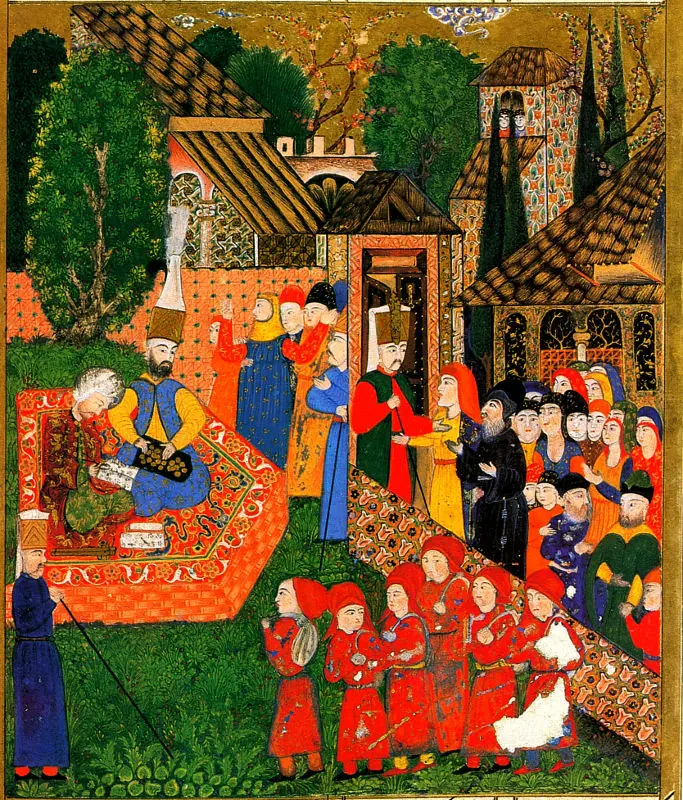
The devshirme was a system the Ottoman Empire used to take Christian boys from villages in the Balkans, convert them to Islam, and train them for service to the sultan. The word means "collecting" in Turkish, and the practice was also called the "blood tax." It probably began in the late 1300s and continued, with gaps, into the early 1700s. Every few years, Ottoman officials traveled through Christian communities in what are now Greece, Serbia, Bosnia, Albania, and Bulgaria and chose boys for the levy, most of them between eight and eighteen years old. The children were taken from their families and marched to the Ottoman capital. They almost never returned, and their families rarely learned what became of them. Some of the boys went on to lead armies, administer provinces, and hold the empire's highest offices. Sokollu Mehmed Pasha, taken from a shepherd family in Bosnia, became grand vizier and ran the Ottoman government for fourteen years.
How the devshirme levy worked
When the sultan ordered a levy, a decree set how many boys were needed. Recruiting officers arrived in selected villages and required the local priest to hand over his baptismal register. They used it to identify boys and selected the ones they judged strongest and most promising. Only sons of Christian families were eligible. Jewish and Armenian communities were generally excluded. Muslim families were formally barred. Some bribed officials to smuggle their sons into the devshirme anyway, because of the careers it could lead to.
The selected boys were taken to the capital and divided into two tracks. The most promising went to the palace school in Istanbul, where they studied Turkish, Arabic, Persian, Islamic law, and administration. These boys were being trained to run the empire. The rest were placed with Turkish farming families in Anatolia, where they learned the language, adapted to Muslim life, and built physical strength over several years. After that period, they joined the Janissaries, the sultan's personal infantry corps. Together, the two tracks supplied both the Ottoman government and the Ottoman military with men who had been trained from childhood for the job.
Why the Ottoman sultans relied on the devshirme
Legally, every boy taken through the devshirme became a "kul," a slave of the sultan. In practice, the most capable devshirme men governed provinces, commanded fleets, and served as grand vizier, the highest office in the empire below the sultan himself.
The best-known example is Sokollu Mehmed Pasha. He was born around 1505 to a Serbian Orthodox family of shepherds near what is now Rudo in Bosnia. His original name was probably Bajica. When the devshirme officers came for him, his family did not want to let their son go. The recruiting officer talked them into it and took him to Edirne along with about forty others collected that year. Sokollu rose through the palace school, became a military commander, and served as grand vizier from 1565 to 1579 under three sultans, including Suleiman the Magnificent. He was assassinated in 1579.
The reason the sultan valued men like Sokollu was that they had no family connections in the Ottoman elite and no hereditary claim to power. They owed their position entirely to the sultan. A powerful Turkish aristocracy might have challenged the throne, as noble families regularly did in European kingdoms. The devshirme elite could not, and that was the point. The system gave the sultan a governing class that depended on him alone.
For most families, losing a son to the devshirme meant losing him to a foreign religion and a distant city. But the system had a record of producing powerful men, and not every family saw the levy the same way. Records show some Christian families trying to get their sons selected, and Muslim families paying bribes to get past the ban.
How the devshirme ended
Over time, the devshirme became unnecessary. Janissaries gained the right to marry and pass their positions to their sons. As the corps increasingly passed from father to son, the need for new recruits from the Balkans shrank. The last known devshirme levy was ordered for Greece in 1705.
The Janissary corps survived for another century, but it changed. The corps grew in number but lost discipline. Janissaries became a political force in Istanbul, deposing sultans they opposed and blocking reforms that threatened their privileges. By the early 1800s the Janissaries challenged the Ottoman government more often than they served it.
Sultan Mahmud II ended them on June 15, 1826. He had begun forming a new army trained on European methods. When the Janissaries revolted against his reforms, he ordered artillery to bombard their barracks in Istanbul. Thousands were killed. The survivors were executed, exiled, or imprisoned. The day became known as the Auspicious Incident. For three centuries, the devshirme had supplied the Ottoman Empire with soldiers and officials, all of them taken as children from the peoples the empire ruled.