
Janissaries
The Janissaries were the Ottoman sultan's elite infantry, formed from Christian boys taken from Balkan villages.
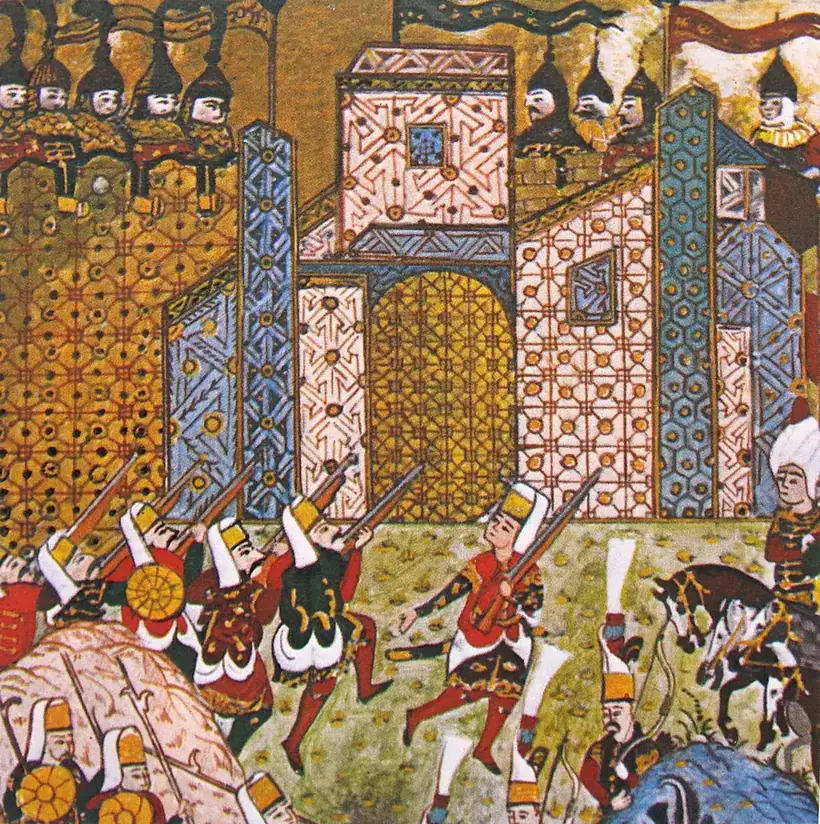
The Janissaries were the Ottoman Empire's professional standing infantry. Sultan Murad I created the corps in the late 1300s, at a time when most European armies were feudal forces that assembled for a campaign and disbanded when it ended. The Janissaries lived in barracks, trained constantly, received a salary, and answered only to the sultan. Until the late 1500s, the majority were born into Christian families. Ottoman officials took boys from villages across the Balkans, converted them to Islam, and trained them as soldiers through a system called the devshirme. For about two centuries, the Janissaries were among the best infantry in Europe. They helped Mehmed II take Constantinople in 1453 and fought in nearly every major Ottoman campaign until Sultan Mahmud II destroyed the corps in 1826.
How the devshirme built the Janissary corps
Every few years, Ottoman officials went into Balkan villages with Christian populations and took a quota of boys, roughly aged eight to eighteen. The practice was called the devshirme, meaning "collection" in Turkish. The families who lost sons called it the blood tax.
These boys were taken to Istanbul, converted to Islam, and taught Turkish. Officials sorted them by ability. The most talented entered the palace schools, where they trained to become administrators. Some rose to become grand vizier, the most powerful office in the empire after the sultan. The rest trained as soldiers.
Legally, every one of these boys was the sultan's slave, called kapıkulu. But the word is misleading in this context. A shepherd's son from a Serbian village could command armies or run the empire. The system cut boys off from their families and clans on purpose. With no local ties and no loyalty except to the sultan, they were supposed to be impossible to corrupt. For generations, the design worked.
How the Janissaries fought and what made them effective
Early Janissaries held two advantages over their opponents. They drilled as a unit while most European armies were collections of feudal knights who fought as individuals. And they adopted gunpowder muskets early, at a time when many European knights still considered firearms beneath them.
The Janissaries were the core of the Ottoman force at the Battle of Kosovo in 1389. They helped Mehmed II take Constantinople in 1453. They defeated the Hungarian army at Mohács in 1526. In 1683, they reached the walls of Vienna, the deepest Ottoman advance into central Europe.
They also brought their music. The Janissary military bands, called mehter, marched with drums, cymbals, and zurna pipes. European armies copied the style. Mozart, Haydn, and Beethoven all wrote pieces in what they called the "alla turca" style, imitating the sound of the mehter. The modern military marching band descends in part from these Ottoman bands.
How the Janissaries turned against the sultans
Over the generations, the Janissaries gained privileges that changed the corps. They gained the right to take wives, pass membership to their sons, and earn money from trades outside the corps. The rolls swelled with men who drew a salary but rarely trained or fought. Like Rome's Praetorian Guard, the Janissaries learned they could use their position to control who ruled.
In 1622, Sultan Osman II tried to weaken the Janissaries by building a new army. The Janissaries revolted, dragged the seventeen-year-old sultan through the streets of Istanbul, and strangled him. Osman II was the first Ottoman sultan killed by his own soldiers. Over the next two centuries, the Janissaries blocked every attempt at military reform that threatened their privileges.
By the early 1800s, the corps was militarily obsolete and stood in the way of the modernization the empire needed. In June 1826, Sultan Mahmud II set a deliberate trap. He announced the creation of a modern army trained on European lines. The Janissaries revolted as expected, signaling mutiny by overturning their ceremonial cooking kettles. This time, Mahmud II was ready. Loyal artillery units bombarded the Janissary barracks in Istanbul and set them on fire, killing thousands within hours. Thousands more were executed, exiled, or imprisoned in the weeks that followed. Ottoman chroniclers named the event the Vaka-i Hayriye, the Auspicious Incident.
Were Janissaries slaves?
Legally, yes. Every Janissary was classified as the sultan's personal slave, called kapıkulu. But Janissaries earned a salary, held property, and could rise to the highest offices in the empire. The most capable among them governed provinces and commanded armies. The system was closer to a forced military draft combined with a path to power than to chattel slavery.
People sometimes ask whether Janissaries were castrated. They were not. The Ottoman palace did use castrated men as eunuchs to guard the harem, but those were a separate group. Boys taken through the devshirme who became Janissaries served as soldiers and were not castrated.