
Suleiman the Magnificent
Suleiman the Magnificent was the Ottoman sultan whose 46-year reign marked the empire's golden age of conquest, law and art.
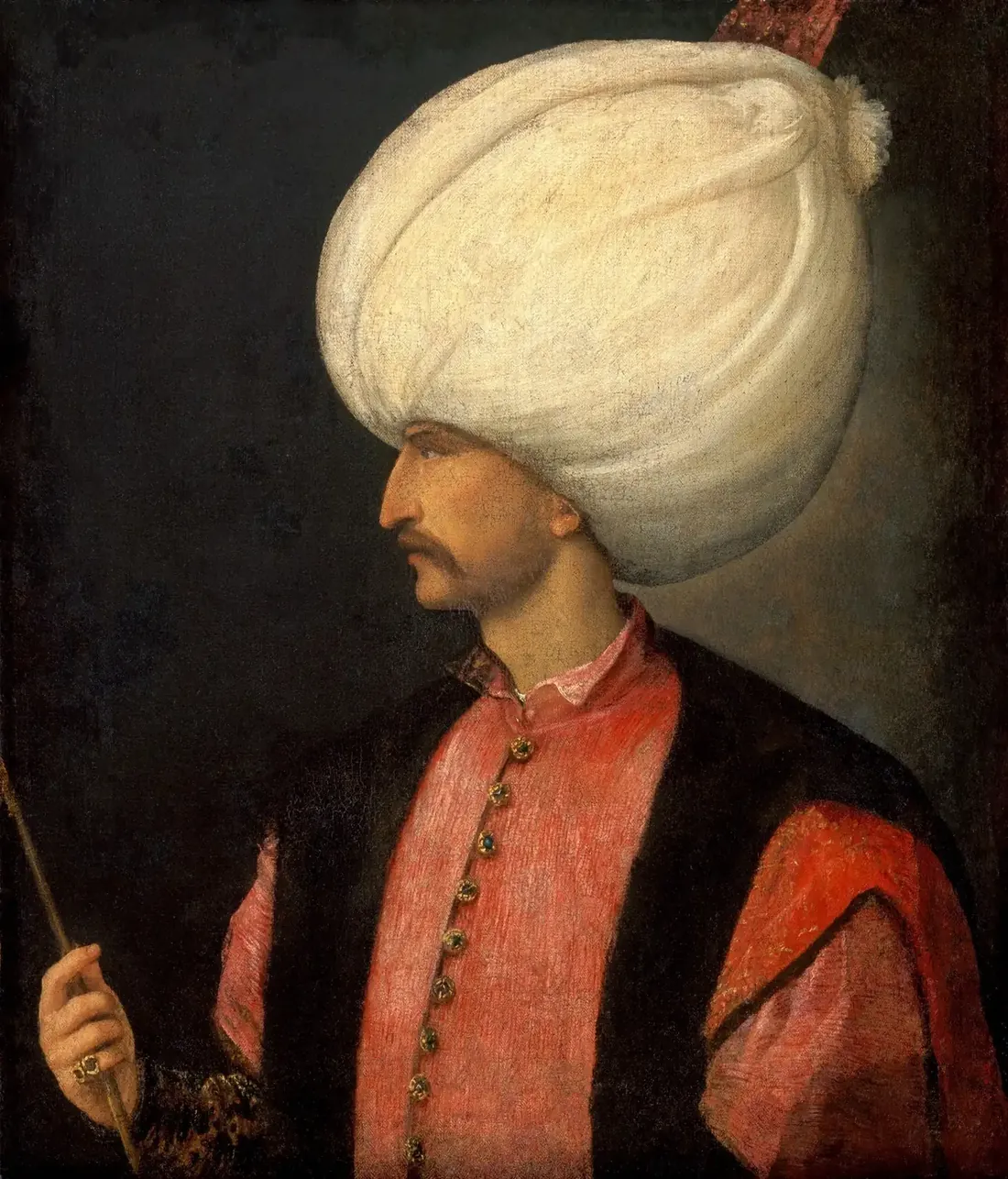
Suleiman the Magnificent was the tenth sultan of the Ottoman Empire and its longest-reigning ruler, holding power from 1520 until his death in 1566. Europeans called him "the Magnificent" for the wealth and military force he brought against their continent. Within the empire he was known as Kanuni, "the Lawgiver," for the legal code he created. During his 46-year reign, the Ottoman Empire reached its peak in power, wealth and cultural achievement, ruling about 25 million people from Hungary to North Africa to the Persian Gulf. Suleiman conquered Belgrade, destroyed the Hungarian kingdom at Mohács, besieged Vienna, and sent his fleets to control the Mediterranean. He also married a former slave, ordered the killing of two of his own sons, and died at 71 in his tent on campaign in Hungary.
How Suleiman pushed deep into Europe
Suleiman was born in 1494 in Trabzon, a port city on the Black Sea coast, where his father Selim served as provincial governor. He was Selim's only surviving son. When Selim died in 1520, Suleiman inherited both the throne and a powerful military.
He used it immediately. In 1521, his army took Belgrade, opening the Danube valley to Ottoman control. The next year, Suleiman besieged Rhodes, the island fortress of the Knights Hospitaller, and captured it after months of fighting.
His most important victory came at the Battle of Mohács on August 29, 1526. Suleiman's army destroyed nearly the entire Hungarian royal force in about two hours. King Louis II of Hungary drowned in a swollen creek while fleeing the field. The defeat ended Hungary as an independent kingdom and split the country between the Ottomans, the Habsburgs, and the principality of Transylvania.
In 1529, Suleiman marched on Vienna with over 100,000 soldiers. The city held out for nearly three weeks, and autumn rains, early snow, and overstretched supply lines forced Suleiman to withdraw. Vienna was the farthest the Ottomans ever pushed into central Europe, and the failed siege shaped European politics for the next century.
Suleiman's reach extended to sea as well. His admiral Hayreddin Barbarossa, a former corsair from the island of Lesbos, built the Ottoman navy into the strongest fleet in the Mediterranean. Barbarossa defeated a combined European fleet at the Battle of Preveza in 1538, giving the Ottomans control of the central Mediterranean for decades. Suleiman spent decades competing with Charles V, the Habsburg emperor, and that rivalry shaped European politics for the rest of the century.
Suleiman the Lawgiver
Suleiman earned the name Kanuni by reorganizing the empire's secular law. Islamic sharia governed religious matters, but the sultan also issued kanun, secular law covering taxation, land tenure, and criminal punishment. Suleiman and his chief jurist brought these scattered rules together into a single code that applied across the empire. The code carried Suleiman's name for centuries.
His reign was also the high point of Ottoman art and architecture. The architect Mimar Sinan, who served as chief imperial architect for fifty years, built the Süleymaniye Mosque in Istanbul between 1550 and 1557. The mosque still defines the city's skyline along the Golden Horn. Sinan designed over 300 structures across the empire, and historians often compare him to his Italian contemporary Michelangelo. Suleiman himself wrote poetry under the pen name Muhibbi, meaning "the lover," and his court became a center of Ottoman literary culture.
Suleiman broke Ottoman tradition by legally marrying his concubine Hürrem Sultan, known in Europe as Roxelana. She had been captured as a girl in what is now western Ukraine and brought to the imperial harem as a slave. No Ottoman sultan had married since Mehmed II. Suleiman freed her and made her his legal wife, and Hürrem became a real political force, corresponding with foreign rulers and funding mosques, schools, and hospitals across the empire.
Why did Suleiman kill his son?
In 1553, Suleiman ordered the execution of his eldest surviving son, Şehzade Mustafa. Mustafa was popular with the janissaries and widely expected to become the next sultan. But the grand vizier Rüstem Pasha, an ally of Suleiman's wife Hürrem, presented Suleiman with documents claiming that Mustafa was plotting with the Safavid Persians to seize the throne. Historians still debate whether those documents were forged.
Mustafa was summoned to his father's tent during a military campaign and strangled by the royal executioners. The janissaries mourned openly, and Suleiman dismissed Rüstem Pasha from office, though he later reappointed him.
Six years later, another son, Bayezid, rebelled and fled to Safavid Persia after losing a battle against his brother Selim's forces. Suleiman paid the Persian shah 400,000 gold coins to hand Bayezid over. In 1561, Bayezid and his four sons were strangled. These killings left only Selim as heir.
How did Suleiman the Magnificent die?
Suleiman died on September 6, 1566, at the age of 71, during the siege of the fortress of Szigetvár in Hungary. He had spent much of his reign on campaign and was still leading his army in his final year, though he was too ill to ride most of the way.
His grand vizier, Sokollu Mehmed Pasha, kept Suleiman's death secret for 48 days. Sokollu forged letters in the sultan's name, and the army kept fighting until Szigetvár fell the day after Suleiman died. A messenger rode to summon Prince Selim so he could take the throne before any rival acted. Only when Selim was about to reach the army did Sokollu announce that the sultan was dead.
Historians once marked Suleiman's death as the point when the Ottoman Empire began its long decline. The empire lasted another 350 years, but it never again matched the power, wealth, or cultural achievement of Suleiman's reign.