
Domino Theory
The domino theory was the Cold War belief that if one country fell to communism, its neighbors would follow in sequence.
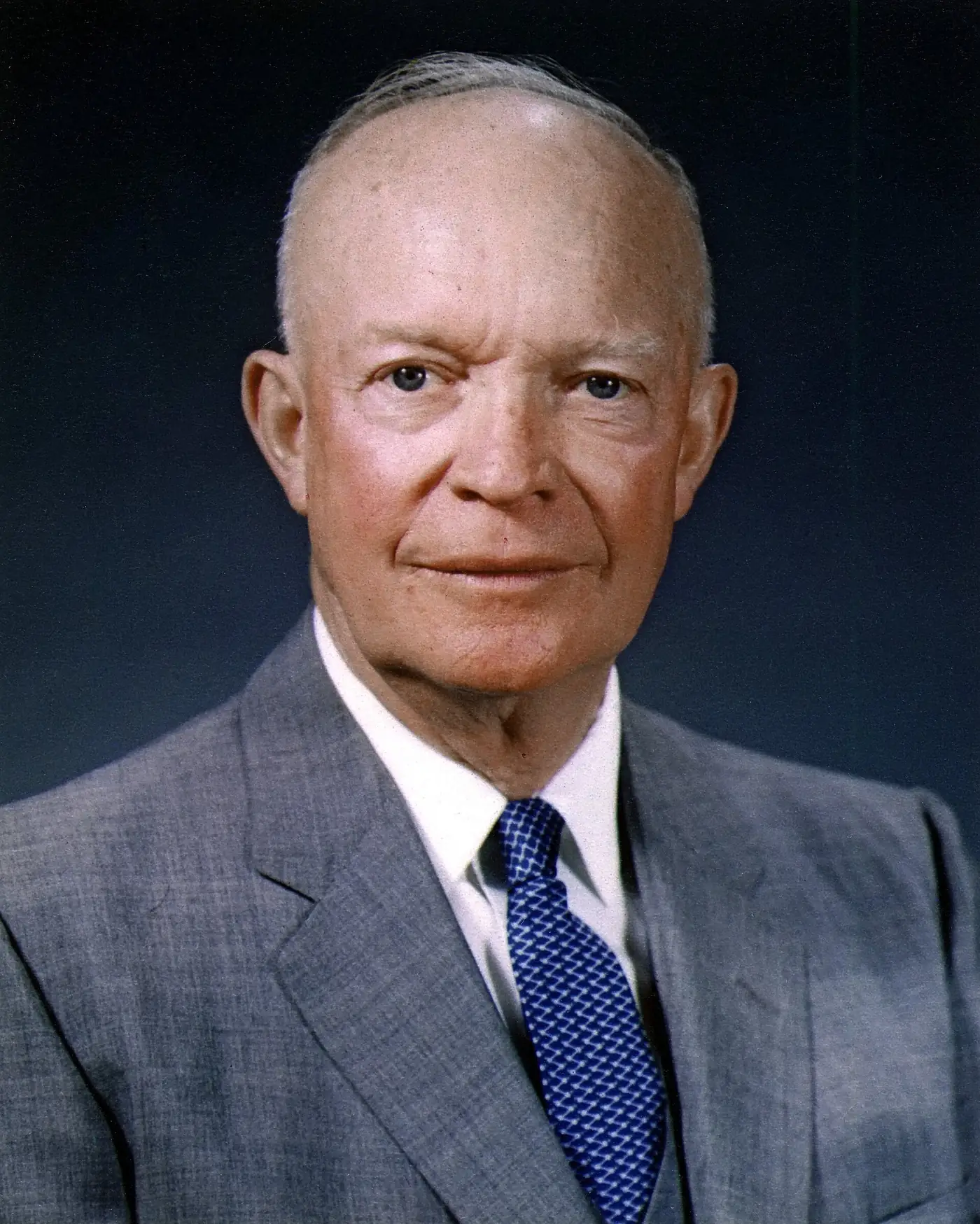
The domino theory was the Cold War belief that if one country fell to communism, its neighbors would follow in sequence. President Dwight D. Eisenhower popularized the idea at a press conference on April 7, 1954, as France was losing its war against communist forces in Vietnam. The theory became the central justification for American military involvement in Southeast Asia for the next two decades, including the Vietnam War. After the war ended in 1975 with a communist victory in Vietnam, the predicted chain reaction mostly did not happen. Thailand, the Philippines, Malaysia, and Indonesia all remained non-communist, and Southeast Asia went on to become one of the fastest-growing economic regions in the world.
How Eisenhower introduced the domino theory
A reporter at the April 7 press conference asked President Eisenhower why the war in Indochina mattered to Americans. Eisenhower described what he called the "falling domino principle," warning of "a beginning of a disintegration that would have the most profound influences" if one Southeast Asian country went communist. The point took only a few sentences. In the same answer he listed the region's tin, tungsten, and rubber as reasons the area mattered to American interests. Journalists soon shortened his phrase to the "domino theory," a name Eisenhower himself never used.
The idea built on containment, the policy of opposing Soviet influence wherever it appeared. The domino theory went further, claiming to explain how communist expansion would spread. A victory for communism in one country would give neighboring insurgencies a safe haven, a supply line, and trained fighters. It would signal to movements elsewhere that they were on the winning side. American allies would begin to doubt whether a United States security guarantee meant anything. On this view, credibility held the entire alliance system together and could not be divided.
The officials shaping policy had seen Czechoslovakia fall to a communist coup in 1948, the Soviet Union blockade Berlin that same year, and Mao's communists take power in China in 1949. The experience of appeasement in the 1930s reinforced their thinking: giving ground to an aggressive state only encourages further aggression.
How the domino theory drove the Vietnam War
The theory also served a domestic political purpose. After China fell to communism in 1949, a bitter fight over who "lost China" ended careers in Washington. After 1949, no president wanted to preside over a similar loss.
Korea seemed to prove the theory right. North Korea launched an invasion across a recognized border, the United States fought back, and the line held. But Vietnam was a different kind of conflict. Ho Chi Minh's movement drew its support from Vietnamese nationalism, first in the fight against France and then against the United States. It was not directed from Moscow. Treating Vietnam as a test of the domino theory meant opposing the most powerful political movement in the country, while the American-backed governments in Saigon struggled to win their own people's loyalty.
The theory also treated all communist states as interchangeable and controlled from a single center. That assumption was already breaking down. Yugoslavia had split with Moscow in 1948. The rivalry between the Soviet Union and China was public by 1960. The Vietnamese had resisted Chinese influence for centuries, and in 1979, four years after the war ended, Vietnam and China fought a border war against each other.
Was the domino theory correct?
Communist forces took Saigon in April 1975. Laos and Cambodia also fell that year, but both countries had been part of the same war. After those three, nothing else fell. Thailand, the Philippines, Malaysia, and Indonesia all remained non-communist.
Indonesia was the country whose loss Presidents Eisenhower and Kennedy feared most. But Indonesia had already turned sharply against communism in 1965, when the army under General Suharto carried out a purge that killed an estimated 500,000 to one million people and destroyed the Indonesian Communist Party. Within a few years of the American withdrawal from Vietnam, Southeast Asia was building closer ties through the Association of Southeast Asian Nations and beginning decades of rapid economic growth.
Defenders of the theory argue that the years America fought in Vietnam gave the region's less stable countries time to strengthen. On that view, the dominoes did not fall because the United States spent enormous resources propping them up. There is no way to prove or disprove that argument, and that is the central flaw in using the theory to guide decisions: it turned every local war into a referendum on American credibility worldwide, with no way to verify the assumption underneath it.
Domino theory today
The domino theory as Eisenhower stated it is no longer official American policy. But the reasoning behind it has outlasted the Cold War. Arguments that losing in one place leads to losses elsewhere, that failing to enforce a commitment weakens deterrence everywhere, and that abandoning one ally teaches others to hedge have appeared in policy debates from Iraq to Ukraine.
The domino theory was not always wrong. Sometimes a communist victory in one country did help movements in neighboring ones. The problem was treating a hypothesis about one particular situation as a universal rule and then using that rule to justify a war in a country the United States did not understand.