
Enlightenment
The Enlightenment was the 18th-century movement that argued human reason, not tradition or authority, should decide how societies are governed.
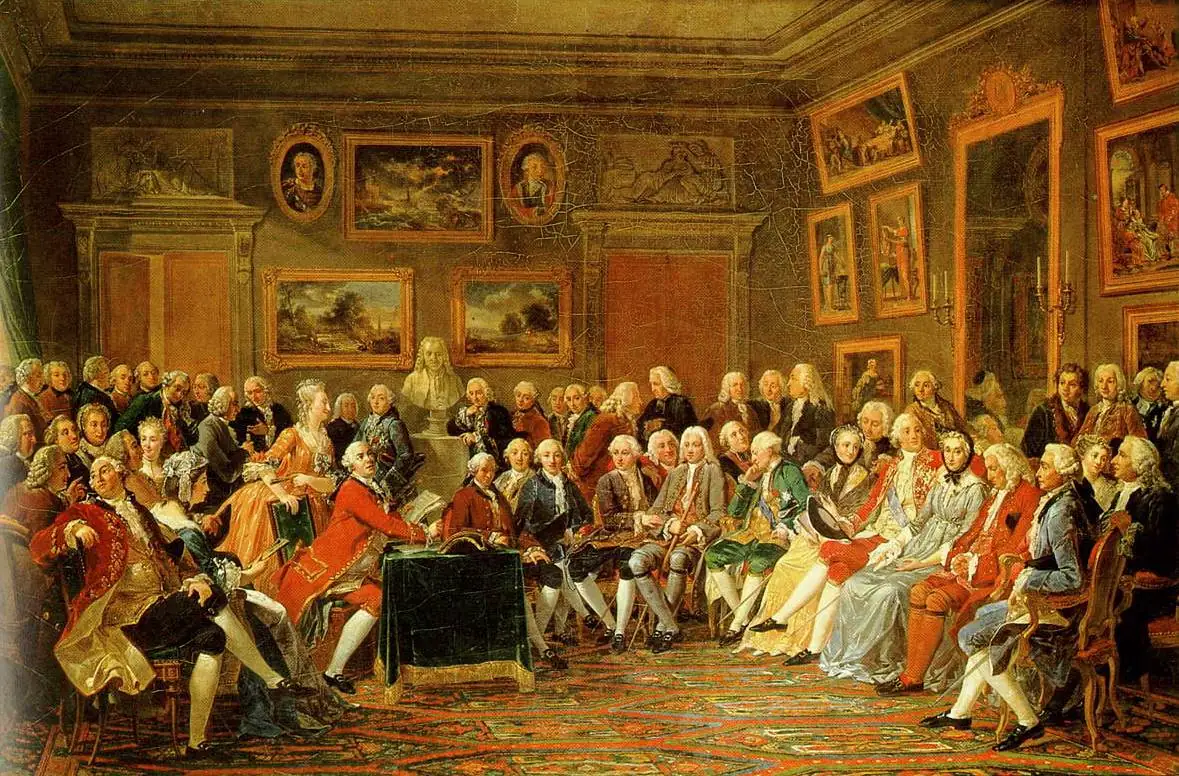
The Enlightenment was a European intellectual movement that lasted from roughly the 1680s to Napoleon's time in the early 1800s. Its central claim was that human reason, not inherited tradition, religious teaching, or the authority of kings, should decide what is true and how societies should be organized. That idea was radical when most of Europe was still governed by monarchs who claimed to rule by divine right. The movement's roots were in the Scientific Revolution. It produced a generation of writers who accepted nothing on tradition alone and supplied the ideas behind the American and French revolutions. In 1776, Thomas Jefferson declared that governments hold power only by "the consent of the governed." That phrase expressed what Enlightenment thinkers had been arguing for a century.
From Newton to the philosophes
In 1687, Isaac Newton published his Principia Mathematica and showed that the motion of planets follows a small set of mathematical laws. Other thinkers took this as proof that reason could do the same for law, religion, economics, and government. That conviction produced the writers the French called the philosophes.
John Locke, an English physician and philosopher, argued that individuals have a natural right to life, liberty, and the ownership of property. He held that no government is legitimate unless the people it rules have agreed to it, and that the people can remove a ruler who violates that agreement. Locke published his Two Treatises of Government in 1689, but anonymously, and never publicly admitted to writing them. Montesquieu, a French nobleman, spent 21 years writing The Spirit of the Laws, published in 1748. He argued for dividing a government's powers into branches so that each would check the others. The Catholic Church placed his book on its Index of Forbidden Books three years later. Voltaire, born François Marie Arouet, spent nearly a year in the Bastille for mocking the French regent. He then lived in exile in England for about three years, where he came to admire parliamentary government. He returned to France and used his fame to campaign against religious persecution and censorship. Jean-Jacques Rousseau was a watchmaker's son from Geneva who had almost no formal education. He argued that sovereignty belongs to the people and is expressed through their collective will. Paris banned his Social Contract in 1762, and Geneva had it publicly burned. Adam Smith made the case that a nation grows richest when its people are free to trade and compete.
How Enlightenment ideas spread
These ideas reached a wide audience through new channels. In Paris, salons run by women like Marie Thérèse Geoffrin became regular meeting places for writers, artists, and reformers. Geoffrin held two dinners a week at her home on the Rue Saint-Honoré, one for artists on Mondays and one for writers on Wednesdays. Her guest lists included Voltaire, Diderot, and Montesquieu. In London, coffeehouses served a similar purpose. Cheap pamphlets carried the arguments beyond the universities and into the reading public.
The central project of the era was Denis Diderot's Encyclopédie, first published in 1751. It grew to 17 volumes of text and 11 volumes of illustrations, with the goal of compiling everything humanity knew into a single reference. It also aimed, less openly, to get critical and reformist thinking past the French censors. Geoffrin helped pay for the project.
How the Enlightenment shaped modern government
Enlightenment thinkers gave modern democracies their basic framework: written constitutions, separated powers, and individual rights protected by law. Their ideas moved from books and salons into the founding documents of new nations.
The American Declaration of Independence, issued in 1776, drew directly on Locke's argument that government exists to protect the rights of individuals and may be overthrown when it fails to do so. The U.S. Constitution, written in 1787, built Montesquieu's separation of powers into a working system with three branches of government, each able to check the other two. In 1789, France's National Assembly adopted the Declaration of the Rights of Man, which declared that every person is born free and with equal rights. For the first time, states were being founded on written principles rather than on dynasty or conquest.
The French Revolution also showed what could go wrong. In 1793 and 1794, during the period known as the Terror, the revolutionary government executed about 17,000 people, and tens of thousands more died in related violence across France. The killings were carried out in the name of reason and virtue. The same confidence that rational people could redesign society also convinced the revolution's leaders that anyone who resisted could be eliminated.
The Enlightenment's lasting contribution is the idea that individuals have rights, that governments answer to the people, and that anyone may think and speak freely. It also left a warning. The belief that people with the right theory can remake everything at once has fueled political violence from the Terror onward. Both legacies are still at work. Every time a court overturns a law for infringing on someone's rights, it is applying an argument that Enlightenment thinkers wrote down in the late 1600s.