
John Locke
John Locke was an English philosopher who argued that government exists only by the consent of the governed and can be overthrown when it fails.
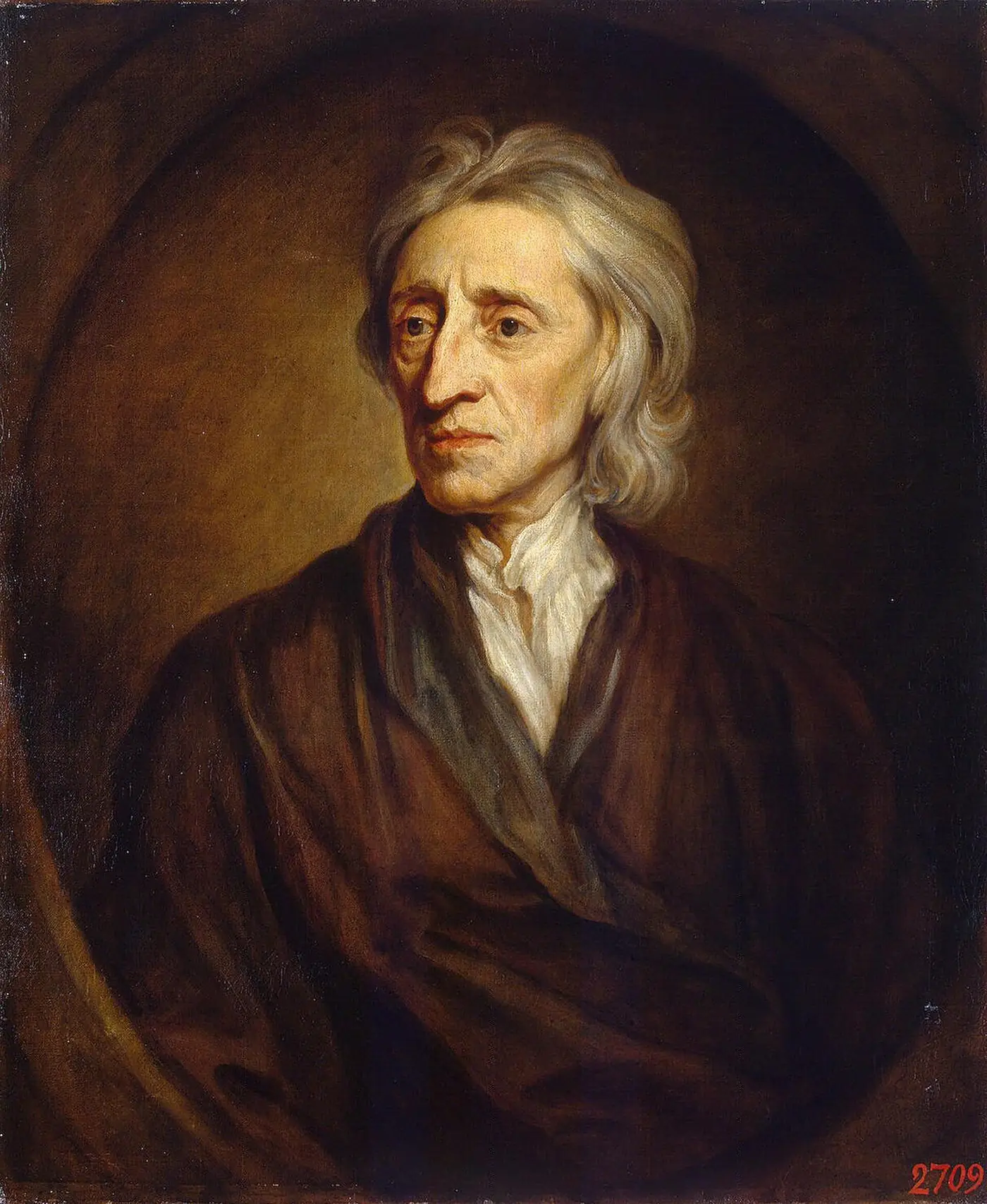
John Locke was an English philosopher who argued that governments exist only because people agree to be governed, and that any government that attacks the rights it was created to protect can be overthrown. Born in 1632 in Wrington, Somerset, he trained as a physician before spending most of his adult life as a political adviser and writer. His Two Treatises of Government, published in 1689, set out the case for natural rights, limited government, and the right of revolution. Thomas Jefferson drew on Locke's language so directly that parts of the Declaration of Independence read like paraphrases of the Two Treatises. Locke never married and never publicly admitted to writing the work during his lifetime.
How Locke became a political philosopher
Locke studied medicine at Oxford and in London under Thomas Sydenham, one of the leading physicians of his time. In 1667, he moved into the London household of Anthony Ashley Cooper, later the first Earl of Shaftesbury, to serve as his personal doctor. The following year, Locke helped arrange a dangerous operation to drain an abscess near Shaftesbury's liver. Surgeons inserted a silver tube to let the wound drain, and the tube stayed in Shaftesbury's body for the rest of his life. Shaftesbury credited Locke with saving him.
The relationship quickly went beyond medicine. Shaftesbury was one of the most powerful Whig politicians in England, and Locke became his secretary, researcher, and political adviser. When a crisis erupted over whether the Catholic Duke of York could inherit the throne, Shaftesbury led the opposition, and Locke wrote most of the Two Treatises around 1679 to 1680. The work was not calm philosophy written in safety. It was an argument for resisting royal power, composed while that fight was underway.
In 1683, Shaftesbury's faction was linked to the Rye House Plot, an alleged conspiracy to assassinate King Charles II. Shaftesbury had already died in exile in the Netherlands. Locke fled there too, settling in Amsterdam and revising his manuscripts. He returned to England in 1689, once William III had driven out the Catholic King James II in the Glorious Revolution. Locke published the Two Treatises anonymously that year. He spent his last fourteen years living at the estate of Lady Damaris Masham in Essex, where visitors included Isaac Newton, and died there in 1704 at the age of 72.
What did John Locke believe?
Locke's central argument begins with what he called the "state of nature." Before any government exists, people are free and roughly equal. They hold natural rights to life, liberty, and property. Unlike Thomas Hobbes, who described the state of nature as a war of everyone against everyone, Locke saw it as a condition governed by reason, where people could live and work in relative peace.
The problem, Locke said, was that without a neutral judge, disputes had no fair resolution. So people agree to form a government for one purpose: to protect the rights they already have. Government authority comes from this agreement and is limited to that protective purpose. When a ruler turns against the rights the government was formed to secure, the people have the right to resist and replace him. Locke called this the "appeal to heaven," meaning, in practice, rebellion.
Locke extended this thinking beyond politics. In his Essay Concerning Human Understanding, published in 1690, he argued that the mind starts as a blank slate with no innate ideas. All knowledge comes from experience. If people are not born with fixed natures, then inherited hierarchies have no natural basis, and education matters more than birth.
In his Letter Concerning Toleration, published in 1689, Locke argued that it is not the government's role to force people into particular religious beliefs. Genuine belief cannot be created through compulsion, so laws that try to enforce it fail on their own terms.
How did John Locke influence the Declaration of Independence?
When Thomas Jefferson drafted the Declaration of Independence in 1776, he borrowed Locke's framework almost point by point. The Declaration claims that people hold rights no government can take away, that a government's authority comes from the agreement of those it governs, and that the people can change or remove any government that fails to protect those rights. All three ideas come directly from the Two Treatises. Jefferson changed one notable term: where Locke wrote "life, liberty and estate," Jefferson wrote "life, liberty and the pursuit of happiness."
Locke's influence reached beyond the American founding. The Bill of Rights and the arguments in the Federalist Papers for limited government both draw on his framework. France's 1789 declaration on the rights of citizens draws from Locke as well. Locke helped establish the Enlightenment principle that rulers answer to the people they rule, not the other way around.
John Locke and slavery
Locke wrote the most widely cited defense of natural rights in the English language. He was also a shareholder in the Royal African Company, the corporation that held England's monopoly on the Atlantic slave trade. Locke helped write the 1669 Fundamental Constitutions of Carolina, which gave colonists absolute power over enslaved people. And his theory that unworked land belongs to whoever cultivates it was later used to justify taking land from indigenous peoples in the Americas.
These facts are not minor details. Locke knew what the Royal African Company did, and the Carolina constitutions put slaveholders' power into law under his pen. The man who wrote the founding text of natural rights did not believe those rights applied to everyone.
Abolitionists, suffragists, anticolonial leaders, and civil rights campaigners all took Locke's language and argued that it meant what it said. His ideas remain the standard by which governments are judged today, not because Locke applied them consistently, but because others did.