Fairchild Semiconductor
Fairchild Semiconductor was the 1957 startup whose engineers invented the mass-produced chip and went on to found Intel, AMD, and dozens of other firms.
Fairchild Semiconductor was a chip company founded in Palo Alto, California, in 1957 by eight young scientists and engineers who quit their jobs on the same day. Their former boss, William Shockley, had co-invented the transistor and recently won a Nobel Prize, but he managed people so badly that his best researchers walked out together. Within two years, Fairchild engineers invented the planar process and a version of the integrated circuit that could be mass-produced, two breakthroughs that made the modern semiconductor industry possible. The company itself later declined, but the people who passed through it went on to found Intel, Advanced Micro Devices, and dozens of other firms. One of its founders later started Kleiner Perkins, the venture capital firm behind Amazon and Google. Fairchild did not just make chips. It created the culture of leaving to start something new that Silicon Valley still runs on.
How eight scientists and engineers walked out on a Nobel laureate
William Shockley shared the Nobel Prize in Physics in 1956 for co-inventing the transistor. He had moved to Mountain View to start Shockley Semiconductor Laboratory, and he hired some of the best young scientists he could find. But Shockley was a terrible manager. He was paranoid and controlling, posted employees' salaries on a bulletin board for everyone to see, and ordered polygraph tests after a secretary cut her finger.
Eight of his researchers decided to leave together: Julius Blank, Victor Grinich, Jean Hoerni, Eugene Kleiner, Jay Last, Gordon Moore, Robert Noyce, and Sheldon Roberts. Noyce, a charismatic Iowa native who had nearly been expelled from Grinnell College for stealing a pig for a luau, was the group's natural leader. Moore, a quiet chemist from the farming town of Pescadero, California, would later become famous for Moore's Law. They all signed resignation letters and walked out on the same day. They became known as the "traitorous eight," a label the group eventually took pride in.
The eight had talent but no money. Eugene Kleiner wrote to the New York investment bank Hayden Stone, and the firm assigned a young analyst named Arthur Rock to help them find backing. Rock contacted more than 30 companies before finding a backer: Sherman Fairchild. Fairchild was an inventor who held dozens of patents and was the largest individual shareholder in IBM, a fortune inherited from his father, who had chaired the company that became IBM. His company, Fairchild Camera and Instrument, invested about $1.4 million to create a new division. Fairchild Semiconductor opened for business in the fall of 1957.
The planar process and the first mass-produced chip
In January 1959, Jean Hoerni invented the planar process, a way to build transistors on a flat silicon surface sealed under a protective layer of silicon dioxide. Before the planar process, transistors were fragile and hard to manufacture consistently. Hoerni's method made them reliable enough to produce in volume.
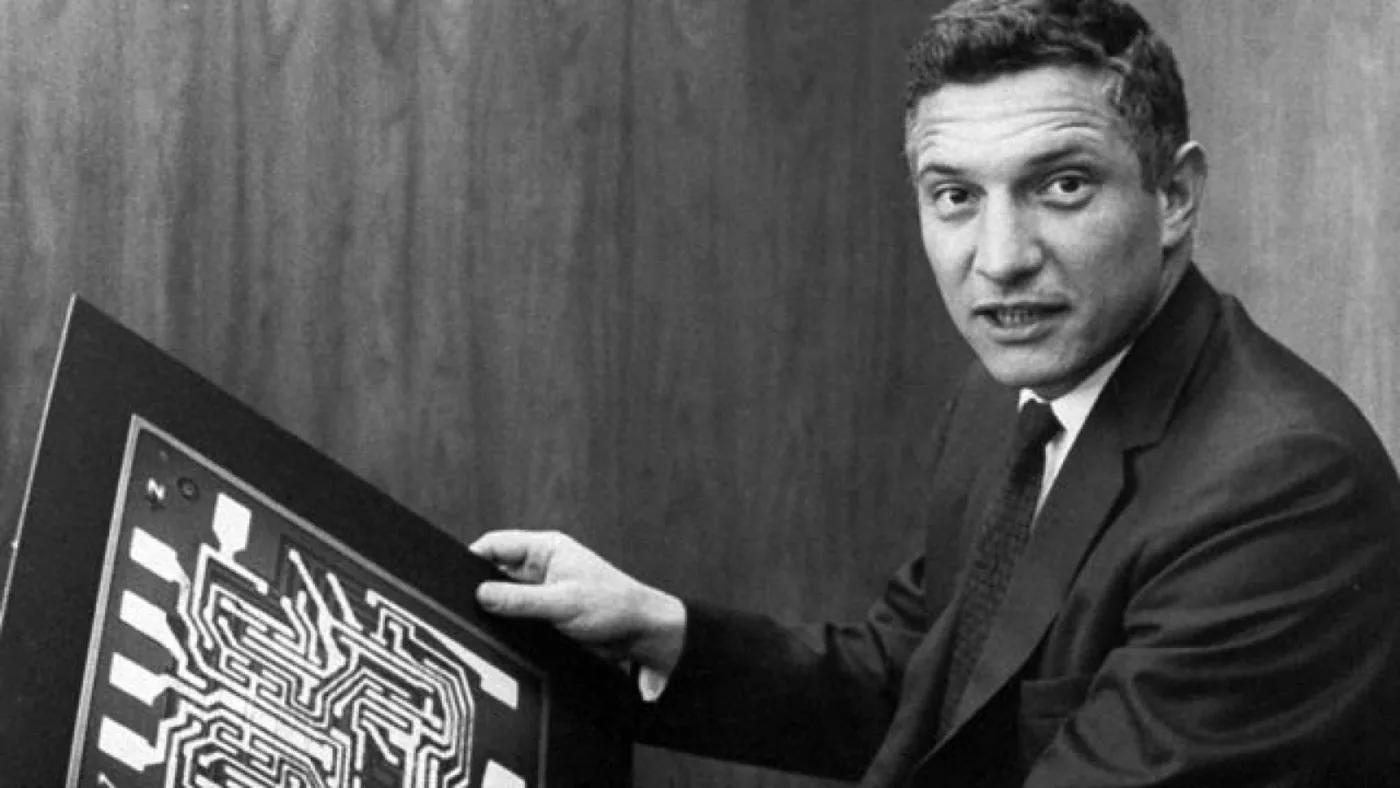
Robert Noyce saw that the same flat surface could hold many components connected by thin aluminum lines, all on a single chip. Jack Kilby at Texas Instruments had built an integrated circuit a few months earlier, but Kilby's version required tiny gold wires attached by hand between components. Noyce's design could be printed and manufactured on an assembly line. Fairchild sold the resulting products as Micrologic chips, making the integrated circuit a commercial product.
The biggest early customer was NASA. In 1962, MIT chose the Micrologic design for the Apollo guidance computer, and the Apollo program became the largest buyer of integrated circuits in the early 1960s. Every Apollo spacecraft that flew to the Moon carried guidance computers built around Fairchild's chip design.
How Fairchild Semiconductor seeded Silicon Valley
Fairchild's engineers did not stay long. Through the 1960s, they kept walking out to launch new firms, and those firms spawned still more. The alumni called the resulting firms the "Fairchildren."
In 1968, Robert Noyce and Gordon Moore left to found Intel. The next year, Jerry Sanders, Fairchild's former head of marketing, and seven colleagues started Advanced Micro Devices. Charlie Sporck left to run National Semiconductor. By one count, more than a hundred semiconductor companies in Silicon Valley trace their roots to Fairchild.
The influence went beyond chipmaking. Eugene Kleiner, one of the eight founders, started the venture capital firm Kleiner Perkins in 1972 with Tom Perkins, a Hewlett-Packard executive. Noyce and Moore were among its first investors. Kleiner Perkins later backed Amazon, Google, and Genentech, among hundreds of other companies. Arthur Rock, the banker who had arranged Fairchild's original funding, became one of the first venture capitalists and was an early investor in both Intel and Apple.
Fairchild created a pattern that the technology industry still follows: talented employees leave to build competing companies, backed by investors and given equity in what they build. In the culture that grew up around Fairchild, changing jobs was treated as ambition, not betrayal.
What happened to Fairchild Semiconductor?
After its best engineers left through the 1960s, Fairchild struggled. Sales kept growing through the 1970s, but profits and major new products did not keep up. In 1979, the French oil-services company Schlumberger bought Fairchild Camera and Instrument, including the semiconductor division. Schlumberger could not turn the business around either, and in 1986 it tried to sell Fairchild to Japan's Fujitsu. The U.S. government opposed the deal on national-security grounds, Fujitsu withdrew in 1987, and National Semiconductor bought the assets instead.
A decade later, in 1997, National Semiconductor spun off several older product lines. A group of managers at the Fairchild plant in South Portland, Maine, reconstituted the company as Fairchild Semiconductor International. The reborn Fairchild focused on power-management chips and operated as an independent public company until 2016, when ON Semiconductor (now called onsemi) acquired it for $2.4 billion. The Fairchild name is no longer used, but Intel, AMD, and dozens of other companies that grew out of Fairchild still make the chips that run much of the world's electronics.