
Jack Kilby
Jack Kilby built the first integrated circuit at Texas Instruments in 1958, putting an entire electronic circuit on a single chip.
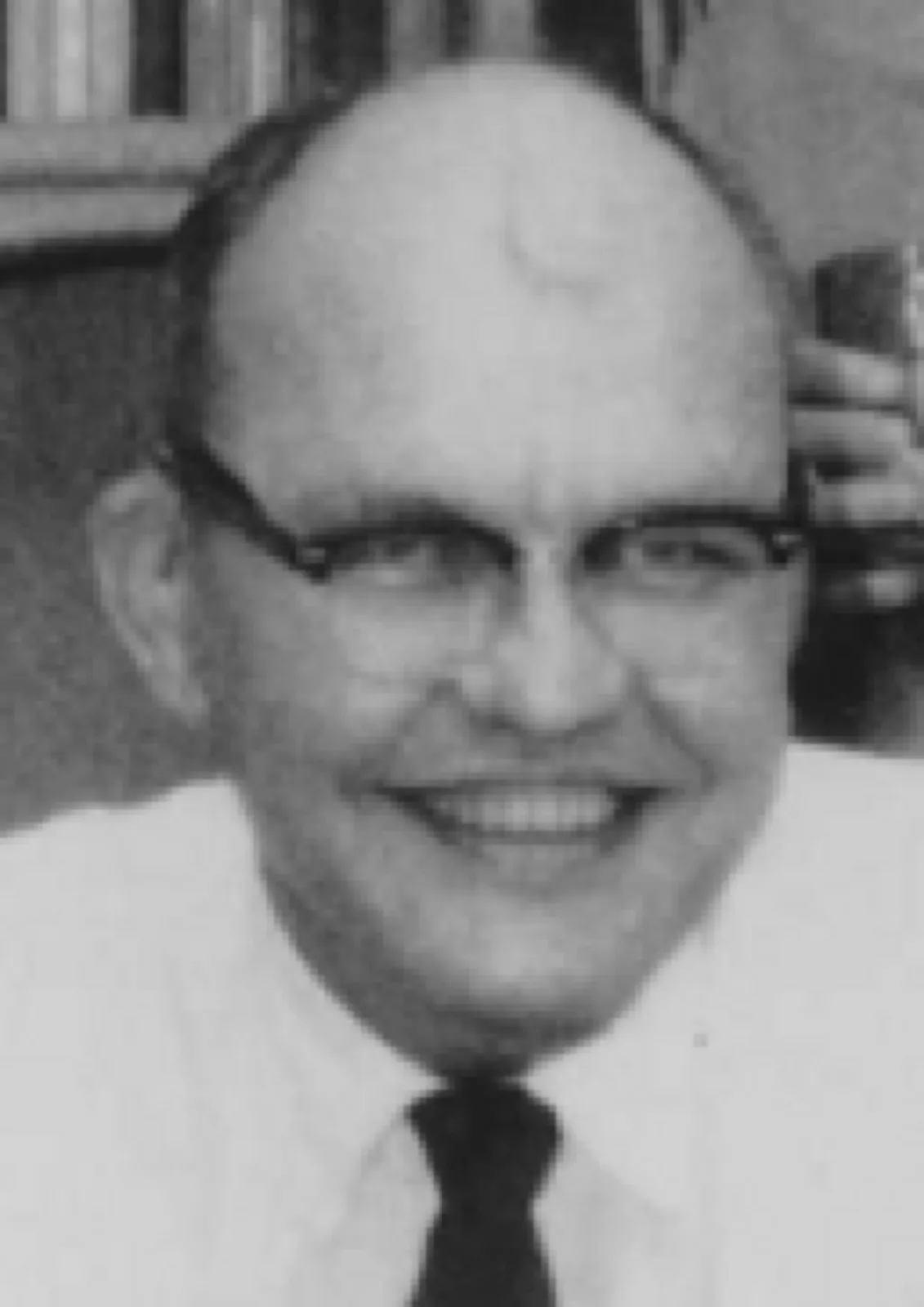
Jack Kilby was an American electrical engineer who built the first integrated circuit at Texas Instruments in 1958. His device showed that transistors, resistors, and capacitors could all be formed on a single piece of semiconductor material, replacing thousands of hand-soldered connections with one small chip. Robert Noyce at Fairchild Semiconductor reached the same idea independently and developed the manufacturing process that made it practical. Together they are credited as co-inventors of the technology behind computers, smartphones, and the internet. Kilby received the 2000 Nobel Prize in Physics for the invention and died in Dallas in 2005 at 81.
How Jack Kilby built the first integrated circuit
Kilby was born in Jefferson City, Missouri, in 1923 and grew up in Great Bend, Kansas. His father ran a small electric company that served customers across rural western Kansas. When a massive ice storm knocked down telephone and power lines across the region during Kilby's high school years, his father used amateur radio operators to reach customers who had lost service. That experience got Kilby interested in electronics.
He studied electrical engineering at the University of Illinois, served in the Army during World War II, and earned a master's degree from the University of Wisconsin while working at a components company called Centralab in Milwaukee. In 1958, at 34, he joined Texas Instruments in Dallas.
The problem every electronics company faced was wiring. Engineers could design circuits with thousands of transistors, resistors, and capacitors, but each part had to be manufactured separately and soldered together by hand. Every solder joint was a possible point of failure, and the more complex the circuit, the more likely it was to break. Engineers called this the "tyranny of numbers."
Kilby was too new at Texas Instruments to have earned the company's two-week summer vacation. He spent the empty weeks in the lab, thinking about the wiring problem on his own. His idea was to skip the wiring entirely: instead of connecting separate parts, build the whole circuit on a single piece of semiconductor, forming every component in the same material.
He sketched the concept in his notebook on July 24, 1958. His boss was skeptical but told him to build it. Kilby etched a thin bar of germanium about 11 millimeters long, formed a transistor, a capacitor, and three resistors in the material, and bridged the gaps with fine gold wires. On September 12, 1958, he connected the device to an oscilloscope in front of a small group of Texas Instruments managers. It traced a clean sine wave. The circuit worked.
Did Jack Kilby or Robert Noyce invent the microchip?
Both did, working independently about 1,500 miles apart. About four months after Kilby's demonstration, Robert Noyce at Fairchild Semiconductor in California solved the same problem a different way. Noyce used silicon instead of germanium and replaced Kilby's hand-attached gold wires with thin metal lines printed directly onto the chip surface using Fairchild's planar process. Kilby showed that the idea could work. Noyce figured out how to manufacture it, so that factories could produce chips by the million.
Both men filed patents, and Texas Instruments and Fairchild fought in court for years. In 1966 the two companies settled by cross-licensing each other's patents, and both Kilby and Noyce are now recognized as co-inventors of the integrated circuit. Noyce died of a heart attack in 1990 at 62. When Kilby received the Nobel Prize in Physics in 2000, he said openly that Noyce would have shared it.
Why the integrated circuit matters
When circuits moved from hand-soldered assemblies to printed chips, making them smaller also made them cheaper and faster. Doubling the number of transistors on a chip cost almost nothing extra. In 1965, Gordon Moore, one of Noyce's colleagues at Fairchild, noticed that the number of components on a chip was doubling roughly every year. That trend, now called Moore's Law, held for decades. Kilby's first circuit held one transistor. A high-end processor in 2024 holds over 200 billion.
The integrated circuit made personal computers, mobile phones, global networking, and artificial intelligence possible. Designing and manufacturing the most advanced chips has become a source of national power. The most advanced logic chips are produced by a handful of companies using extreme ultraviolet lithography machines that only one Dutch company, ASML, can build. The United States and China treat chip supply and fabrication capacity as strategic assets, the way Cold War rivals once treated petroleum reserves and sea routes. Taiwan's dominance in advanced chip manufacturing has made the island one of the most strategically important places on Earth.
Beyond the integrated circuit, Kilby co-invented the handheld electronic calculator at Texas Instruments in 1967, working with engineers Jerry Merryman and James Van Tassel. He held more than 60 patents over his career. He was a quiet man who preferred the lab to public speaking. The technology he demonstrated on that oscilloscope in September 1958 is in every computer, phone, and connected device on Earth.