
Transistor
The transistor is a solid-state electronic switch invented at Bell Labs in 1947 that replaced the vacuum tube and became the basis of modern electronics.
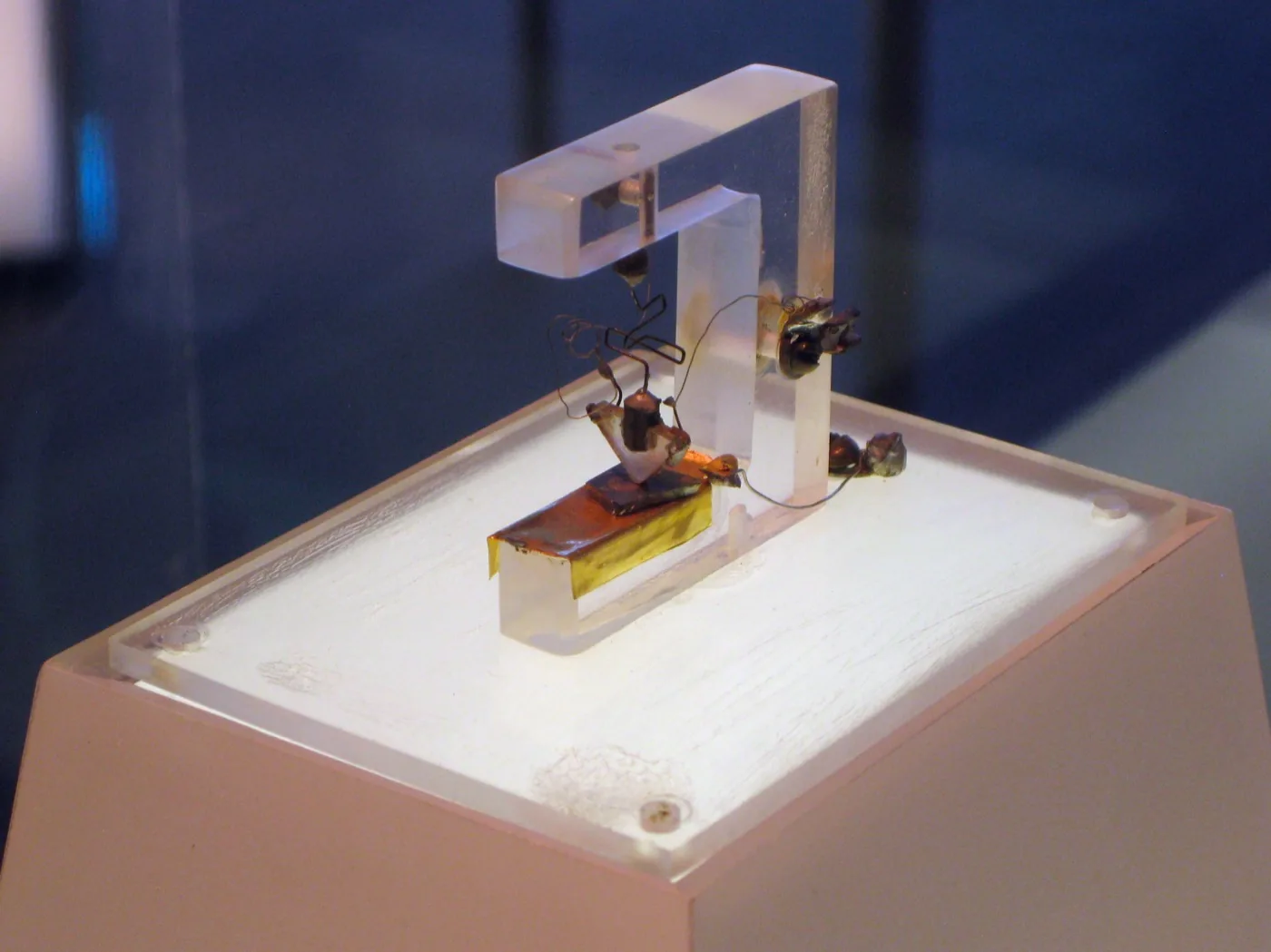
The transistor is a tiny electronic switch made from a solid piece of semiconductor material. John Bardeen, Walter Brattain, and William Shockley invented it at Bell Laboratories in New Jersey in 1947. A small electrical signal at one of its terminals controls a larger current flowing through the device, so it can amplify a signal or switch between on and off. That switching is what computers use to store binary ones and zeros. The transistor replaced the vacuum tube, a fragile glass device that ran hot, burned out often, and consumed a lot of power. By the late 1950s, engineers figured out how to fit many transistors onto one chip of silicon, the integrated circuit. That advance led to the microprocessor, the personal computer, and the smartphone. A modern smartphone chip holds as many as 30 billion transistors, and all of them trace back to an experiment on a piece of germanium no bigger than a pinhead.
How the transistor was invented at Bell Labs
Before the transistor, electronics ran on vacuum tubes. A vacuum tube could make a weak signal stronger or turn a current on and off, the two basic operations every computer needs. But vacuum tubes were glass, fragile, and power-hungry. ENIAC, one of the first computers, ran on about 18,000 vacuum tubes. It took up a 30-by-50-foot room, weighed 30 tons, and broke down constantly as tubes failed.
In the 1930s, Mervin Kelly, the research director at Bell Laboratories, started a program to find a solid-state replacement. The goal was a device that could do everything a vacuum tube did, using a piece of semiconductor material instead of a glass bottle full of heated filaments.
The work took more than a decade. On December 16, 1947, two physicists in the group, John Bardeen and Walter Brattain, pressed two gold contacts onto a tiny slab of germanium. A faint electrical signal came out amplified roughly a hundredfold. The space between the two contacts was about 50 microns, roughly the thickness of a sheet of paper. A week later, on December 23, Bardeen and Brattain demonstrated the device to Bell Labs leadership. One of the supervisors called it a magnificent Christmas present. Almost no one outside the lab noticed.
William Shockley led the research group but was not in the room for the experiment and was left off the patent. He was furious. Within weeks he designed a sturdier version, the bipolar junction transistor, which became the basis for commercial production. All three shared the 1956 Nobel Prize in Physics.
Who invented the transistor?
Three physicists at Bell Laboratories invented the transistor: John Bardeen, Walter Brattain, and William Shockley. Bardeen and Brattain built the first working device on December 16, 1947. Shockley designed an improved version shortly after.
Bardeen was the theorist who worked out the physics of how current moves through semiconductor surfaces. He was quiet and modest. His colleagues at the University of Illinois would say "John will know" whenever they hit a hard problem. He later won a second Nobel Prize in 1972 for his theory of superconductivity, one of only five people ever to win two.
Brattain was the experimentalist who built and tested the devices. He was born in Amoy, China, and grew up on a cattle ranch near the Canadian border in Washington state. He joined Bell Labs in 1929 and spent nearly his entire career there.
Shockley led the research group and designed the junction transistor that became the commercial standard. He was the most ambitious of the three and the hardest to work with.
How the transistor created Silicon Valley
Shockley left Bell Labs in 1956 and returned to California, settling in Mountain View, close to the Palo Alto neighborhood where he grew up. He set up Shockley Semiconductor Laboratory in a former apricot packing shed and recruited some of the country's best young engineers, including Gordon Moore and Robert Noyce.
Shockley was brilliant but impossible to work for. He was secretive and paranoid, and he required his staff to take lie detector tests. In September 1957, eight of his most talented engineers quit on the same day. They founded Fairchild Semiconductor, which became one of the most important technology companies of the twentieth century. Its alumni went on to start Intel, AMD, and dozens of other firms. The valley of apricot orchards came to be called Silicon Valley.
Shockley's own company failed. He took a position at Stanford and spent his later years promoting eugenics, arguing without evidence that Black Americans were genetically inferior. He died in 1989. His children learned of his death from the newspaper.
The technology Shockley helped invent kept advancing. In 1958, Jack Kilby figured out how to put multiple components on a single piece of germanium, creating the integrated circuit. Engineers packed thousands of transistors onto a chip, then millions, then billions. Gordon Moore predicted in 1975 that the number would double roughly every two years, and for decades it did. Today a single smartphone chip holds as many as 30 billion transistors. Every phone, car, pacemaker, and satellite runs on the device that Bardeen and Brattain first tested in a New Jersey lab in December 1947.