
Moore's Law
Moore's Law is the prediction that the number of transistors on a computer chip doubles roughly every two years.
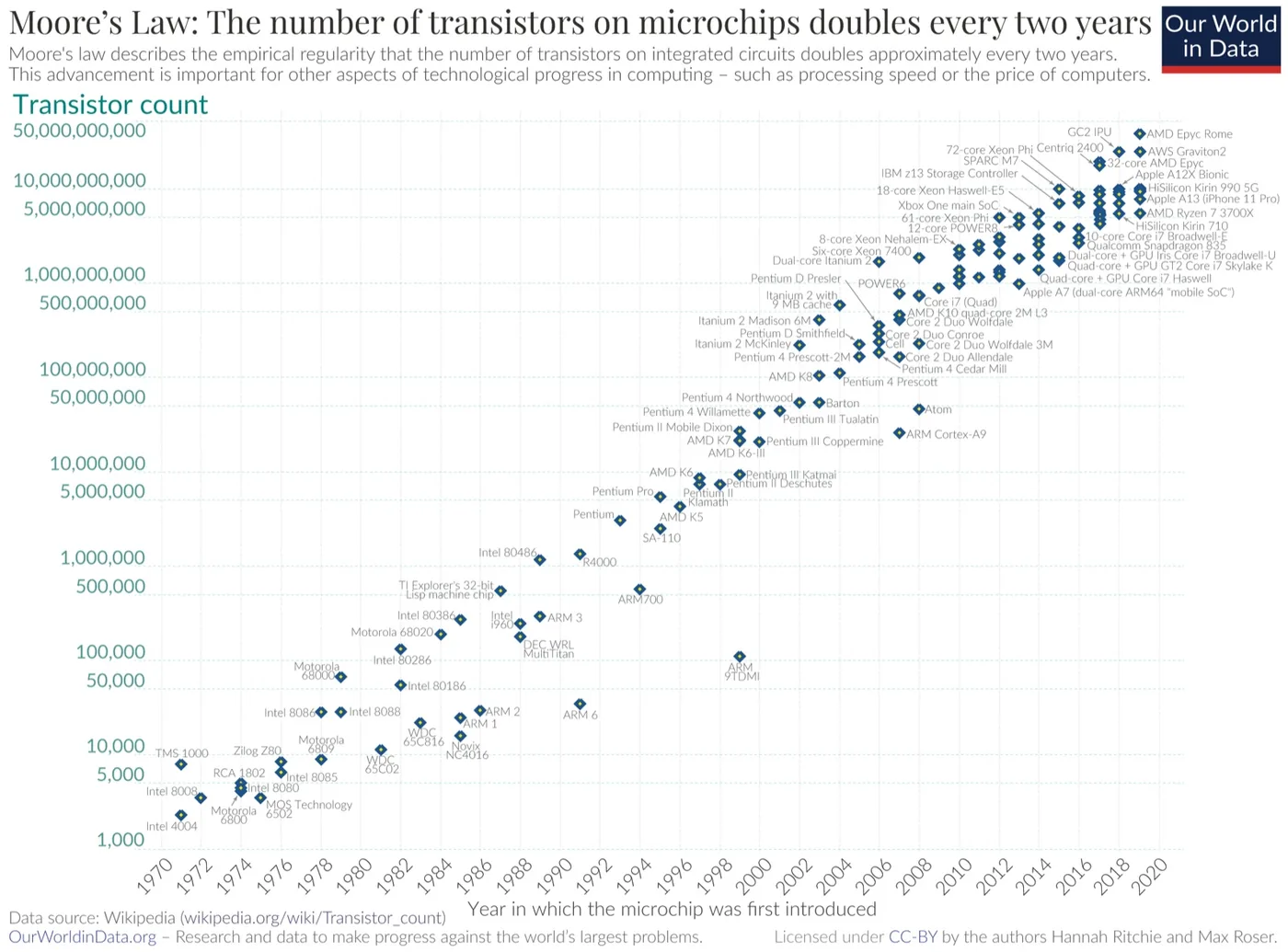
Moore's Law is the prediction that the number of transistors on a computer chip doubles roughly every two years. Gordon Moore, then the research director at Fairchild Semiconductor, made the prediction in a 1965 magazine article. Despite its name, it is not a physical law. No force in nature compels transistors to get smaller on a timetable. But the chip industry organized its investments around the prediction, and for more than fifty years it came true. The first integrated circuits, built in the late 1950s by engineers like Jack Kilby, held a handful of transistors. Nvidia's Blackwell B200 chip, released in 2024, holds 208 billion. That compounding is the difference between a room-sized computer and a phone that carries more processing power than the computers that guided the Apollo missions to the moon.
How Gordon Moore's prediction became an industry plan
In 1965, Electronics magazine asked Gordon Moore to write about the future of integrated circuits for its thirty-fifth anniversary issue. Moore was 36, a chemist by training who had earned his PhD at Caltech and then helped build some of the first commercial silicon transistors at Fairchild. He was not trying to announce a scientific discovery. The article was a pitch to customers, encouraging them to design around the newest chips. In it, he noted that the number of components on a chip had been doubling every year. Extrapolating the trend, he predicted chips would hold 65,000 components by 1975.
The prediction came true. In 1968, Moore and Robert Noyce left Fairchild to co-found Intel, and Moore watched the doubling play out inside his own company. Intel's first microprocessor, the 4004, held about 2,300 transistors in 1971. By the 1990s Intel's chips held millions. In 1975 Moore revised the pace: the doubling would happen roughly every two years instead of every year. Around the same time, Caltech professor Carver Mead gave the prediction its name, calling it Moore's Law.
What made the prediction last is why it kept working. Each new generation of chips required smaller transistors, better materials, and more precise manufacturing equipment. No single company could deliver all of that alone. So the semiconductor industry built a shared roadmap that told designers, manufacturers, and materials companies what they each needed to deliver and when. Every company planned its investments around the same schedule. Moore's Law held because an entire industry chose to make it hold.
The payoff was enormous. A smaller transistor is not just smaller. It is also faster and uses less power, and manufacturers can fit more of them on a chip without raising the cost much. Every couple of years, computing power roughly doubled at a similar price. Over fifty years of compounding, that turned room-sized mainframes into pocket-sized phones and put processors into cars, watches, and medical devices.
Is Moore's Law still true?
Moore's Law has slowed but not stopped. The pace of transistor doubling began falling behind the two-year schedule around 2010, and each new generation of chips now takes longer and costs more to develop than the one before.
The main obstacle is physics. The smallest features on today's leading chips are only a few nanometers wide, small enough that quantum effects cause transistors to leak current and behave unpredictably. The machines that print those features, called extreme ultraviolet lithography systems, require such extreme precision that just one firm on Earth, the Dutch company ASML, can build them. Building a single cutting-edge chip factory now costs $15 billion to $30 billion.
Chipmakers have found ways to keep improving performance even as traditional shrinking slows. Engineers stack transistors in three dimensions, connect multiple smaller chips into a single package, and design specialized processors for tasks like artificial intelligence. These techniques keep delivering more computing power per dollar, even when the gains no longer come from making each transistor smaller.
The concentration of advanced chipmaking has also changed who pays attention to it. When each new chip generation was affordable and available to many producers, governments paid little attention to semiconductors. Now that the next step forward depends on a few companies, a handful of factories, and tools from one supplier, producing the most advanced chips has become a strategic concern for whole countries. Countries that once ignored the chip industry now spend hundreds of billions of dollars subsidizing it.
Gordon Moore died in March 2023 at 94. He and his wife Betty had started a foundation that gave away more than five billion dollars, most of it to science and conservation. "No exponential is forever," he told an engineering conference in 2003. He was right that the pace would slow. More than sixty years after his article in Electronics, transistor counts are still rising, and each new generation of chips still makes computing cheaper and more powerful than the one before.