
Otto von Bismarck
Otto von Bismarck was the Prussian prime minister who unified Germany through three wars and served as its first chancellor from 1871 to 1890.
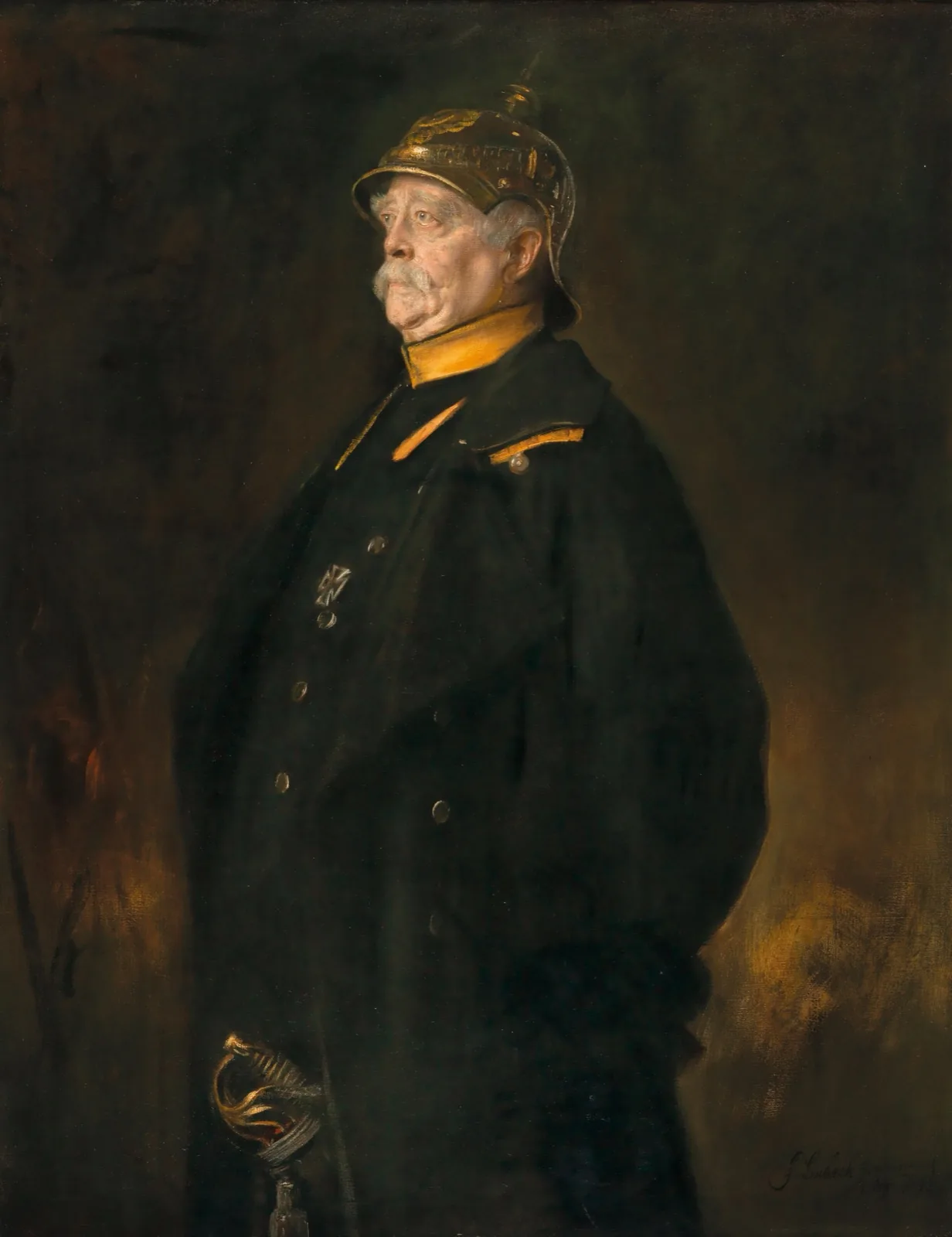
Otto von Bismarck, Prussia's prime minister from 1862, brought Germany's dozens of separate states together into a single empire in 1871. He won three wars in seven years, each chosen to isolate one opponent at a time, and then served as the empire's first chancellor for two decades. Born in 1815 into a Junker family, the Prussian landowning gentry, Bismarck spent years managing his family's rural estates before entering politics. He was physically large, short-tempered, and known for eating and drinking on a scale that alarmed his doctors. He died in 1898. The alliance system he built kept Europe at peace for as long as he ran it, and its collapse after his dismissal was one of the causes of World War I.
How Bismarck unified Germany
Before 1871, there was no country called Germany. There were dozens of German-speaking states, the two largest being Prussia in the north and Austria in the south, and they had competed for influence over the smaller ones for more than a century. King Wilhelm I appointed Bismarck minister-president of Prussia in 1862, and Bismarck decided to resolve the rivalry by force.
He moved in three steps. In 1864, Prussia and Austria together took the duchies of Schleswig and Holstein from Denmark. In 1866, Bismarck turned on Austria. The Austro-Prussian War lasted seven weeks, ended Austrian influence over the other German states, and left Prussia as the leading power in northern Germany. Prussia organized the northern states into the North German Confederation.
The last step was France. In 1870, Bismarck edited a diplomatic telegram, the Ems Dispatch, to make it sound as though the Prussian king had insulted the French ambassador. France declared war, which was what Bismarck wanted: the southern German states, which had stayed out of the confederation, joined Prussia against a common enemy. The Franco-Prussian War ended with a decisive German victory. On January 18, 1871, in the Hall of Mirrors at the Palace of Versailles, the German princes proclaimed Wilhelm I as emperor of a united Germany. France lost Alsace and part of Lorraine. The resentment over those lost provinces lasted for two generations.
How Bismarck governed after 1871
Once the empire existed, Bismarck reversed course. He declared Germany a "satiated" state that wanted no more territory. His greatest worry was that other European powers might combine against Germany and force it into a war on two fronts. He had a French phrase for this fear: "cauchemar des coalitions," meaning nightmare of coalitions.
To prevent this, he worked to keep France isolated by tying every other major power to Germany. In 1873, Germany, Austria-Hungary, and Russia formed the League of the Three Emperors. In 1879, Germany and Austria-Hungary signed the Dual Alliance, and Italy joined in 1882 to form the Triple Alliance. In 1887, Bismarck negotiated a secret Reinsurance Treaty with Russia, in which both sides pledged neutrality if the other was attacked by a third power. At the Congress of Berlin in 1878, Bismarck positioned himself as an "honest broker" mediating disputes over the Balkans.
At home, Bismarck tried to weaken the growing socialist movement. In the 1880s he introduced health insurance, accident insurance, and old-age pensions, the first national welfare programs of their kind. His reasoning was straightforward: workers who received their security from the state would have less reason to support a revolution.
The alliance system worked as long as Bismarck ran it. But it depended on his personal judgment to manage commitments that sometimes contradicted each other. Germany was allied with both Austria-Hungary and Russia, two powers that were rivals in the Balkans, and only Bismarck's constant attention kept both of them satisfied.
Why is Bismarck called the Iron Chancellor?
The nickname comes from a speech Bismarck gave to the Prussian parliament's budget committee in September 1862, shortly after becoming minister-president. He told the legislators that debates and votes would not settle Germany's future. The answer, he said, was "iron and blood." The phrase stuck, usually reversed to "blood and iron," and it defined his public image for the rest of his life.
Bismarck governed by what became known as Realpolitik: politics based on practical results rather than ideology. He was a conservative monarchist who built a welfare state, a wartime leader who maintained European peace for nearly twenty years, and a Prussian loyalist who created a Germany larger than Prussia alone.
Bismarck's dismissal and World War I
In March 1890, Kaiser Wilhelm II, 31 years old and eager to direct policy himself, dismissed Bismarck as chancellor. Bismarck was 74. The British magazine Punch marked the moment with a cartoon titled "Dropping the Pilot."
Bismarck's successors let the Reinsurance Treaty with Russia lapse almost immediately. Without it, Russia had no reason to stay tied to Berlin, and by 1894 Russia and France had signed an alliance. This created exactly the encirclement Bismarck had spent two decades trying to prevent. German war planning narrowed to the Schlieffen Plan, a strategy built around defeating France quickly before turning east to fight Russia. Bismarck had designed his alliances to make such a war unnecessary. His successors took them apart and then had to prepare for the very conflict those alliances had been built to avoid.
In his later years, Bismarck reportedly told a visitor that a major European war would eventually come from "some damned foolish thing in the Balkans." He died in 1898. Sixteen years later, a Serbian gunman killed Archduke Franz Ferdinand in Sarajevo, and the chain of alliance obligations that followed pulled Europe into war.