
Treaty of Versailles
The Treaty of Versailles ended the First World War in 1919 and imposed reparations, territorial losses, and military limits on Germany.
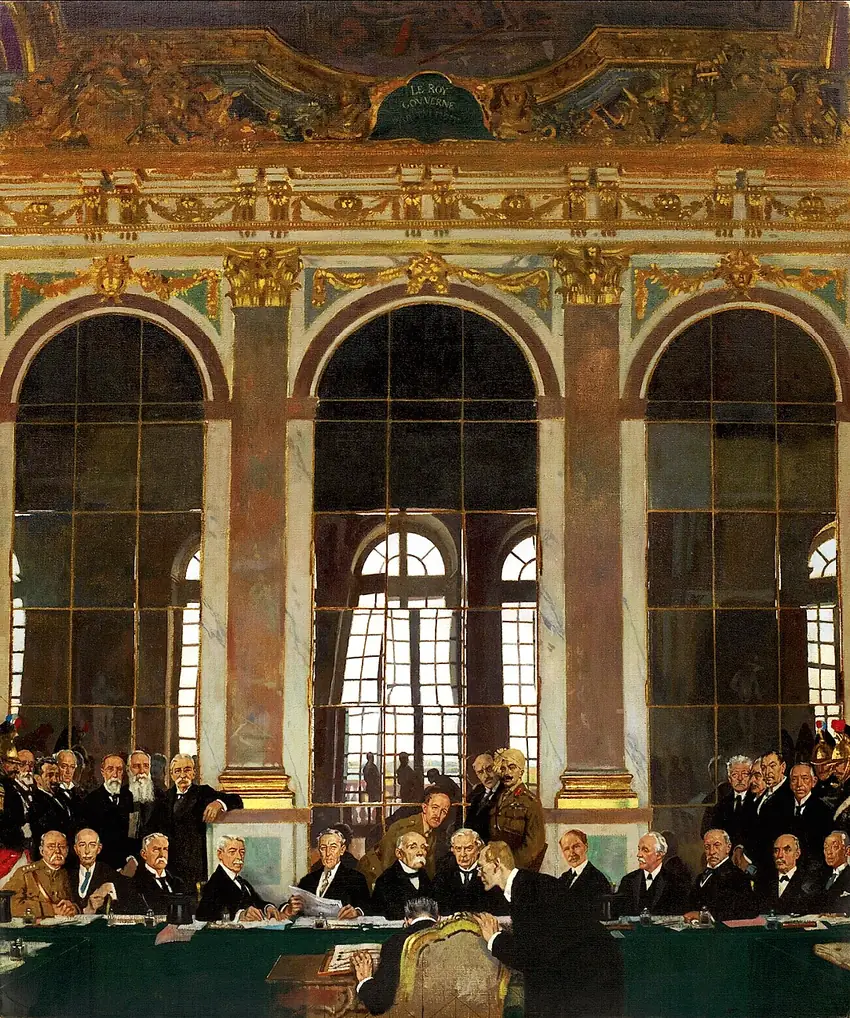
The Treaty of Versailles was the peace settlement that ended the First World War. Allied leaders signed it on 28 June 1919 inside the Hall of Mirrors at the Palace of Versailles, outside Paris. The treaty took about 13 percent of Germany's territory in Europe, along with every overseas colony. It limited the army to 100,000 soldiers, banned Germany from building warplanes or submarines, and imposed reparations that the Allies would fix in 1921 at 132 billion gold marks, roughly $600 billion in today's money. Germany had almost no say in the terms. The German public called the agreement a Diktat, a dictated peace, and the bitterness it created shaped European politics for the next two decades.
How the Allies wrote the peace at Versailles
The Paris Peace Conference opened in January 1919 with delegates from 27 nations, but three men made the decisions. France's prime minister, Georges Clemenceau, was 77 years old and had lived through two German invasions of his country. He wanted to make sure Germany could never invade again. Britain's prime minister, David Lloyd George, wanted a peace firm enough to satisfy British voters but moderate enough to keep trade with Germany open. America's president, Woodrow Wilson, came with his Fourteen Points, a plan for a new international order built on self-determination and a League of Nations. Wilson was the first sitting American president to set foot in Europe.
Germany was not allowed to negotiate. The Allies drafted the treaty among themselves over five months, then handed the finished document to the German delegation and told them to accept it. When Germany hesitated, the Allies threatened to reimpose the naval blockade, which had already caused hundreds of thousands of civilian deaths inside Germany. The signing date and place were both chosen for their symbolism. 28 June was the fifth anniversary of the assassination of Archduke Franz Ferdinand in Sarajevo. The Hall of Mirrors was the room in which the German Empire had been founded in 1871, after France's defeat in the Franco-Prussian War.
What the treaty required of Germany
The treaty redrew Germany's borders. France reclaimed Alsace and Lorraine. Belgium received Eupen and Malmedy. After a vote, Denmark took back northern Schleswig. A wide strip of eastern land went to the newly created Poland, with a corridor reaching the Baltic coast that separated East Prussia from the rest of the country. Danzig was placed under League of Nations control as a free city. France received the Saar coalfields for fifteen years. The treaty also forbade any union between Germany and Austria.
The military terms restricted the army to 100,000 men, abolished conscription and the general staff, and banned submarines, military aircraft, and tanks. Allied troops occupied the Rhineland, which was to remain permanently demilitarized, for fifteen years.
In 1921 the Allies fixed the reparations total at 132 billion gold marks, though only about 50 billion of that figure was seriously expected to be collected. Germany paid only a small share, mostly using loans from banks in the United States. The final installment came in October 2010, 92 years after the war ended.
What was the war guilt clause?
Article 231 of the treaty held Germany and its allies responsible for "all the loss and damage" caused by the war. American lawyers, among them the young diplomat John Foster Dulles, drafted the clause to provide a legal foundation for reparations demands. An almost identical provision appeared in the treaty with Austria.
Its authors intended it as a technical instrument. Germans read it as a statement of guilt. Across the political spectrum people called it a lie, and it became a rallying point for every faction that wanted to undo the peace.
The British economist John Maynard Keynes added weight to that argument. Keynes quit the British delegation in protest and later that year published The Economic Consequences of the Peace. The book persuaded a generation of readers in Britain and America that the peace terms were punitive and unworkable.
Did the Treaty of Versailles cause World War II?
The treaty is often blamed for Adolf Hitler's rise and the Second World War. The connection is real but not simple. The treaty handed Hitler a grievance to build a movement on. Article 231, the lost territories, and the reparations were central to Nazi propaganda. But Germany's industrial base and cities survived the First World War intact, and the two great empires to its east, Russia and Austria-Hungary, had both fallen apart. By the mid-1920s Germany held a stronger strategic position than it had before the war.
The deeper failure was enforcement. The Allies did not consistently uphold the treaty's military restrictions, and each time Germany tested a limit without facing consequences, it learned the terms could be bent. Keynes's argument that the peace was unjust fed into 1930s appeasement: if the settlement was unfair, Germany's protests sounded justified.
After 1945 the Allies took a different path. They held Germany under military occupation for ten years, prosecuted its leaders at Nuremberg, and rebuilt its economy through the Marshall Plan. They brought Germany into organizations where it shared decision-making. That approach was more punishing in its early years than the 1919 settlement, but the result was a partner, not an adversary.