
Habsburg Dynasty
The Habsburg dynasty was a European royal family that ruled from 1273 to 1918, gaining thrones from Spain to Hungary largely through marriage.
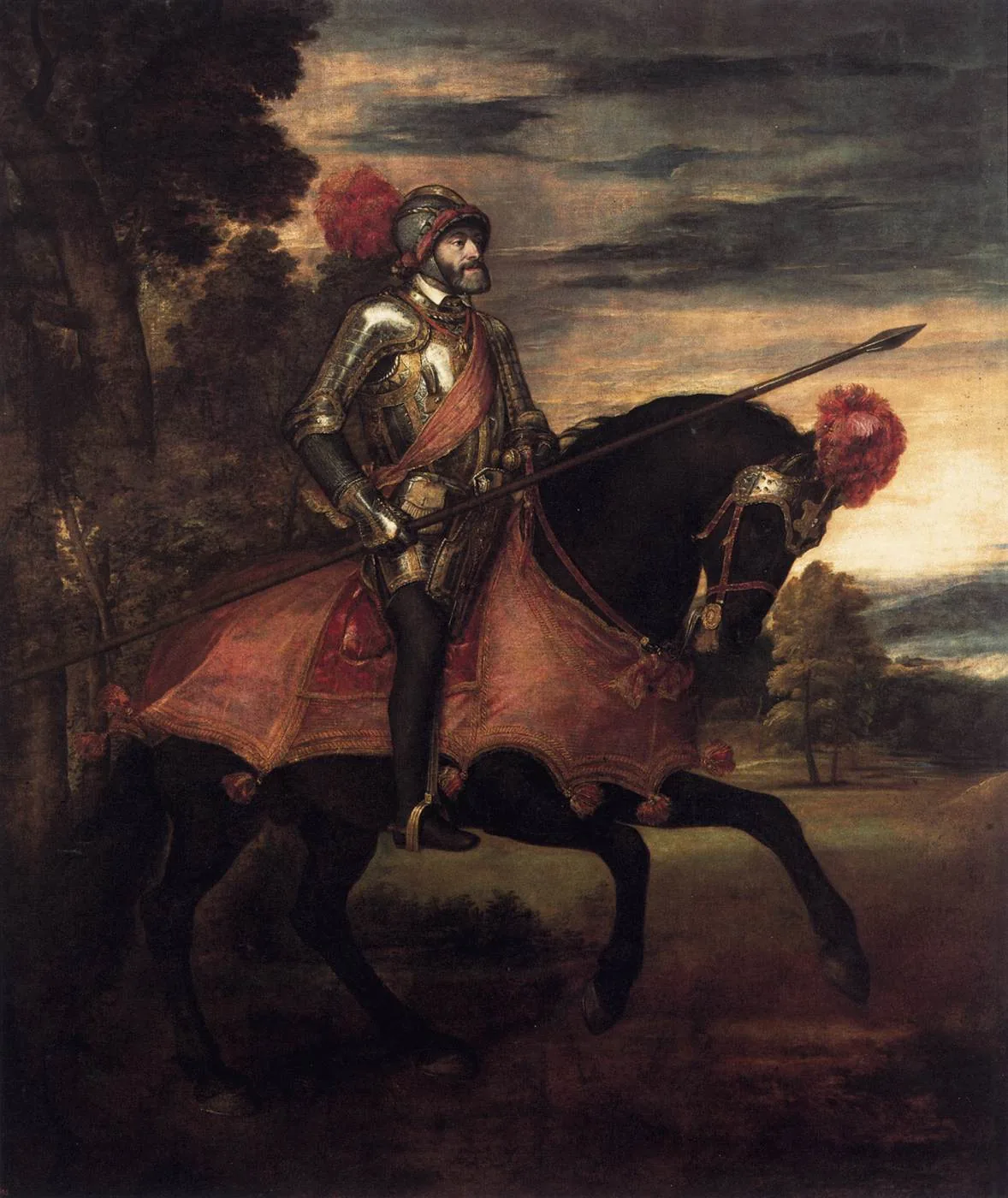
The Habsburgs were a European royal family whose power spanned from the late 1200s to the end of the First World War. Their origins were modest: a castle called the Habichtsburg, or Hawk's Castle, overlooking the river Aare in northern Switzerland. Over the following centuries, a series of advantageous marriages brought them control of the Low Countries, Spain, Hungary, Bohemia, and much of Italy. By the early 1500s a single Habsburg held more land than any European ruler since the fall of Rome. A Latin motto summed up their approach: Bella gerant alii; tu, felix Austria, nube, roughly "Where others fight, Austria marries." They waged wars constantly, but marriage is what built the empire.
How the Habsburgs gained power through marriage
Rudolf of Habsburg became King of the Romans in 1273 after the German electors picked him, expecting a ruler too weak to challenge their own authority. He surprised everyone. Rudolf took Austria by force from a rival dynasty and turned it into the family's permanent base.
Two marriages in later generations transformed the Habsburgs from regional lords into the dominant family in Europe. In 1477, Maximilian I wed Mary of Burgundy, who brought with her the Low Countries, at the time the most commercially developed part of Europe. Mary died in a riding accident in 1482, but Maximilian held on to her inheritance. Maximilian and Mary had a son, Philip, who married Joanna, heiress to the newly unified Spanish crown.
Philip and Joanna's son Charles, born in 1500 in the Flemish city of Ghent, received everything: Spain and its American colonies, the Low Countries, Austria, and the Kingdom of Naples. In 1519 he became Holy Roman Emperor after borrowing heavily from the Fugger bank in Augsburg to buy the electors' votes. No European since the fall of Rome had governed so many lands at once. His reign was consumed by simultaneous wars against France, the Ottoman Empire, and the Protestant Reformation. By 1556, worn out at fifty-six, Charles gave up the throne and divided his possessions. His son Philip II received Spain and the Netherlands. His brother Ferdinand received Austria and the imperial crown.
How the Spanish Habsburgs collapsed
The Spanish branch had enormous wealth and spent it faster than American silver could replenish it. Silver from Mexico and Peru paid for decades of warfare with the Dutch Republic, England, and France. Philip II went bankrupt four times: in 1557, 1560, 1575, and 1596. The Spanish crown declared bankruptcy again in 1607, 1627, and 1647.
The Spanish Habsburgs compounded their troubles by marrying within the family for generations. The last of the line, Charles II, was born in 1661 with an inbreeding coefficient of 0.254, slightly exceeding what geneticists would expect from a sibling union. A severe jaw deformity, passed down through generations of intermarriage, left him barely able to chew. He produced no children, and when he died in 1700 the struggle over his crown became the War of the Spanish Succession. The war lasted thirteen years and concluded with the Peace of Utrecht in 1713, which gave the Spanish throne to the French Bourbon dynasty and ended Habsburg power in Spain permanently.
How nationalism broke the Austrian Habsburgs
The Austrian branch lasted two more centuries, but it faced a different kind of problem. Its territories were home to more than a dozen ethnic groups, including Hungarians, Czechs, Slovaks, Poles, Croats, Serbs, Romanians, and Italians alongside German speakers, all living under one crown without a common identity. Before the French Revolution, most European states worked this way. After 1789, nationalism turned national identity into a political force, and a dynasty ruling over a dozen distinct peoples had no convincing answer to it.
After Napoleon abolished the Holy Roman Empire in 1806, the Habsburgs ruled their lands as the Austrian Empire. The revolutions that swept Europe in 1848 came close to toppling them. Emperor Franz Joseph, who took power that year at the age of eighteen, held on for sixty-eight years. In 1867 he negotiated an agreement that made Hungary an equal partner, creating the dual state of Austria-Hungary. The arrangement gave nothing to the empire's Slavic peoples, and their resentment shaped Habsburg politics for the next half century. In his personal life, Franz Joseph lost his only son to suicide in 1889 and his wife, Empress Elisabeth, to assassination in 1898.
Franz Joseph's heir, Archduke Franz Ferdinand, was shot dead in Sarajevo on June 28, 1914. The government in Vienna treated the assassination as a question about whether an empire of many nations could hold together in an age of nation-states. Austria-Hungary chose war. Four years later the empire no longer existed.
When did the Habsburg dynasty end?
The Habsburgs' time as rulers ended in November 1918. On November 11, Emperor Karl I, a grandnephew of Franz Joseph, issued a proclamation giving up his role in governing Austria. He refused to formally abdicate. His empire broke apart into new countries, including Austria, Hungary, Czechoslovakia (now the Czech Republic and Slovakia), and the Kingdom of Serbs, Croats and Slovenes, later called Yugoslavia.
Austria's new republic passed the Habsburg Law in 1919, sending the family into exile and seizing much of its wealth. Karl made two attempts to retake the Hungarian crown in 1921, both unsuccessful. He died on the Portuguese island of Madeira in 1922, at thirty-four.
Habsburgs still live across Europe today. Karl von Habsburg, the family's current head, lives in Austria. Other members of the family are active in diplomacy. But the family has not held a throne since 1918. Over 645 years, the Habsburgs governed more of Europe for longer than almost any other dynasty, and the borders they drew still shape the continent.