
George Washington
George Washington commanded the Continental Army in the American Revolution and served as the first president of the United States.
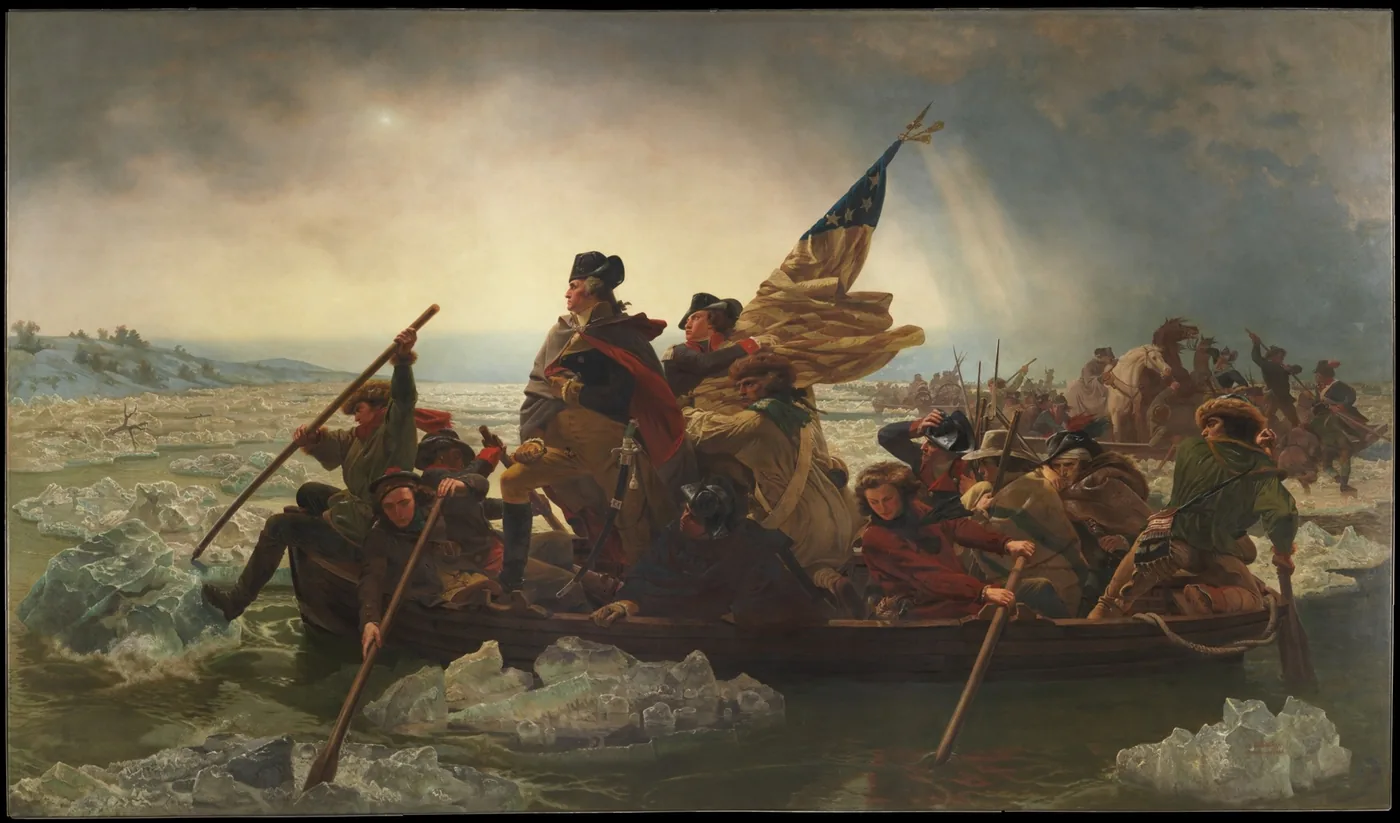
George Washington led the Continental Army to victory in the American Revolution and became the first president of the United States. He was born on February 22, 1732, in Westmoreland County, Virginia, into a family of tobacco planters. Washington stood six feet three inches tall, was known as a skilled horseman, and thought of himself first as a farmer. In the Revolutionary War he won fewer battles than he lost, but he kept his army alive long enough for Britain to decide the war was not worth continuing. He is best known for giving up power twice, once as commanding general in 1783 and once as president in 1797, when no law required him to leave.
How Washington fought the Revolutionary War
In June 1775, the Continental Congress chose Washington to command its new army. He was 43, had not led troops since the French and Indian War seventeen years earlier, and was the only delegate at the Congress who wore his military uniform to the sessions. The army he took over was a collection of colonial militias, short on training, ammunition, and money.
Washington's approach was to avoid large battles and keep his army intact. Historians call this a Fabian strategy, after the Roman general Fabius, who fought Hannibal by avoiding open battle and wearing his army down through delay. Washington gave up territory to buy time and attacked only when the odds were in his favor.
His most important early victory began on the night of December 25, 1776. Washington led 2,400 soldiers across the ice-choked Delaware River in a snowstorm and attacked the Hessian garrison at Trenton, New Jersey, at dawn. The Americans captured about 900 soldiers and had no men killed in the fighting. The victory came at the lowest point of the war, when enlistments were about to run out, and it kept the army from collapsing.
From December 1777 to June 1778, Washington's army camped at Valley Forge, Pennsylvania. About 2,000 soldiers died of disease and cold over those six months. The survivors drilled under Baron von Steuben, a Prussian officer who had volunteered for the American cause, and came out as a more disciplined fighting force.
The war ended because of an alliance with France. France entered the war in 1778, bringing troops, money, and a navy the Americans lacked. In late August 1781, French Admiral de Grasse sailed his fleet into the Chesapeake Bay and cut off a British army under General Cornwallis at Yorktown, Virginia. Washington and the French General Rochambeau besieged Yorktown with about 17,000 troops. Cornwallis surrendered on October 19, 1781, and the fighting was effectively over.
How Washington gave up power
With the war won, Washington held more popularity and influence than anyone in the new country. In March 1783, a group of unpaid officers at the army's camp in Newburgh, New York, threatened to march on Congress or refuse to disband. Washington called a meeting and spoke against the plan. Then he pulled out a letter from a congressman and paused to reach for his spectacles. "Gentlemen," he said, "you will permit me to put on my spectacles, for I have not only grown gray but almost blind in the service of my country." Several officers wept. The mutiny talk ended.
On December 23, 1783, Washington walked into the Maryland State House in Annapolis and resigned his commission as commander in chief. He returned to his farm at Mount Vernon the next day. King George III reportedly called Washington "the greatest character of the age" after Washington also gave up the presidency. The remark was reported by the American painter Benjamin West in 1797.
Washington became the first president in 1789, inaugurated on April 30 in New York City. He served two terms and stepped down voluntarily in March 1797. No law required him to leave. The two-term tradition he set lasted until Franklin Roosevelt won a third term in 1940, and the Twenty-Second Amendment wrote it into the Constitution in 1951.
Did George Washington fight for the British?
Yes. Before the Revolution, Washington served as a British colonial officer in the French and Indian War, the North American part of the Seven Years' War. In 1754, at the age of 22, he led a Virginia militia unit into the Ohio Valley and attacked a French patrol near present-day Uniontown, Pennsylvania, one of the events that helped start the war. Washington later surrendered at Fort Necessity and served under General Edward Braddock on a march toward Fort Duquesne in 1755.
Washington fought for the British because he was a British subject. Like most colonists, he did not begin to oppose British policy until the 1760s, when Parliament started taxing the colonies and restricting settlement of the western lands that veterans like Washington had been promised.
How many battles did George Washington win?
Washington fought about 17 major battles during the Revolutionary War. He won roughly six, lost seven, and fought the rest to a draw. His most important victories were at Trenton in December 1776, Princeton in January 1777, and Yorktown in October 1781.
The record looks poor on paper, but Washington understood that his army did not need to win in the field. It needed to survive long enough for the cost of the war to become too high for Britain to continue. Washington avoided the large set-piece battles the British wanted and kept his forces together through eight years of fighting. The strategy worked.
Washington and slavery
Washington was a slaveholder for his entire adult life. By 1799, the year he died, 317 enslaved men, women, and children lived and worked at Mount Vernon. Washington owned 123 of them directly. Another 153 were "dower" slaves, legally tied to the estate of Martha Washington's first husband, Daniel Parke Custis. Virginia law prevented Washington from freeing the dower slaves.
In his will, Washington ordered the 123 people he owned to be freed after Martha's death. He was the only slaveholding founder to make this provision. Martha Washington freed them on January 1, 1801, about a year after George Washington died on December 14, 1799, at the age of 67. The 153 dower slaves remained in bondage. Washington's act freed fewer than half the people enslaved at his estate and did nothing to challenge slavery as an institution in the country he had helped to found.