
Hannibal
Hannibal Barca was a Carthaginian general who crossed the Alps to invade Italy and defeated Rome repeatedly, most famously at the Battle of Cannae.
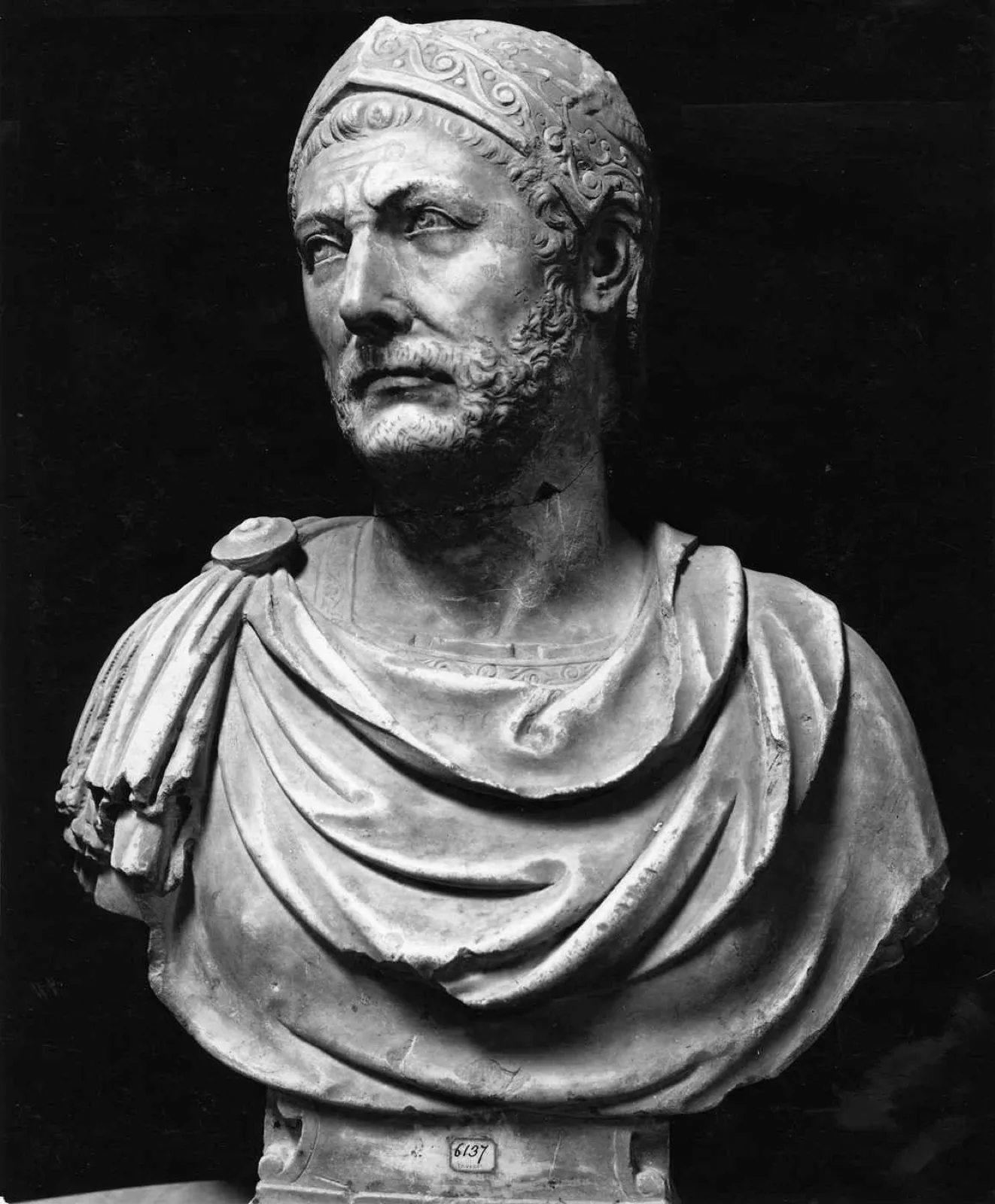
Hannibal Barca (247–183 BCE) was a Carthaginian general who invaded Italy and defeated Rome in a series of battles that nearly destroyed the republic. He is best known for leading an army with war elephants across the Alps and for the Battle of Cannae in 216 BCE. At Cannae he surrounded and killed tens of thousands of Roman soldiers in a single day using a tactic called double envelopment, still taught in military academies as the textbook example of a perfect battle. Yet Hannibal spent fifteen years fighting in Italy without ever taking Rome, and he ultimately lost the war.
How Hannibal invaded Italy
Hannibal's father, Hamilcar Barca, commanded Carthage's armies in the First Punic War. After Carthage lost, Hamilcar took his family to Spain to rebuild. Before they left, he brought nine-year-old Hannibal to a temple and made him swear at an altar to be an enemy of Rome for life.
In 218 BCE, Hannibal set out from Spain with an army and 37 war elephants. He crossed the Pyrenees and the Rhone, then led the army through the Alps, which were deep in snow. The Alpine crossing took about fifteen days and cost him roughly half his soldiers to cold, snow, and attacks by mountain tribes.
The survivors reached northern Italy behind Rome's defenses. Hannibal defeated a Roman army at the Trebia River that December. The following June, at Lake Trasimene, he set an ambush that destroyed the consul Gaius Flaminius and his entire army. The Roman Senate then raised the largest force in the republic's history, around 80,000 men, and sent it to finish him. The two armies met at Cannae in 216 BCE. Hannibal's army was smaller, but he placed his weakest infantry in the center and his best troops on the wings. As the Romans pushed the center back, the line bowed inward. Then both wings swung forward and closed around the Roman army. The Romans were packed so tightly they could barely swing their swords. By ancient accounts, as many as 70,000 died in a single day.
Why didn't Hannibal march on Rome?
After Cannae, Hannibal's cavalry commander Maharbal urged him to march directly on the city. According to the Roman historian Livy, Maharbal told him, "You know how to win a victory, Hannibal, but you do not know how to use one." Hannibal refused, and the question has been debated ever since.
The practical reasons were straightforward. Hannibal had no siege equipment capable of breaking Rome's walls. His army was exhausted and far from any source of reinforcement. Carthage's government, divided by internal rivalries, sent him little support throughout the war. And Rome, unlike any opponent Hannibal had fought before, would not make peace no matter how badly Hannibal beat it in the field. The city raised new legions and kept fighting.
How Rome defeated Hannibal
Rome found a way to fight Hannibal without meeting him in open battle. The general Quintus Fabius Maximus avoided pitched fights and instead wore Hannibal down by cutting his supply lines and recapturing his Italian allies. Romans mocked Fabius as a coward at first, but the strategy worked. The word "Fabian," meaning a deliberate policy of delay, comes from his name.
For about fifteen years Hannibal operated across Italy, undefeated in the field but unable to force a decision. In 204 BCE, the Roman general Scipio carried the war to North Africa and threatened Carthage directly. Hannibal was recalled to defend the city. At the Battle of Zama in 202 BCE, Scipio turned Hannibal's own methods against him. He opened lanes in his formation to let the Carthaginian elephants pass through harmlessly, and his cavalry, much of it led by the Numidian commander Masinissa, surrounded the Carthaginian army the way Hannibal had surrounded the Romans at Cannae. Hannibal lost, and Carthage surrendered. Scipio earned the name Africanus for the victory.
How did Hannibal die?
Hannibal survived the war but spent his final years as a hunted exile. He fled first to the Seleucid king Antiochus III in Syria, then moved between the courts of Rome's enemies in the eastern Mediterranean. Rome never stopped looking for him.
Around 183 BCE, Roman agents tracked him to Libyssa in Bithynia, on the eastern shore of the Sea of Marmara in what is now Turkey. He was a guest of King Prusias, who was preparing to hand him over. When Hannibal found that soldiers were guarding every exit from his house, he took poison he had carried with him for years rather than surrender to Rome. He was about 64 years old. The Latin phrase "Hannibal ad portas," meaning "Hannibal at the gates," survived for centuries as a warning Roman parents used to frighten their children.