
Seven Years' War
The Seven Years' War (1756-1763) was a global conflict fought on five continents that made Britain the world's leading colonial power.
The Seven Years' War (1756-1763) was fought across five continents by two coalitions of European powers. Britain and Prussia led one side. France, Austria, Russia, Spain, and Sweden led the other. The fighting spread from Europe to North America, India, the Caribbean, West Africa, and the Philippines. In North America the same conflict is known as the French and Indian War. It was, as Winston Churchill put it, the first world war. Britain won the global contest and emerged as the leading colonial power on earth, with control of Canada and a growing hold on India. The costs of that victory were steep. Within three decades, the debts from the war helped set off both the American Revolution and the French Revolution.
What caused the Seven Years' War?
Two conflicts, one European and one colonial, combined into a single global war.
The European conflict started in 1740 when Frederick the Great of Prussia seized Silesia, one of Austria's wealthiest provinces. Austria's ruler, Maria Theresa, was only 23 when she inherited the Habsburg lands that same year and immediately lost Silesia to Frederick. She spent the next sixteen years assembling an alliance to win it back.
The colonial conflict centered on North America. In the Ohio Valley, British and French settlers were competing for the same land. In 1754, a 22-year-old Virginia militia officer named George Washington led a small force that attacked a French party and killed its commander, Joseph Coulon de Jumonville. France treated the killing as the murder of a diplomatic envoy. The incident helped push Britain and France toward open war.
In 1756 the major European powers rearranged their alliances in what became known as the Diplomatic Revolution. France, which had been at war with Austria on and off for two hundred years, suddenly joined Austria's side. Britain allied with Prussia. Russia and Sweden also turned against Frederick. Frederick ruled a kingdom of about four and a half million people and found himself surrounded by enemies with far larger armies and populations.
How Britain won the Seven Years' War
British strategy, directed by Secretary of State William Pitt the Elder, had two parts. Pay Frederick to keep French armies tied down in Europe, and deploy the Royal Navy to capture French colonies overseas.
In Europe, Frederick held off his enemies through speed and aggressive tactics. He was an unusual ruler, a flute player who wrote philosophy in French and kept up a long correspondence with Voltaire. But he was also one of the boldest battlefield commanders of the century. His victories at Rossbach in November and Leuthen in December 1757, both against armies that outnumbered his own, are still studied at military academies. Over the following years, the combined forces of France, Austria, and Russia ground Prussia down. By 1761, Frederick had lost much of his army and carried a vial of poison with him. What rescued him was pure chance. In January 1762, Empress Elizabeth of Russia died. Her successor, Peter III, openly admired Frederick and immediately withdrew Russia from the war.
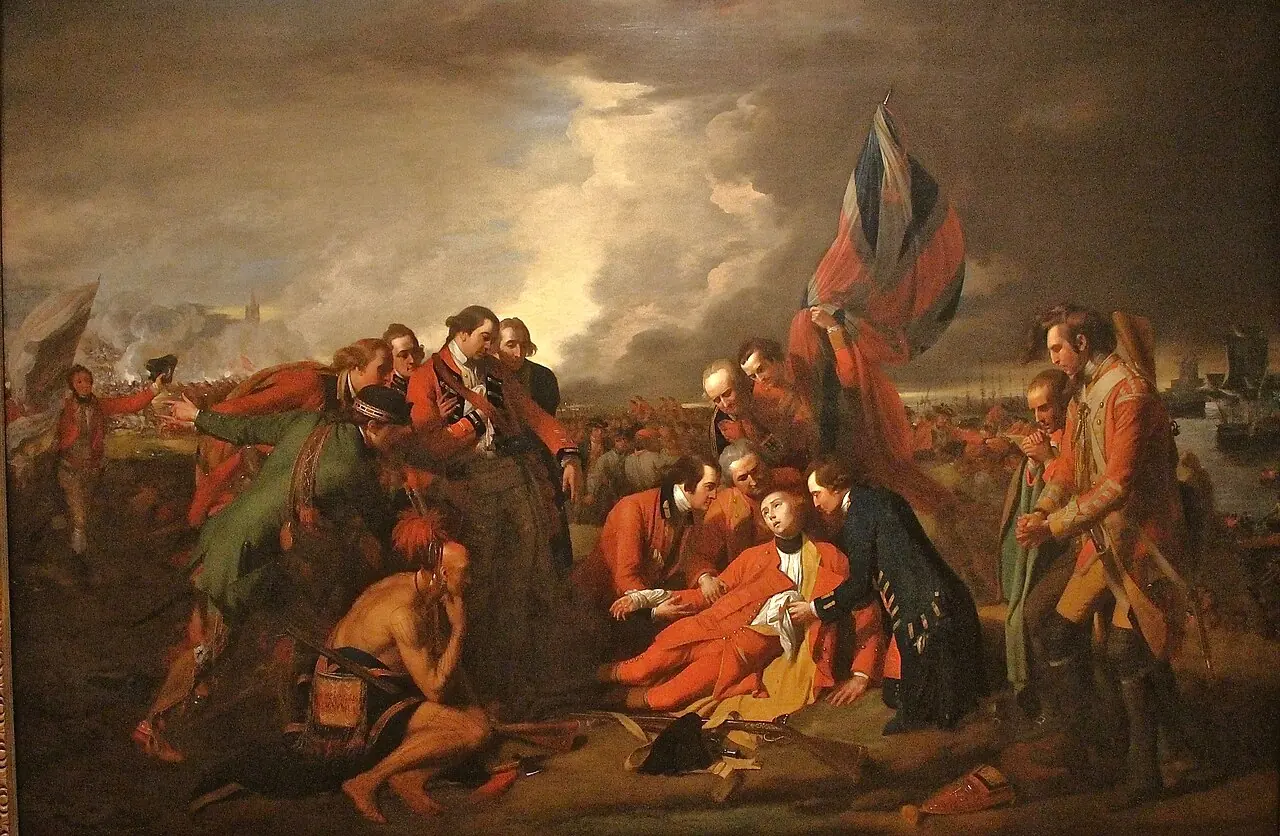
While Frederick fought for survival in Europe, Britain was winning everywhere else. Quebec fell in September 1759 after General James Wolfe's forces climbed the cliffs below the Plains of Abraham. Wolfe was killed in the battle, the scene depicted in the famous painting by Benjamin West. The rest of French Canada fell soon after. In India, Robert Clive and the East India Company defeated French-backed forces at Plassey in 1757, and Company troops beat the French at Wandiwash in 1760. Those victories ended French power on the subcontinent and left a private trading company collecting taxes in Bengal. British forces also captured Martinique, Guadeloupe, Senegal, Manila, and Havana.
The Treaty of Paris, signed in February 1763, gave Britain all of Canada and French territory east of the Mississippi River. France gave up Louisiana to Spain to make up for Spain's loss of Florida to Britain. Britain handed Guadeloupe and Martinique back to France. At the time, sugar-producing islands were considered more valuable than the vast forests of inland North America. In Europe, the result was closer to a draw. Frederick kept Silesia, the province he had fought for, but Prussia was exhausted after seven years of continuous war.
How the Seven Years' War led to the American and French revolutions
The war roughly doubled Britain's national debt, bringing it to about 130 million pounds. Interest payments alone consumed most of the government's annual income. Parliament decided that American colonists, who had benefited from British military protection, should contribute to the cost. It imposed the Stamp Act of 1765, taxing legal documents, newspapers, and playing cards in the colonies. But the colonists had just seen France driven out of North America. They felt no need to pay for defense against a threat that no longer existed. Twelve years after the peace, shots were fired at Lexington and Concord.
France took a different path. The French government openly backed the American rebels starting in 1778 to take revenge on Britain. The intervention helped the Americans win their independence, but it left France's finances in ruins. The resulting crisis forced King Louis XVI to summon the Estates-General in 1789. That assembly set the French Revolution in motion.
The Seven Years' War made Britain the dominant power on earth. The debts it created helped produce both of the revolutions that came after it.