
Gettysburg Address
The Gettysburg Address is a 272-word speech by Abraham Lincoln, given at a Civil War cemetery in 1863, arguing that the war was a test of democracy.
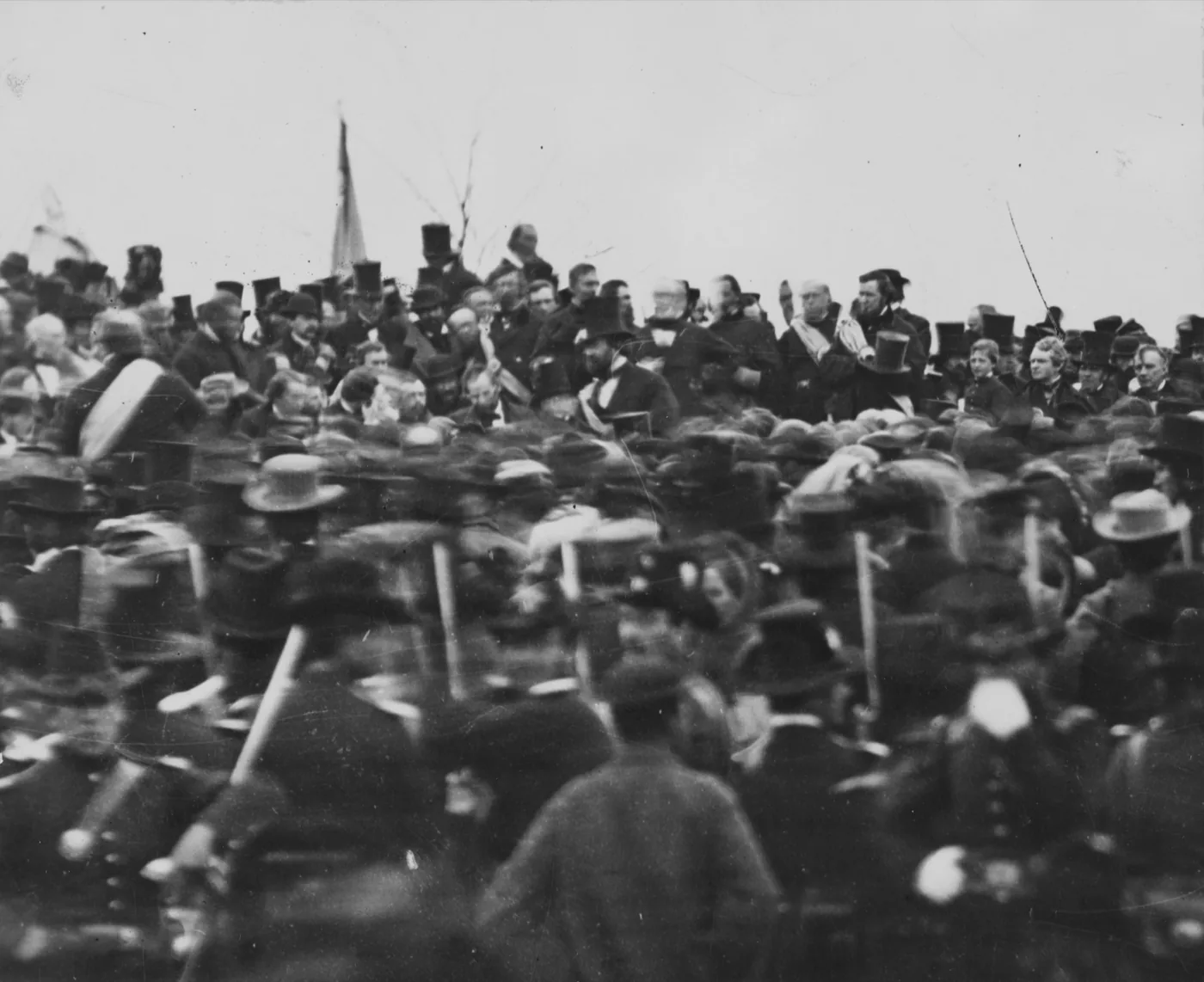
The Gettysburg Address is a speech by Abraham Lincoln, delivered on November 19, 1863, at the dedication of the Soldiers' National Cemetery in Gettysburg, Pennsylvania. It is 272 words long and took about two minutes to deliver. About 15,000 people attended the ceremony, but Lincoln was not the main speaker. Edward Everett, a 69-year-old former senator, former secretary of state, and former president of Harvard, spoke for two hours. Lincoln stood, read ten sentences in about two minutes, and took his seat. In those sentences Lincoln argued that the Civil War was not just a fight to hold the country together but a test of whether democracy itself could survive. Everett wrote Lincoln a letter the next day, saying Lincoln had captured the meaning of the ceremony in two minutes better than Everett had managed in two hours.
The Battle of Gettysburg
The cemetery held the Union dead from the bloodiest battle of the Civil War. From July 1 to July 3, 1863, Robert E. Lee's Confederate army and George Meade's Union army fought at Gettysburg, a small crossroads town in southern Pennsylvania. About 51,000 soldiers on both sides were killed, wounded, or captured, making it the costliest battle ever fought in North America. On the third day, Lee ordered about 12,500 soldiers to march across open ground toward the Union center. The assault, later called Pickett's Charge, failed. More than half the men Lee sent were killed, wounded, or captured. His army retreated to Virginia and never invaded the North again.
In the months after the battle, workers moved thousands of bodies from shallow battlefield graves into a new national cemetery. By November the work was still unfinished, and the cemetery needed a formal dedication. The organizers invited Everett, the most famous orator in the country, as the main speaker. Lincoln was invited later, asked to offer "a few appropriate remarks." He almost did not go. His youngest son, Tad, ten years old, was sick with a fever. Lincoln's wife, Mary, begged him to stay. Lincoln had already buried two sons, and the fear was real. He went anyway. When he arrived in Gettysburg, a telegram told him Tad was improving.
What Lincoln argued in the Gettysburg Address
The Constitution, the country's legal foundation, protected slavery. Lincoln went past it. He started not with the Constitution but with an older document: the Declaration of Independence. He quoted its promise that "all men are created equal" and treated it as the country's real founding. "Four score and seven years ago" pointed back to 1776, not to 1789 when the Constitution took effect.
Lincoln had already issued the Emancipation Proclamation ten months earlier, freeing enslaved people in Confederate states. At Gettysburg he went further. He said the war would decide whether a nation "so conceived and so dedicated" could endure. He did not mention the Union or the Confederacy by name. He did not mention slavery. He was asking whether any country built on equality could govern itself and last.
He ended with a promise. The soldiers at Gettysburg had died for "a new birth of freedom," and government of, by, and for the people would never perish.
Did Lincoln write the Gettysburg Address on the back of an envelope?
No. The story that Lincoln scribbled the speech on an envelope during the train ride from Washington is a myth, invented decades after the event. Lincoln started working on the text weeks in advance. He wrote the first draft on White House stationery. He finished his revisions at the home of David Wills, the Gettysburg lawyer who organized the ceremony, the night before the dedication. The surviving drafts are in Lincoln's normal, steady handwriting, not the shaky writing a jolting 1863 train would have produced. Lincoln revised the text repeatedly, even after delivering the speech.
Five handwritten copies of the Gettysburg Address survive, each slightly different. The last one, called the Bliss copy, is the version carved into the south wall of the Lincoln Memorial in Washington. It is the only copy Lincoln signed and gave a title.
The Gettysburg Address today
The Gettysburg Address was not an immediate sensation. Newspaper reactions split along party lines: papers that supported Lincoln praised it, and papers that opposed him dismissed it as silly or ignored it entirely. Its reputation grew over the following decades as more Americans recognized what Lincoln had done in 272 words. He had argued that the country was founded not on the Constitution, which tolerated slavery, but on the Declaration of Independence, which promised equality.
The Gettysburg Address is carved into the Lincoln Memorial, read aloud at public ceremonies, and memorized in American schools. It is quoted more often than any other statement about democracy in the English language. The closing line Lincoln delivered at Gettysburg is still the one Americans reach for when they describe what self-government means.