
Robert E. Lee
Robert E. Lee was a US Army officer who turned down Union command in 1861 and led the Confederate Army of Northern Virginia through most of the Civil War.
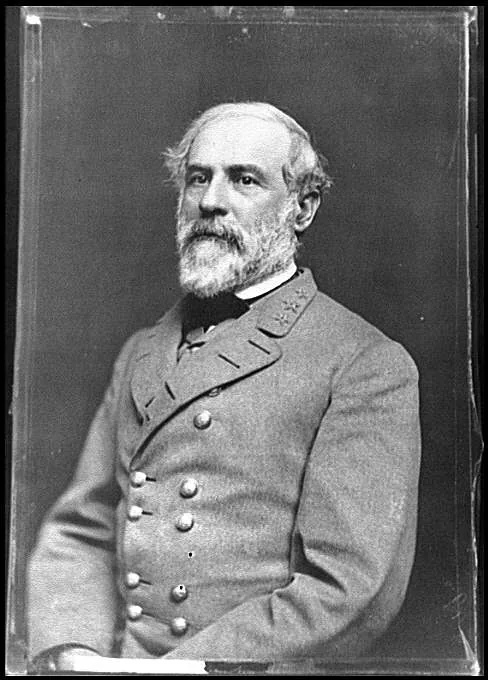
Robert E. Lee (1807–1870) was a United States Army officer who turned down command of the Union army at the start of the American Civil War and instead led the Confederacy's main fighting force, the Army of Northern Virginia. Between June 1862 and May 1863, Lee defeated a series of Union commanders who had more men and better supplies. His aggressive tactics also cost the South soldiers it could not replace, and by mid-1864 his army was pinned in defensive trenches around Petersburg, Virginia. On April 9, 1865, Lee surrendered to Ulysses S. Grant at Appomattox Court House in Virginia. After his death in 1870, Lee became the central figure of the Lost Cause, a retelling of the war that replaced slavery with honor as its reason.
How Robert E. Lee chose the Confederacy
Lee was born on January 19, 1807, at Stratford Hall in Virginia. His father, Henry "Light-Horse Harry" Lee, had been a cavalry hero of the Revolutionary War but fell into debt and left the family when Robert was six.
Lee entered West Point in 1825 and graduated second in his class of forty-six in 1829 without a single demerit. In 1831 he married Mary Anna Custis, a great-granddaughter of Martha Washington. His wife's family owned the Arlington estate overlooking Washington, D.C., and one of the largest enslaved workforces in Virginia.
Lee fought in the Mexican-American War under General Winfield Scott, who later called him "the very best soldier I ever saw in the field." By 1861 Lee was fifty-four, a colonel with a spotless military record and no political enemies.
When the country broke apart in April 1861, Abraham Lincoln offered Lee the top field command in the army being assembled to suppress the Southern rebellion. Lee declined. Virginia's convention had voted to secede on April 17, and on April 20 Lee resigned his commission. Three days later he accepted command of Virginia's military forces.
Lee was the officer both sides wanted most. With him commanding the Confederacy's main army, a war that many expected to end in months lasted four years and cost roughly 750,000 American lives.
How Robert E. Lee fought the Civil War
Lee took command of the Army of Northern Virginia in June 1862, after General Joseph E. Johnston was wounded outside Richmond. The Confederate capital was in danger of falling to Union general George McClellan, whose army had pushed to within a few miles of the city.
Lee went on the offensive immediately. In the Seven Days Battles, he drove McClellan's forces back from Richmond. In August 1862, Lee defeated Union general John Pope at the Second Battle of Bull Run. His greatest tactical victory came at Chancellorsville in May 1863, where he split his army, outnumbered roughly two to one, and still won.
Lee's style of fighting relied on speed and aggression, and it came at a cost. His battles produced higher casualties for his own side, in proportion to its size, than for his opponents. The North could replace its losses. The South could not.
At Gettysburg in July 1863, on the third day of the battle, Lee ordered about 12,500 men to advance across open ground into massed Union artillery and rifle fire. The assault, known as Pickett's Charge, killed, wounded, or captured more than half the men who took part. After Gettysburg and the earlier losses at Antietam in September 1862, Lee's army never recovered its strength.
From May 1864, Union general Grant pressed Lee into the trenches around Petersburg, extending his lines until Lee's shrinking army could barely hold them. While Grant pinned Lee in place, Union general William Sherman marched through the Confederate interior. Lee surrendered to Grant at Appomattox on April 9, 1865.
Did Robert E. Lee own slaves?
Yes. Lee held enslaved people himself, and his wife's family owned one of the largest slaveholding estates in Virginia. When his father-in-law George Washington Parke Custis died in 1857, Lee took charge of the Custis estate at Arlington and managed its enslaved workforce.
Lee wrote to his wife in 1856 that slavery was a moral and political evil. In the same letter he said it burdened white people more than Black people. Ending slavery, Lee argued, should be left to God, not to human action. This was a common position among Virginia slaveholders who had no intention of changing anything.
When three enslaved people on the estate ran away in 1859, Lee had them caught and whipped. Wesley Norris, one of the three, told the story after the war: Lee ordered fifty lashes for the men and twenty for Norris's sister, then had the overseer wash their backs with brine.
During Lee's invasion of Pennsylvania before the Battle of Gettysburg in June 1863, soldiers in his army seized free Black civilians from towns like Chambersburg and shipped them south to be enslaved. Lee issued orders to protect white Pennsylvanians' property but did nothing to stop the kidnapping of Black residents.
How Robert E. Lee became a symbol of the Lost Cause
After the surrender, Lee refused to support guerrilla warfare against the Union. He took an oath of allegiance to the United States and accepted the presidency of Washington College, a small school in Lexington, Virginia. While alive, Lee discouraged the building of Confederate monuments and wrote in 1869 against keeping open what he called the sores of the war. He also opposed Black voting rights and said little while Reconstruction-era violence terrorized Black communities across the South. Lee died on October 12, 1870. The college later renamed itself Washington and Lee University.
After Lee's death, Southern writers built an idealized version of him: a reluctant, flawless Christian soldier who lost only because he was outnumbered. Lee became the central symbol of the Lost Cause, a narrative that recast the Civil War as a fight over states' rights and honor instead of slavery.
Monuments to Lee went up on courthouse lawns, schools, and military bases across the South. Most were not built in the years right after the war. The largest wave came between 1890 and 1920, the same period when Jim Crow laws stripped Black Southerners of the right to vote. Another wave came during the civil rights movement of the 1950s and 1960s.
In August 2017, the planned removal of a Lee statue in Charlottesville, Virginia, drew a white supremacist rally that turned violent and killed counter-protester Heather Heyer. In September 2021, a 21-foot bronze statue of Lee on horseback was lifted off its 40-foot pedestal on Richmond's Monument Avenue, the last Confederate monument on the street. The arguments over Lee's monuments have always been about what caused the Civil War, not about one general's reputation.