
Qin Shi Huang
Qin Shi Huang was the king of Qin who conquered China's warring states in 221 BC and became its first emperor.
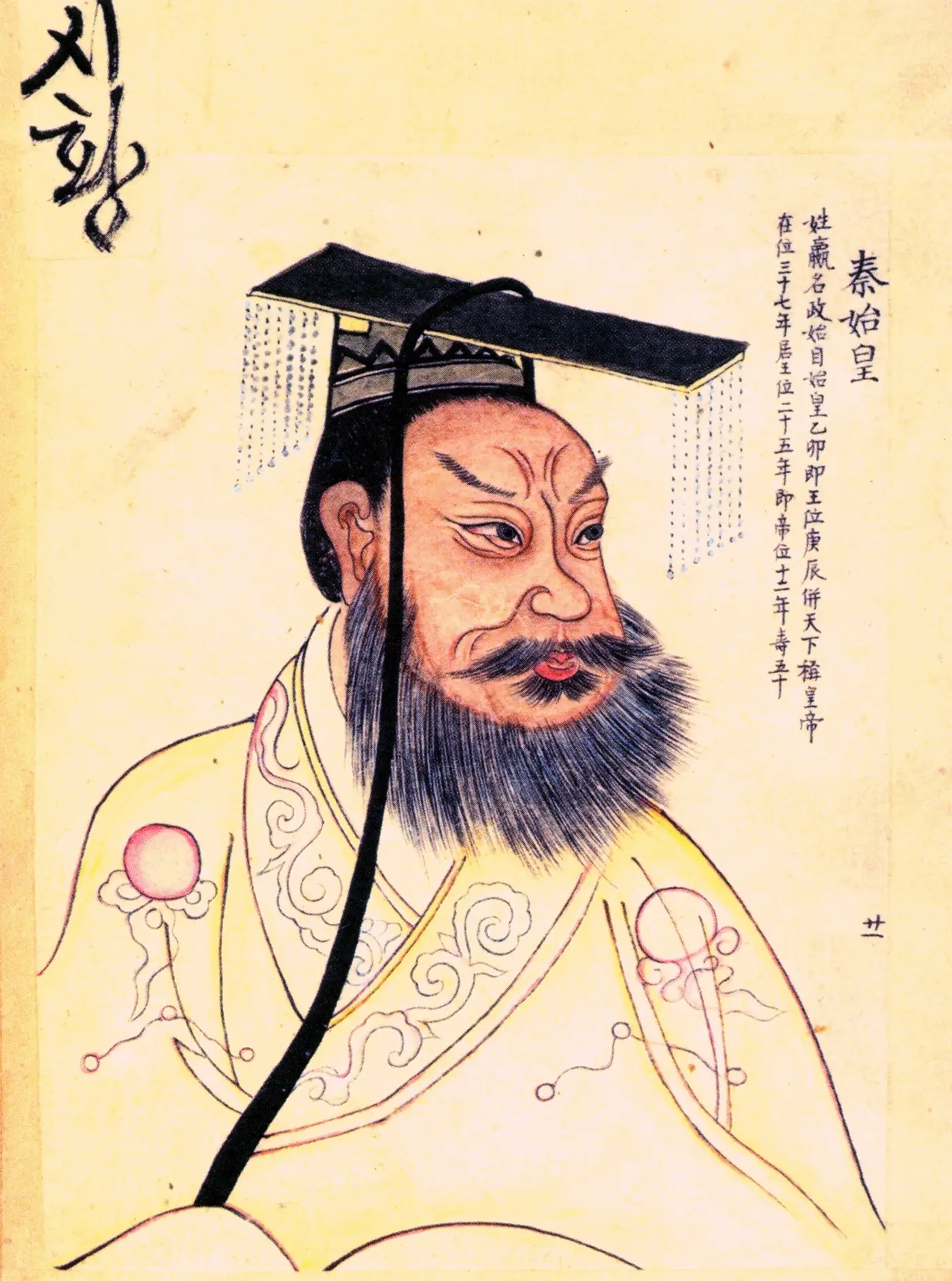
Qin Shi Huang (born Ying Zheng, 259–210 BC) was the king of Qin who conquered China's six rival kingdoms and in 221 BC became the first person to rule the entire country as a single state. He gave himself the title Shi Huangdi, meaning "First Emperor," because he believed the old title of king was not grand enough for someone who had conquered all of China. He expected his dynasty to last ten thousand generations, but it lasted only fifteen years. The unified country he created, however, set a pattern that has held for more than 2,200 years: every time China has broken apart, it has re-formed into a single state. The English word "China" most likely comes from "Qin."
How Qin Shi Huang unified and reshaped China
Ying Zheng became king of Qin at thirteen, after his father, King Zhuangxiang, died in 247 BC. A regent governed in his place for the first several years. By his early twenties he had taken full control, and over the next decade Qin's armies conquered the six other kingdoms of the Warring States period one by one, ending with the state of Qi in 221 BC.
With the wars over, Qin Shi Huang's first problem was making a patchwork of former enemy states function as one country. He governed as a Legalist, believing that strict laws and harsh punishments, not tradition or virtue, held a state together. He ended the old feudal system and replaced hereditary lords with appointed officials who ran a system of commanderies and counties. This was the first centralized bureaucracy in Chinese history, and that basic framework lasted into the twentieth century.
His chancellor, Li Si, oversaw a program of forced uniformity. One standard script, called the small seal script, replaced the regional variants so that an edict written in the north would read the same in the south. One standard coin, the bronze banliang with a square hole in its center, replaced the various local currencies. Standard weights and measures were made from bronze and sent to officials across the empire. Even the width of cart axles was fixed so that wheels would fit the same roads everywhere.
To silence critics, Li Si persuaded the emperor in 213 BC to ban and burn books held in private hands. Tradition holds that scholars who resisted were killed. The target was Confucian learning, the same tradition that later dynasties would treat as sacred.
Qin Shi Huang also put conscripted laborers to work on enormous projects. He linked the old border walls of the former warring states into a continuous rampart of rammed earth, thousands of kilometers long, to defend against the Xiongnu nomads to the north. This was the earliest version of the Great Wall of China. He built a network of roads and waterways through the empire, and near his capital he began a tomb complex whose buried army would not be found for more than two thousand years.
How did Qin Shi Huang die?
Qin Shi Huang was obsessed with living forever. He sent expeditions to find a substance that would make him immortal and took tonics that probably contained mercury. He had survived at least one assassination attempt. In 227 BC, during the conquest wars, a man named Jing Ke approached the king's throne on behalf of the rival state of Yan. Jing Ke carried a poisoned dagger hidden inside a rolled-up map. Jing Ke grabbed the king by the sleeve, but Qin Shi Huang tore free and fought him off, and his guards killed the assassin. After unification, the emperor grew increasingly suspicious. He had 270 palace buildings connected by covered walkways and slept in a different room every night so that no one could predict where to find him. Anyone who revealed his location was executed.
The mercury in those tonics may have shortened his life instead of extending it. In 210 BC, Qin Shi Huang died while traveling through the eastern provinces of his empire. He was forty-nine. His chancellor Li Si and a eunuch named Zhao Gao hid his death, forged the succession documents, and forced the rightful heir, Prince Fusu, to kill himself. They placed a younger, more pliable son on the throne.
Rebellions broke out almost immediately. By 206 BC, just four years after the First Emperor's death, the Qin dynasty was over. But the idea of a unified China proved far more durable than the dynasty itself.
Why was the Terracotta Army built?
Qin Shi Huang wanted an army to protect him in the afterlife. Near his capital, workers built one from clay: thousands of life-sized soldiers arranged in battle formation, each with an individually sculpted face. The ranks include infantry, archers, cavalry, charioteers, and officers. Every figure was originally painted in bright colors, but the pigments crumbled within minutes of being exposed to air during excavation.
The tomb's army was lost for more than two thousand years. In 1974, farmers digging a well near the city of Xi'an broke through to the first pit. Archaeologists have since excavated about 2,000 figures, with an estimated 6,000 more still in the ground. The central burial chamber, where ancient texts describe rivers of mercury flowing through a model of the empire, has never been opened. Modern surveys have detected mercury levels in the soil above the tomb far higher than in the surrounding area, which suggests the ancient accounts may be accurate.
The site is a UNESCO World Heritage Site and one of the most visited archaeological sites in the world. Every ruler who has reunified China since has followed the template Qin Shi Huang created.