
Guillotine
The guillotine is a beheading device used in France from 1792 to 1977, first proposed as a humane reform during the French Revolution.
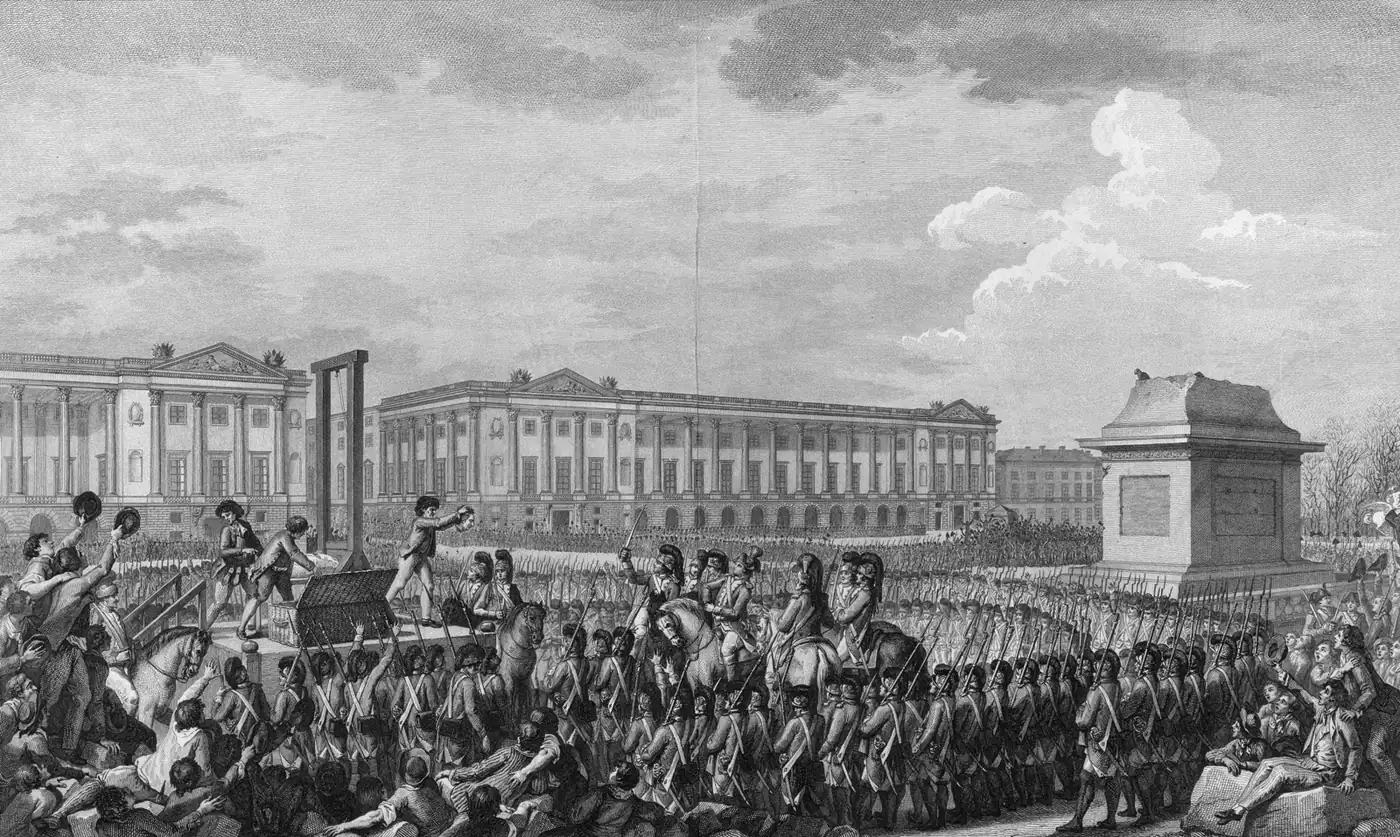
The guillotine is a device for beheading. A heavy angled blade slides down between two tall wooden posts and severs the head in a fraction of a second. It is named after Joseph-Ignace Guillotin, a French doctor and politician who proposed it to the National Assembly in 1789 as a fast, painless method of execution, the same for every citizen regardless of social class. The machine was first used in April 1792. Within 18 months it had killed the king and queen of France. During the Reign of Terror that followed, roughly 17,000 people were officially executed across the country. France kept using the device for nearly two more centuries. The last person guillotined in France died in 1977.
How the guillotine was invented
Before the French Revolution, how a condemned person died in France depended on their rank. A noble was beheaded by sword, usually quickly if the executioner was skilled. A commoner could face hanging, or be tied to a large wheel and have his bones broken one by one, a punishment that sometimes lasted hours. Joseph-Ignace Guillotin, a doctor and elected deputy in the new National Assembly, wanted to end that inequality. In October 1789 he proposed that France adopt a single mechanical device for all executions, one that would make death swift, certain, and equal. His argument drew on Enlightenment thinking about human dignity and the reduction of suffering.
Guillotin opposed capital punishment entirely. He saw the machine as a first step toward abolishing the death penalty by removing the cruelty from execution. He did not design the device himself.
Two men built it. Antoine Louis, who served as surgeon to the king, drew the plans. Tobias Schmidt, an engineer from Germany, constructed the prototype. The machine's crucial feature was an angled blade, which cut more cleanly than the curved or straight blades on older beheading devices. People briefly called the machine the "louisette" after Louis, but the public named it after Guillotin, the man who had argued for it. Guillotin was mortified. His family later petitioned to have the machine renamed, and failed.
The first execution by guillotine took place on April 25, 1792, in the Place de Greve in Paris. The condemned man was Nicolas Pelletier, a highwayman.
The guillotine and the Reign of Terror
On January 21, 1793, King Louis XVI was guillotined at the Place de la Revolution in Paris before a crowd of thousands. He was 38 years old. His queen, Marie Antoinette, was executed on October 16 of the same year.
What came after was the Terror. From the fall of 1793 to the summer of 1794, the revolutionary government sent its opponents to the guillotine at a pace no one who proposed the device had imagined. In Paris, the executioner was Charles-Henri Sanson, whose family had held the post for generations. Sanson had personally executed the king, and during the Terror he performed several more executions in a single day. The guillotine stood in the Place de la Revolution, where crowds gathered to watch and sellers offered printed sheets listing the names of those set to die. The machine collected nicknames: the National Razor, the People's Avenger.
Official records list about 17,000 executions across France during the Terror. In Paris, almost every one was carried out by guillotine. The condemned ranged from aristocrats and priests to revolutionaries who had fallen out of favor with the government. When Charlotte Corday was executed in July 1793 for stabbing to death the radical journalist Jean-Paul Marat, an assistant picked up her severed head and slapped it across the face. People in the crowd insisted her face reddened with anger.
The Terror ended when Robespierre, the leader who had driven much of the killing, was himself arrested and guillotined on July 28, 1794. But the machine outlived him. France continued using the guillotine through Napoleon's rule, two restorations of the monarchy, and four more republics.
When was the guillotine last used?
The last public execution by guillotine in France took place on June 17, 1939, when Eugen Weidmann, a convicted serial killer, was beheaded outside the prison of Saint-Pierre in Versailles. The spectators' behavior disturbed the authorities enough that all executions afterward moved behind prison walls.
The guillotine kept working in private for almost four more decades. France's last execution took place on September 10, 1977, when Hamida Djandoubi, a Tunisian immigrant convicted of torture and murder, was guillotined at Baumettes prison in Marseille. Djandoubi was also the last person executed in Western Europe.
Even after nearly two centuries of use, no one fully settled the question of whether the guillotine killed as instantly as Guillotin had promised. In 1905, a French doctor named Gabriel Beaurieux watched the execution of a prisoner named Henri Languille. Beaurieux wrote that, several seconds after the blade fell, the man's eyelids lifted and his eyes seemed to fix on him when he called out the name. Reports like this, going back to Charlotte Corday in 1793, kept the question open for the full span of the machine's use.
France abolished the death penalty on October 9, 1981, under President François Mitterrand. The guillotine had been France's method of execution for 185 years, from its first use in 1792 to its last in 1977.