
Hadith
A hadith is a report of something the Prophet Muhammad said or did, and hadiths are the main source of detailed Islamic law.
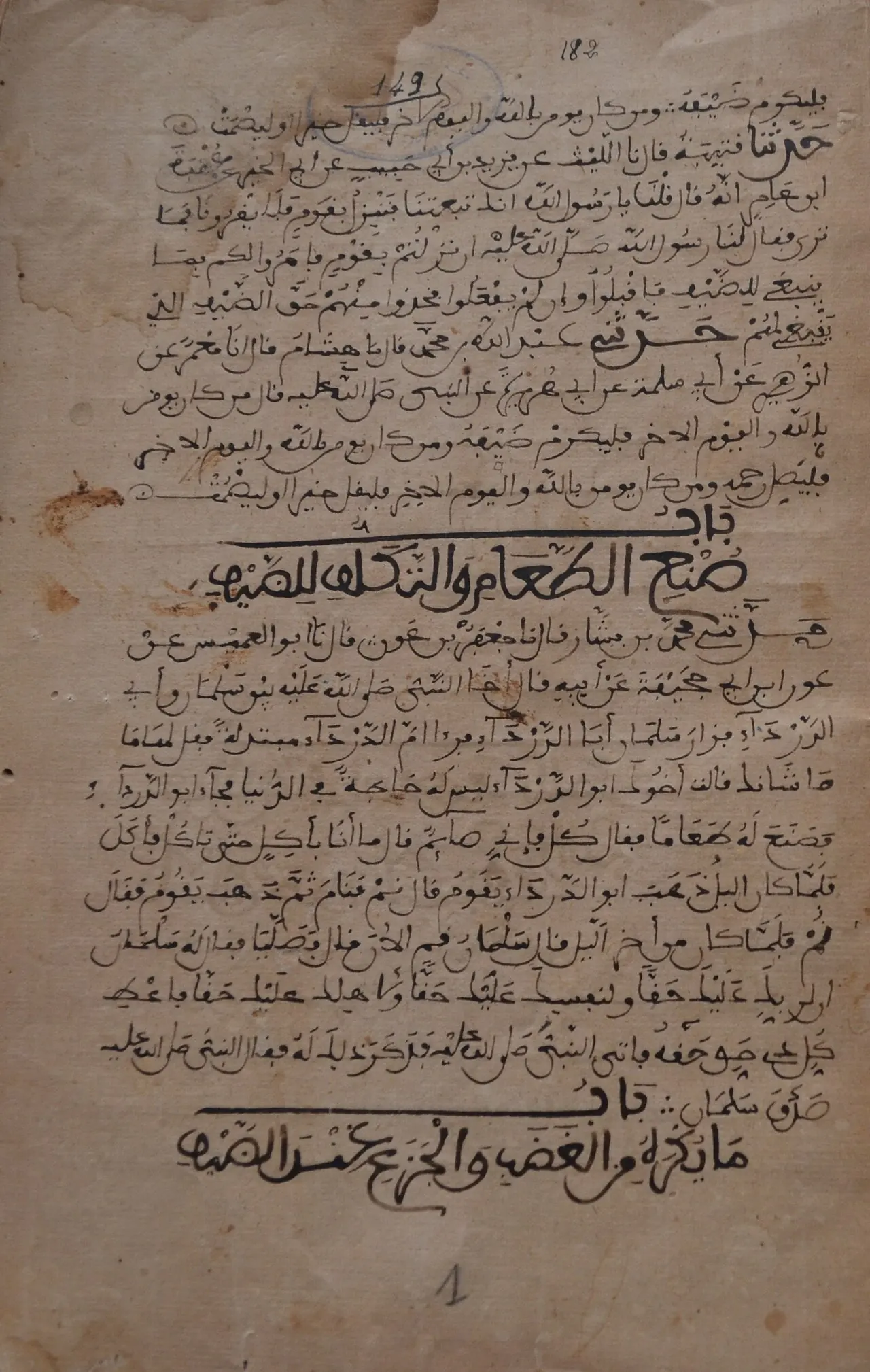
In Islam, a hadith is an account of the Prophet Muhammad's words, actions, or unspoken consent. Thousands of these accounts, taken together, form what Muslims call the Sunnah, the Prophet's example. After the Quran, the Sunnah is the most important basis for Islamic law, and in day-to-day practice it provides far more specific guidance than the Quran itself. The Quran commands prayer, for instance, but says little about the mechanics. Hadiths fill that gap: the postures, the words, and the daily schedule all come from reports of what Muhammad did. From dietary restrictions to criminal penalties, many specifics of Islamic law trace back to hadith. When Muslims today disagree about what their faith demands, the question usually comes down to which hadiths they accept and how they interpret them.
How scholars separated truth from fabrication
In the first two centuries after Muhammad's death in 632, fabricated hadiths spread widely. Rival political camps, preachers looking for authority, and partisans of various sects invented reports and attributed them to Muhammad. Scholars of the time knew the problem well. Their response was to build a systematic method for checking who had actually passed a report along.
A hadith consists of two elements. The first, called the isnad, traces the report from narrator to narrator, back through the generations, until it reaches a contemporary of Muhammad. The second, the matn, is the actual content, typically a sentence or two. Scholars concentrated their scrutiny on the isnad. They assembled biographical records for tens of thousands of narrators and assessed each one's reputation, recall, and whether the dates and places of their life made it possible for them to have actually encountered the previous link in the chain. If a narrator was known to embellish, the report he carried lost credibility no matter how devout its message. If a chain depended on two people having met, but one lived in Baghdad and the other in Medina a generation apart, that chain was broken.
Scholars sorted hadiths into grades. Sahih (sound) sits at the top: the chain is complete, every narrator is trustworthy, and the content agrees with other established reports. Hasan (good) is nearly as strong but has a small flaw. Da'if (weak) has a real problem, such as a missing narrator or someone with a poor reputation. Mawdu' (fabricated) is a forgery.
The canonical hadith collections
The landmark Sunni collections took shape in the 800s, about two centuries after Muhammad. The most authoritative is the Sahih al-Bukhari, compiled by Muhammad al-Bukhari, a scholar born in Bukhara in 810 who died in 870. Al-Bukhari reportedly reviewed around 600,000 reports and accepted about 7,275, including duplicates transmitted through different chains. Without those duplicates, the count drops to roughly 2,600 unique traditions. He set a strict bar: every narrator in a chain had to pass his tests before he would include the report.
The second-ranking collection is the Sahih Muslim, the work of Muslim ibn al-Hajjaj, who died in 875. Along with four more books, these two make up the Kutub al-Sittah, or Six Books, the standard Sunni canon.
Shia Muslims follow a separate set of texts, the Four Books, assembled between the 900s and the 1000s. These collections draw on traditions passed down through the Shia Imams and exclude some narrators whom Shia scholars view as unreliable because of their conduct after Muhammad's death. Two scholars, one Sunni and one Shia, can use the same method of evaluation and still arrive at different answers, because the texts they trust are not the same.
What is the difference between hadith and Sunnah?
The Sunnah is the Prophet Muhammad's example, meaning everything he did, said, and taught. A hadith is a single written record of one piece of that example. In common usage the two terms blur together: when scholars say they follow the Sunnah, they normally mean they follow what the verified hadiths describe. The distinction becomes important in certain legal debates. Some scholars hold that the living practice of the early Muslim community, handed down continuously from generation to generation, carries more weight than a written report whose chain of narrators may have a weak link.
How hadith shapes modern Islamic arguments
Disputes in Muslim communities often look like disagreements about faith, but they are usually disagreements about texts. When two sides cite Muhammad in support of opposing positions, each is claiming that its hadiths are more authentic or better understood than the other's. That kind of textual contest has been going on, at a high scholarly level, for well over a thousand years.
The Salafi and Wahhabi traditions call for going straight to the Quran and verified hadith, setting aside centuries of commentary from the medieval legal schools. Reformist scholars take a different approach. They contend that some of the strictest positions on women's roles, apostasy, and treatment of non-Muslims depend on reports transmitted through only one chain, which never met a high standard of proof. Those positions, they say, became orthodoxy through repetition rather than evidence. A small faction called the Quranists goes further and denies that hadith should carry any legal weight at all. Most scholars across every tradition consider that position untenable, because the Quran's commands lack detailed instructions without hadith to fill them in.
Outside the Muslim world, Western historians have asked since the 1800s whether the chain-of-narration method truly works as a guarantee of authenticity, given that the major compilations came together some two hundred years after the events they record. Muslim scholars counter that the biographical apparatus behind hadith criticism represents a level of source criticism unmatched anywhere else in the premodern world. The argument is not settled, but hadith remains the working basis on which Islamic law is built and debated.